
India’s Sports Governance Ecosystem & National Sports Governance Act, 2025
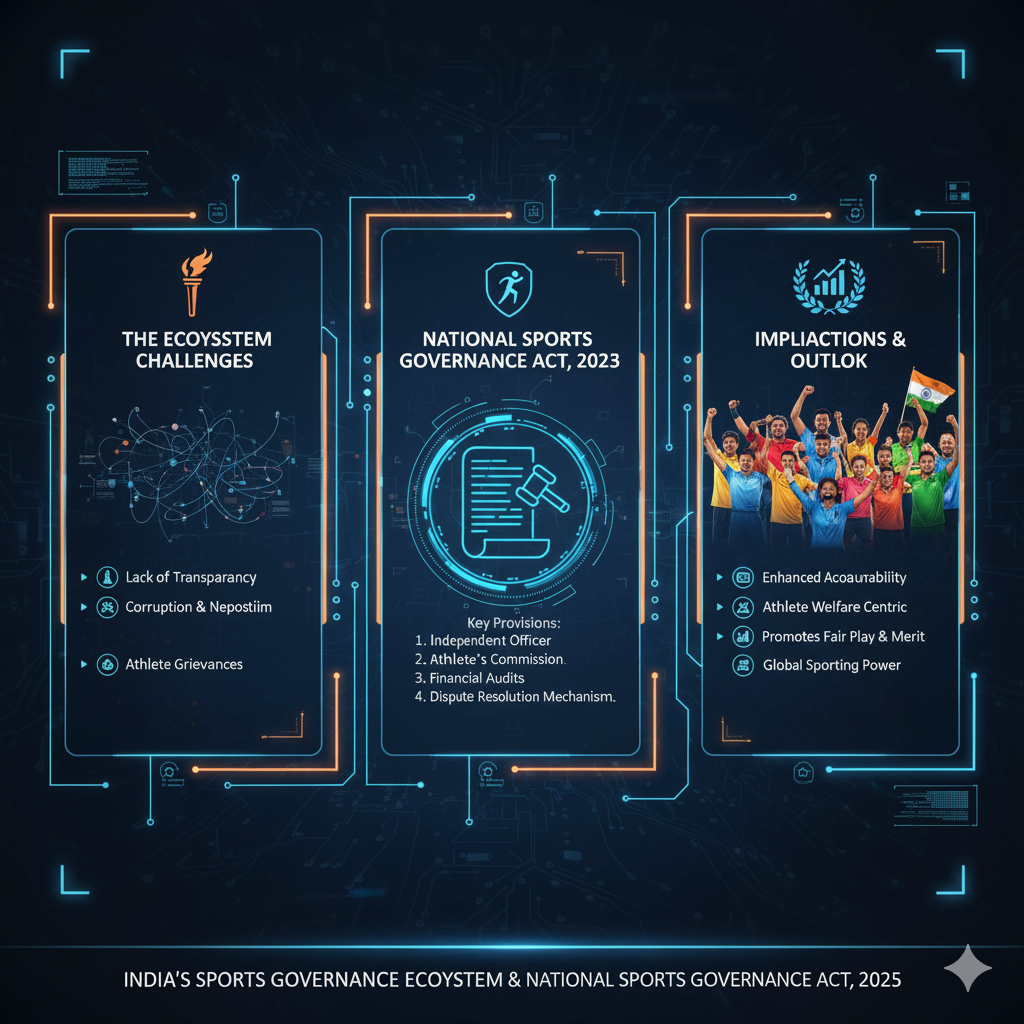
The National Sports Governance Act, 2025 seeks to overhaul India’s sports ecosystem by curbing political interference, improving transparency, and strengthening athlete welfare, marking India’s shift toward global-standard sports regulation.
Introduction
Context & Background
Key Points
- •Constitutional Position & Federal Interface: Sports fall under the State List (Entry 33), but national obligations under UNESCO, IOC & WADA justify Central intervention — invoking cooperative federalism similar to education and health sectors.
- •Shift from Patronage to Professionalism: The Act mandates ethical codes, term limits, RTI compliance, electoral oversight, and expert-led sports governance, breaking entrenched political capture of federations.
- •Athlete-Centric Governance: Ensures athlete representation in decision-making, safe-sport mechanisms, sports science infrastructure, and accessible dispute resolution via the National Sports Tribunal.
- •Transparency & Accountability: Grants public authority status under RTI, introduces independent audits, transparent funding compliance, and a central panel for elections to curb proxy voting and sham polls.
- •Global Alignment: Harmonises Indian sports governance with IOC norms, WADA regulations, and CAS jurisdiction, protecting athletes from doping-related sanctions and governance-related suspensions.
- •Anti-Doping Reforms: 2025 amendment gives autonomy to NADA, mandates WADA lab accreditation, standardises definitions with World Anti-Doping Code, and limits frivolous CAS appeals.
- •Sports-Economy & Soft Power: Recognises sports as a national growth sector — talent pipelines, sports-tech, media rights, league systems, and tourism — crucial for India’s 2036 Olympic bid.
- •Legal Strength & Precedent: Builds on court directions (Delhi HC vs AIFF, SC monitoring of WFI), National Sports Policy 2025, and lessons from BCCI reforms (Lodha Panel) regarding term limits, conflict-of-interest, and professional management.
Related Entities
Impact & Significance
- •Greater athlete welfare, protection, and voice in federations.
- •Enhances India’s medal prospects by improving training ecosystems and sports science.
- •Reduces litigation burden and governance paralysis in sports bodies.
- •Improves India's bid credibility for hosting mega events like Olympics 2036.
- •Strengthens India's sports economy and grassroots-to-elite talent pathways.
Challenges & Criticism
- •Possible tension with IOC on autonomy vs State oversight.
- •Risk of bureaucratisation if implementation lacks sporting expertise.
- •State-Centre coordination challenges, given State subject status.
- •Capacity gaps: expertise shortage in sports law, administration, and science.
- •Ensuring genuine athlete representation, not symbolic appointments.
Future Outlook
- •Institutionalisation of independent complaints & safe-sport units.
- •Possible State-level sports governance laws for true federal integration.
- •Expansion of sports science universities & athlete welfare funds.
- •Mandatory coach licensing & safeguarding requirements.
- •Digital athlete-performance database for injury & performance analytics.
UPSC Relevance
- • GS2: Government policies, Regulatory reforms, Tribunalisation
- • GS4: Ethics in governance, Accountability, Conflict of interest
- • Essay: Sports reforms, youth development, governance & nation-building
Sample Questions
Prelims
With reference to the National Sports Governance Act, 2025, consider the following statements:
- (a)Recognised sports bodies are now public authorities under the RTI Act, 2005.
- (b)The Act establishes a National Sports Tribunal for sports disputes.
- (c)The Centre cannot exempt any sports body from provisions of this Act.
- (d)Affiliation with international federations is mandatory for recognised sports bodies.
Mains
Discuss the significance of the National Sports Governance Act, 2025 in reforming India’s sports ecosystem. How does it address long-standing governance issues while balancing athlete welfare and international compliance?
Introduction: India’s sports sector has long been hindered by political patronage, opaque functioning, weak athlete protection, and governance disputes leading to international suspensions. The National Sports Governance Act, 2025 institutionalises transparency, accountability, and athlete-centric regulation aligned with global standards.
Body:
• Key Governance Improvements
• Mandatory ethical norms & tenure limits
• RTI compliance & independent audits
• Election oversight & professionalisation of federations
• Dedicated Sports Tribunal for speedy justice
• Central Sports Board for recognition & monitoring
• Athlete representation & safe-sport framework
• Athlete-Centric Reforms
• Sports science integration
• Transparent trials & appeals
• Para-sports mainstreaming
• Anti-harassment & safeguarding standards
• Global Alignment & Soft Power
• IOC/WADA compliance
• CAS-linked appeal improvements
• Structural preparation for Olympics 2036
• Challenges
• Balancing autonomy with accountability
• State-Central coordination
• Administrative capacity building
• Ensuring real—not symbolic—athlete representation
Conclusion: The Act ushers India into a new era of sports governance rooted in professionalism, athlete dignity, and global-standard transparency. Its success will depend on robust implementation, federal collaboration, and sustained investment in sports science and grassroots systems — crucial for achieving India’s ambitious global sporting aspirations.