
India–UK Comprehensive Strategic Partnership 2025: Vision 2035 and the New Era of Cooperation
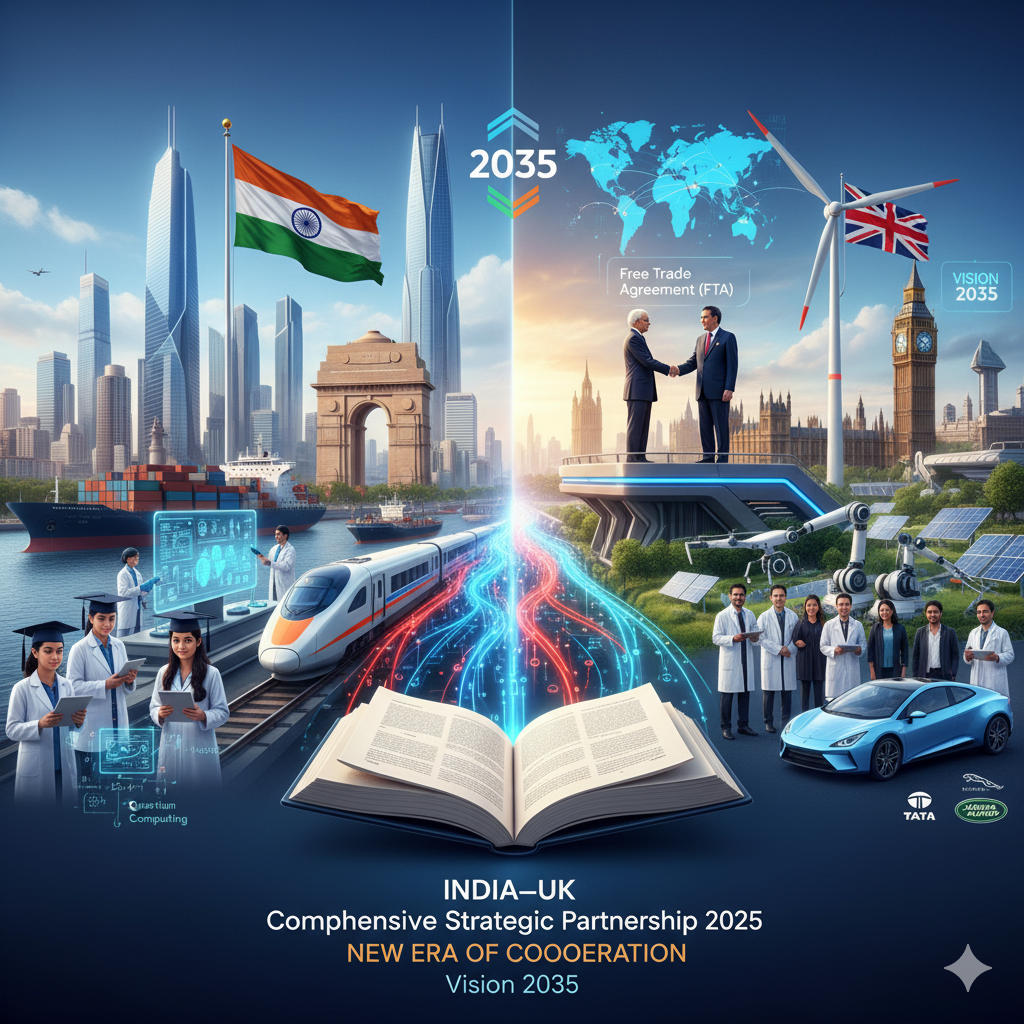
British Prime Minister Keir Starmer’s visit to India in October 2025 marked a turning point in India–UK relations, strengthening cooperation across trade, defence, technology, climate, and education. The partnership now operates under the Vision 2035 framework and the newly signed Comprehensive Economic and Trade Agreement (CETA), aimed at doubling bilateral trade by 2030.
Introduction
Context & Background
• 1947–2004: Diplomatic relations established after India’s independence, with cooperation mainly in trade and education.
• 2004: Upgraded to a Strategic Partnership focusing on mutual security and counterterrorism.
• 2021: Launch of the Comprehensive Strategic Partnership (CSP) — expanding cooperation into innovation, defence, and climate action.
• 2025: Signing of the Comprehensive Economic and Trade Agreement (CETA) and Vision 2035 — marking the most ambitious phase of bilateral engagement focused on long-term, sustainable cooperation.
Key Points
- •1. India–UK Comprehensive Economic and Trade Agreement (CETA): Signed in July 2025, CETA is a Free Trade Agreement (FTA) that reduces tariffs on most goods and services. It aims to double trade from $56 billion (2024) to over $100 billion by 2030.
- •2. Energy and Hydrogen Corridors: The agreement establishes clean hydrogen pipelines and electricity grids for secure green energy transfer, supporting India’s decarbonisation goals and net-zero ambitions.
- •3. Supply Chain Resilience: India and the UK aim to diversify trade routes away from East Asia, reducing dependence on China and mitigating disruptions caused by conflicts or piracy in the Red Sea and Indo-Pacific.
- •4. Diplomatic Capital: The agreement enhances India’s credibility as a global connector linking Europe, the Gulf, and the Indo-Pacific, complementing its ties with the US, UAE, and EU.
- •5. Vision 2035 Framework: This roadmap prioritises cooperation in trade, technology, education, defence, and climate — envisioning a long-term, people-centric relationship built on shared democratic values.
- •6. Defence Collaboration: Over £600 million worth of new defence deals signed, including Lightweight Multirole Missiles co-produced in India and electric propulsion systems for Indian naval ships.
- •7. Innovation & Technology: Launch of the Technology Security Initiative (TSI), joint AI and 6G research centres, and critical minerals collaboration to strengthen strategic tech ecosystems.
- •8. Climate Cooperation: The India–UK Climate Finance Initiative mobilises funds for green infrastructure, while the Offshore Wind Taskforce and Clean Power Alliance promote renewable energy transitions.
- •9. Education & People-to-People Ties: Nine UK universities to open campuses in India; launch of a Young Professionals Scheme allowing 3,000 citizens annually to work across borders.
- •10. Diaspora Power: With over 2.6% of the UK population being of Indian origin, the diaspora acts as a “living bridge” enhancing trade, investment, and cultural links.
Timeline of India–UK Partnership Evolution
| Year/Phase | Event | Significance | Bookmark |
|---|---|---|---|
| 1947 | Establishment of Diplomatic Relations | Laid the foundation for post-independence cooperation | |
| 2004 | Strategic Partnership | Enhanced defence, trade, and security collaboration | |
| 2021 | Comprehensive Strategic Partnership | Expanded into innovation, climate, and healthcare | |
| 2025 | Vision 2035 + CETA | Shift towards sustainable, technology-driven, and green cooperation |
Key Focus Areas Under Vision 2035
| Sector | Initiatives | Expected Impact | Bookmark |
|---|---|---|---|
| Trade & Investment | CETA + JETCO + CEO Forum | Doubling of trade by 2030; duty-free access for 99% of Indian exports | |
| Technology & Innovation | 6G R&D, AI Centre, Critical Minerals Guild | Boosts research in emerging tech and digital economy | |
| Defence & Security | Co-production of missiles and naval systems | Advances Atmanirbhar Bharat and maritime security | |
| Climate Action | Climate Finance Initiative, Wind Taskforce | Accelerates energy transition and climate resilience | |
| Education & Mobility | University campuses, Young Professionals Scheme | Enhances people-to-people and academic exchanges |
Related Entities
Impact & Significance
- •1. Economic Growth: CETA is expected to increase UK exports to India by 60% and Indian exports to the UK by 25%, contributing £25.5 billion in trade value and benefiting Indian MSMEs.
- •2. Green Transition: Joint efforts on clean hydrogen and renewable energy align with India’s climate goals and the UK’s net-zero targets.
- •3. Defence Modernisation: Collaboration supports Atmanirbhar Bharat through co-production of high-tech weapons and naval systems.
- •4. Global Standing: Strengthens India’s role as a connector between Europe, Indo-Pacific, and Gulf regions in global supply chains.
- •5. Technological Leadership: Joint investments in 6G, AI, biotechnology, and critical minerals position both nations as leaders in emerging technologies.
- •6. People-to-People Strength: Enhanced mobility, mutual degree recognition, and diaspora engagement promote shared prosperity and innovation.
Challenges & Criticism
- •1. Ratification Delays: CETA still awaits approval from the UK Parliament, where domestic political and lobbying pressures could slow implementation.
- •2. Regulatory Barriers: Non-tariff restrictions on Indian exports (like mangoes and marine products) remain unresolved.
- •3. Carbon Border Adjustment Mechanism (CBAM): The UK’s climate tariffs may hurt Indian exports in energy-intensive sectors such as steel and cement.
- •4. Mobility Issues: The UK’s immigration politics complicate liberal visa regimes, affecting students and skilled professionals.
- •5. Implementation Gap: Translating MoUs into tangible projects will require strong coordination between bureaucracies.
- •6. Competing Corridors: China’s Belt and Road Initiative (BRI) and Russia–Iran’s INSTC present alternative routes that could challenge IMEC-linked trade interests.
Future Outlook
- •Ensure swift ratification and operationalisation of CETA for immediate trade benefits.
- •Strengthen co-production of defence technologies under Atmanirbhar Bharat to reduce import dependence.
- •Expand collaboration in AI, quantum computing, biotech, and 6G to lead global technology standards.
- •Enhance climate finance mechanisms for scalable renewable energy solutions.
- •Institutionalise CEO Forums, JETCO, and UKIIFB for transparent implementation of agreements.
- •Deepen education, culture, and migration partnerships to sustain the ‘living bridge’ between societies.
UPSC Relevance
- • GS-2: Bilateral Relations, India–UK strategic ties, regional diplomacy, diaspora policy.
- • GS-3: Technology, climate cooperation, energy transition, industrial collaboration.
- • Essay: Post-Brexit Britain and India’s Global Role; Trade Diplomacy and Sustainable Development.
Sample Questions
Prelims
With reference to the India–UK Comprehensive Strategic Partnership, consider the following statements:
- (a)The Comprehensive Economic and Trade Agreement (CETA) was signed in 2025.
- (b)The Vision 2035 framework focuses only on defence cooperation.
- (c)The UK–India Infrastructure Financing Bridge promotes clean energy and infrastructure investment.
- (d)Under the Young Professionals Scheme, 3,000 citizens can work annually across both countries.
Mains
The India–UK Comprehensive Strategic Partnership under Vision 2035 seeks to transform historical ties into a forward-looking partnership. Discuss how trade, technology, and climate cooperation are central to this transformation.
Introduction: India and the UK have elevated their partnership to a new level through Vision 2035 and CETA, focusing on trade liberalisation, green energy, and technology collaboration.
Body:
• Trade: CETA eliminates most tariffs, enhances supply chain resilience, and promotes duty-free access for Indian exports.
• Technology: The Technology Security Initiative and AI centres foster innovation in 6G, cybersecurity, and critical minerals.
• Climate Cooperation: The Climate Finance Initiative, Wind Taskforce, and hydrogen corridors support decarbonisation and green growth.
• People-to-People Ties: Educational collaborations and the diaspora strengthen mutual understanding and talent mobility.
Conclusion: The Vision 2035 partnership marks a shift from legacy cooperation to future-oriented collaboration, positioning both nations as key players in global trade, technology, and climate leadership.