
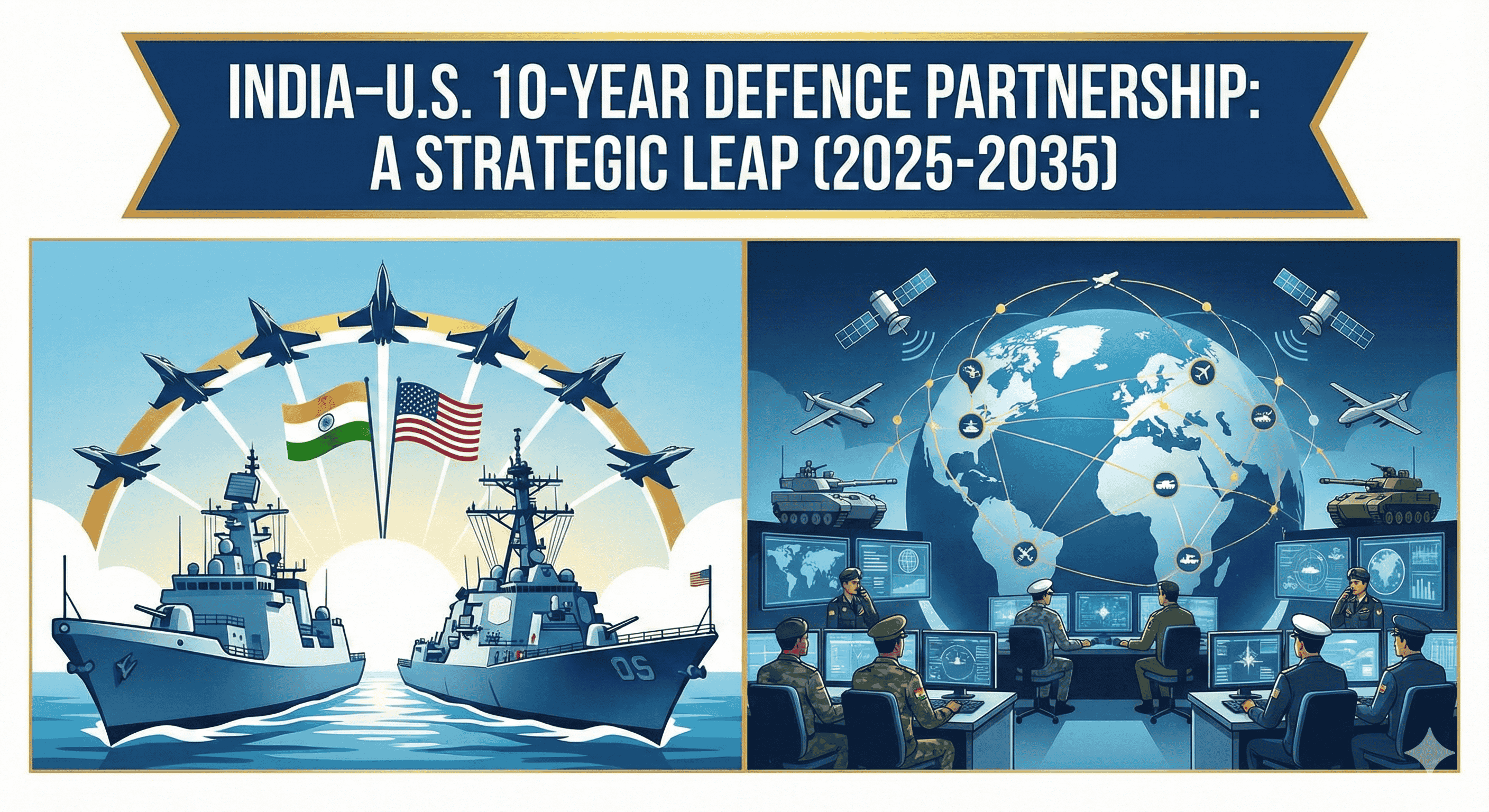
India–U.S. 10-Year Defence Partnership: A Strategic Leap (2025-2035)
Signed in Kuala Lumpur in October 2025, this historic framework guides India-U.S. military ties till 2035. It moves beyond simple weapon sales to 'co-production' (building weapons together) and 'interoperability' (fighting together). It specifically counters the fear of a 'G2' (U.S.-China) global order that might sideline India.
Introduction
Beginner's Note: Think of this framework as a 'marriage contract' for defence. Instead of dating (buying occasional weapons), both countries have agreed to build a life together (co-develop technology) and share resources permanently.
Context & Background
- India's Worry: If the U.S. and China get too cozy, India's security concerns (like the border with China) might be ignored.
- The Signal: By signing this 10-year pact right now, the U.S. is telling the world: 'No matter what happens with China, India remains our key partner in Asia.'
The 'COMPACT' Umbrella: This defence framework is part of a larger initiative launched in Feb 2025 called U.S.-India COMPACT, which also aims for 'Mission 500' (increasing bilateral trade to $500 billion).
Key Points
- •1. Co-Production (The 'Make in India' Boost): The U.S. is moving from 'selling' to 'sharing'.
Specific Projects:- GE F-414 Engines: These powerful jet engines will be made in India to power the Tejas Mk-II fighter jets.
- Stryker Vehicles: Armored fighting vehicles to be co-produced for the Indian Army.
- Javelin Missiles: The famous anti-tank missiles will now be made in India.
- •2. Industrial Collaboration (INDUS-X): Launched to connect startups.
Real Example: An Indian startup and a U.S. company might team up to invent a new underwater drone. The Anduril-Mahindra partnership is a key example, working on autonomous systems to monitor the sea. - •3. Interoperability ('Plug and Play' Militaries): This means Indian and U.S. forces can work together seamlessly.
Example: During the Malabar Exercise, an Indian Navy helicopter should be able to land, refuel, and get data from a U.S. aircraft carrier without technical glitches. - •4. SOSA (Security of Supply Arrangement): Signed recently, this acts like a 'VIP Pass' during emergencies.
How it works: If India needs urgent spare parts during a war, the U.S. government will force its companies to serve India before other commercial clients. India promises to do the same for the U.S. - •5. Regional Security (The Quad Factor): The pact reinforces the Quad (India, U.S., Japan, Australia). It aims to stop any single country (read: China) from dominating the Indo-Pacific region, ensuring 'Freedom of Navigation' for all ships.
SOSA vs. RDP: Understanding the New Agreements
| Feature | SOSA (Security of Supply Arrangement) | RDP (Reciprocal Defense Procurement) - Under Negotiation | Bookmark |
|---|---|---|---|
| Analogy | 'The VIP Line' | 'The Free Entry Pass' | |
| What it does | Ensures priority delivery of goods during emergencies/wars. | Removes trade barriers so Indian companies can sell directly to the U.S. Military. | |
| Legal Status | Non-binding (A strong promise). | Legally binding (A strict contract). | |
| Benefit | Fixes supply chain disruptions. | Opens the massive U.S. market to Indian exporters. |
The 4 Foundational Agreements (The Backbone)
| Agreement | Simple Explanation | Real-World Use | Bookmark |
|---|---|---|---|
| LEMOA (2016) | Logistics Sharing | Indian warships can refuel at U.S. bases in Djibouti or Diego Garcia. | |
| COMCASA (2018) | Secure WhatsApp | Allows Indian pilots to talk to U.S. pilots on encrypted, un-hackable lines. | |
| BECA (2020) | Google Maps for Missiles | India gets U.S. HD satellite data to aim cruise missiles precisely. | |
| GSOMIA (2002) | Secret Keeper | Allows the U.S. to share top-secret blueprints without fear of leaks. |
Related Entities
Impact & Significance
- •Technological Leap: India gets access to 'Crown Jewel' technologies (like jet engine metallurgy) that the U.S. rarely shares, even with close allies.
- •Net Security Provider: With U.S. drones (MQ-9B) and planes (P-8I), India becomes the 'Eye in the Sky' for the Indian Ocean, protecting merchant ships from pirates and hostile submarines.
- •Strategic Autonomy: Critics say India is getting too close to the U.S., but India argues this helps build its own industry (Atmanirbhar Bharat), reducing dependence on any single country (like Russia).
Challenges & Criticism
- •The 'Red Tape' (ITAR): The U.S. has a strict law called ITAR that prevents sharing military secrets. Changing this law is hard, so technology transfer is often slower than promised.
- •Cost Factor: U.S. weapons are premium and expensive.
Comparison: A Russian missile might cost $1 million; a similar U.S. one might cost $4 million. This strains India's budget. - •The Russia Elephant: India still buys S-400 missiles and oil from Russia. The U.S. dislikes this, and it remains a constant point of friction.
Future Outlook
- •Next Step - RDP: The immediate goal is to sign the Reciprocal Defense Procurement (RDP) agreement, allowing Indian companies like Tata and Mahindra to bid for U.S. Pentagon contracts.
- •New Domains: Cooperation will expand to Space Defence (protecting satellites) and Cyber Warfare.
- •Depoliticization: The framework ensures that even if the U.S. President changes, defence cooperation runs on 'autopilot'.
UPSC Relevance
- • GS-2 (International Relations): Bilateral agreements, Global groupings (Quad), Effect of developed countries' policies.
- • GS-3 (Security): Indigenization of technology (Make in India), Border security.
- • Prelims: Terms like SOSA, RDP, INDUS-X, and Foundational Agreements (LEMOA, BECA).
Sample Questions
Prelims
With reference to India-U.S. defence cooperation, consider the following statements:
- (a)The Security of Supply Arrangement (SOSA) is a legally binding treaty guaranteeing exclusive market access.
- (b)The 'Basic Exchange and Cooperation Agreement' (BECA) allows for the sharing of geospatial intelligence.
- (c)INDUS-X is an initiative to promote defence innovation partnerships between startups of both nations.
Mains
The recently signed 10-year Defence Framework marks a shift from a 'transactional' to a 'strategic' partnership between India and the U.S. Discuss with reference to initiatives like INDUS-X and SOSA.
Introduction: The 2025 Framework establishes a vision till 2035, moving beyond 'buyer-seller' relations to deep technological integration.
Body:
• Shift to Strategic Partnership:
- Co-production: Moving from buying off-the-shelf to making in India (e.g., GE Engines, Strykers).
- Innovation: INDUS-X connects startups for joint R&D (e.g., underwater sensors).
• Strategic Significance:
- SOSA: Ensures supply chain resilience during wars.
- Geopolitics: Counters the 'G2' narrative and Chinese dominance in the Indo-Pacific.
• Challenges: High cost of U.S. tech, bureaucratic hurdles (ITAR), and India's balancing act with Russia.
Conclusion: While challenges remain, the framework acts as a 'trust anchor', ensuring that defence ties remain immune to political shifts.