
Indian Federalism: Need for Structural Recalibration
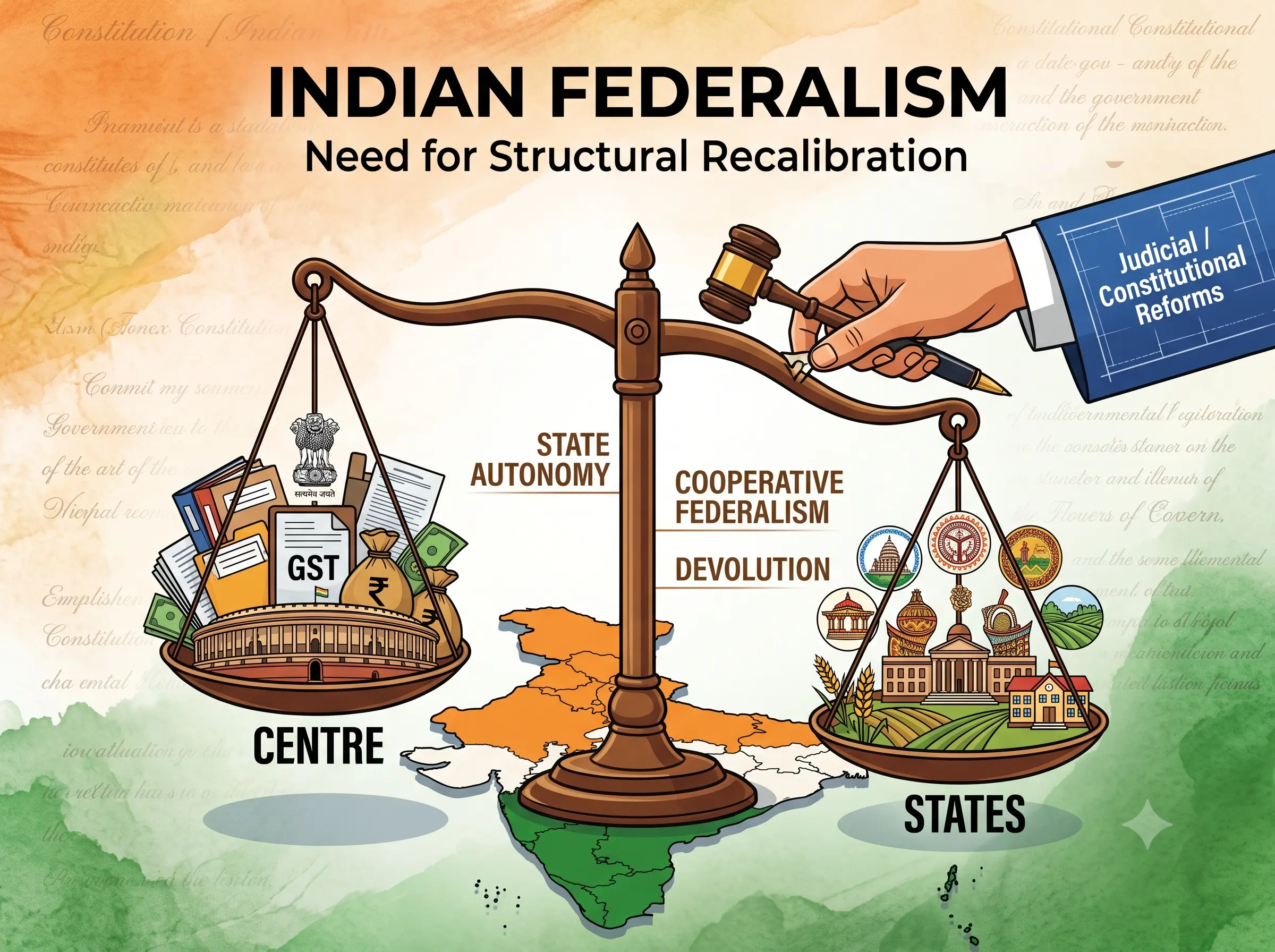
The discussion on the nature and future of Indian federalism has gained fresh momentum following the Justice Kurian Joseph Committee’s report. Constituted by the Tamil Nadu government, the report highlights growing centralization and calls for a fundamental rebalancing of Centre–State relations to protect and strengthen federal democracy.
Introduction
Context & Background
Key Points
- •Dual Polity & Division of Powers: Indian federalism establishes a dual structure comprising the Union and autonomous States, with clear categorization of powers into Union, State, and Concurrent lists.
- •Constitutional Supremacy & Rigidity: The Constitution is the supreme, written law. Federal provisions are amendable only through a stringent process requiring joint action by the Centre and States.
- •Independent Judiciary & Bicameralism: The Supreme Court adjudicates Centre-State disputes, while the Parliament consists of an Upper House (Rajya Sabha) representing States and a Lower House representing the people.
- •Basic Structure Doctrine: As established in the S.R. Bommai v. UOI case, federalism reflects India’s diversity and is a fundamental part of the Constitution's Basic Structure, meaning States are not mere administrative units of the Centre.
- •The Kurian Joseph Report Findings: The high-level committee observed that decision-making is increasingly concentrated at the Union level, straining the federal balance and necessitating a structural reset comparable to the 1991 economic reforms.
Key Constitutional Provisions for Federalism
| Article / Feature | Provision Details | Bookmark |
|---|---|---|
| Seventh Schedule | Divides powers between the Union and states through three lists – Union List, State List, and Concurrent List. | |
| Article 1 | Defines India as a Union of States. | |
| Article 245 & 246 | Grants Parliament and state legislatures the power to make laws and enumerates the subject matters for each. | |
| Article 263 | Provides for the establishment of an Inter-State Council to promote cooperative federalism. | |
| Article 279-A | Empowers the President to constitute a GST Council. |
Historical Federal Perspectives & Reports
| Committee / Landmark | Key Stance / Finding | Bookmark |
|---|---|---|
| Rajamannar Committee (1971) | First comprehensive review of Union–State relations, advocating for more state autonomy. | |
| Sarkaria & Punchhi Commissions | Recognized imbalances in Centre-State relations but avoided structural overhauls. | |
| S.R. Bommai v. UOI Case | Supreme Court ruled that Federalism is part of the Basic Structure of the Constitution. | |
| Kurian Joseph Committee (2025) | Non-partisan constitutional review calling for a 'structural reset' and warning against rising centralization. |
Related Entities
Impact & Significance
- •Erosion of State Autonomy: The 2019 reorganization of Jammu and Kashmir into two Union Territories is cited as a prime example of the Centre’s overriding authority.
- •Fiscal Dependence: The GST regime has structurally altered fiscal relations, leaving States heavily dependent on Union transfers and vulnerable to delayed compensation.
- •Policy Friction: Areas like education, health, and elections are witnessing greater Union involvement, reducing the flexibility of States to address local socio-economic needs.
- •Identity and Representation Fears: Proposed reallocation of Lok Sabha seats (delimitation) has raised fears among Southern States that successfully controlled population growth, while language policy debates continue to create tensions.
Challenges & Criticism
- •Misuse of Governor’s Office: Increasing friction between Governors and elected State governments, characterized by arbitrary dismissals and interference in legislative processes.
- •Misuse of Article 356: Historically invoked under questionable circumstances, President's Rule has frequently been used to undermine state autonomy and political stability.
- •Overreach in the Concurrent List: Ambiguities in power division lead to conflicts, with the Union often overriding State laws through expansive legislation and subordinate rules.
- •Rigid Centrally Sponsored Schemes: 'One-size-fits-all' schemes stretch administrative capacity and force States to spend resources on priorities decided by the Centre rather than local necessities.
Future Outlook
- •Right-sizing the Union Government: The Centre should focus on core national responsibilities (defence, foreign affairs, macroeconomic stability) and reduce its excessive involvement in State subjects like health and education.
- •Restoring Genuine State Autonomy: States must be allowed full legislative and executive freedom within their constitutional domains to restore direct accountability to citizens.
- •Reducing Micromanagement: Replace Centrally Sponsored Schemes (CSS) possessing rigid design templates with block grants, giving States the flexibility to adapt programs to local contexts.
- •Reforming Fiscal Federalism: Move away from conditionality-heavy frameworks in Finance Commission transfers to provide States with greater predictability and autonomy.
- •Strengthening Cooperative Federalism: Institutional dialogue, rather than executive fiat, should guide Centre-State relations, ensuring the Union and States function as constitutional partners.
UPSC Relevance
- • GS-2 (Polity & Governance): Indian Constitution—historical underpinnings, evolution, features, amendments, significant provisions and basic structure; Functions and responsibilities of the Union and the States.
- • GS-2 (Issues and challenges pertaining to the federal structure): Devolution of powers and finances up to local levels and challenges therein.
- • Essay Topics: 'Cooperative Federalism vs. Command Federalism', 'The Centralizing Tendencies in Indian Democracy'.
- • Mains Focus: Analyzing the recommendations of the Kurian Joseph Committee and the need for structural recalibration of Centre-State relations.
Sample Questions
Prelims
Consider the following statements regarding Indian Federalism:
1. Article 245 provides for the establishment of an Inter-State Council.
2. The S.R. Bommai v. Union of India judgement established that federalism is a part of the Basic Structure of the Constitution.
3. The GST Council is a statutory body created by an Act of Parliament.
Answer: Option 2
Explanation: Statement 1 is incorrect; Article 263 provides for the Inter-State Council, while Article 245 deals with the extent of laws made by Parliament and State Legislatures. Statement 3 is incorrect; the GST Council is a Constitutional Body under Article 279-A. Statement 2 is correct.
Mains
“The growing centralization of power threatens the cooperative fabric of Indian federalism.” Analyze this statement in the context of the recent findings of the Justice Kurian Joseph Committee. What structural reforms are needed to restore the federal balance?
Introduction: Define the quasi-federal nature of the Indian Constitution. Introduce the context of the Justice Kurian Joseph Committee report (2025) and its warning against structural imbalances.
Body:
• Issues of Centralization: Highlight the findings of the Kurian Joseph report—concentration of decision-making, misuse of Governor's office, misuse of Article 356, and overriding State laws in the Concurrent List.
• Impact on States: Fiscal imbalances due to the GST regime, symmetric representation concerns due to impending delimitation, and interference in state subjects like health and education.
• Proposed Reforms: Right-sizing the Union government, restoring State autonomy, replacing rigid Centrally Sponsored Schemes with block grants, and rebalancing the Concurrent List.
Conclusion: Conclude that Indian federalism must evolve from a paradigm of 'command federalism' to genuine cooperative federalism, respecting the diversity and autonomy of States as envisioned by the Constituent Assembly.