
India’s Crypto Industry: Market Growth, Regulatory Vacuum, and Security Challenges
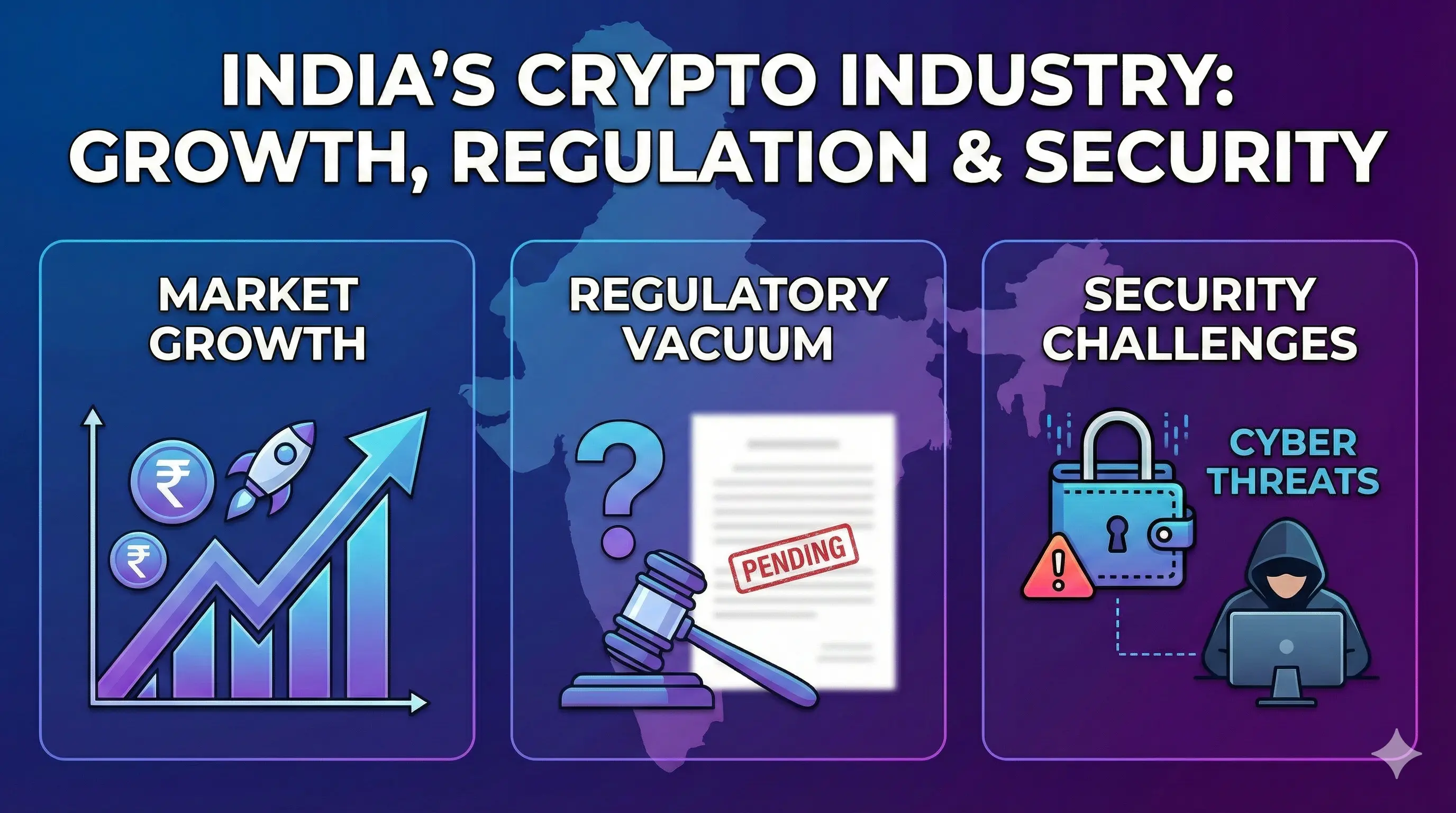
India's cryptocurrency market is projected to reach $15 billion by 2035 with a massive user base. However, the sector operates in a regulatory grey zone, facing significant challenges regarding money laundering, cyber-fraud, and a lack of clear legislative guardrails, prompting calls for a centralized licensing regime.
Introduction
Context & Background
Key Points
- •What are Crypto Exchanges? These are online platforms (like CoinSwitch, WazirX, Binance) that function similarly to stock exchanges. They allow users to convert fiat currency (Rupees) into digital tokens (Bitcoin, Ethereum) and store them in digital wallets. For beginners: think of them as the 'Amazon' for buying digital money.
- •The Regulatory Grey Zone: Despite the 2020 SC judgment allowing operations, there is no central regulator (like SEBI for stocks or RBI for banks) overseeing crypto. This means if an exchange collapses or fraud occurs, users have limited grievance redressal mechanisms.
- •Rising Criminal Misuse: The anonymity and speed of crypto make it a favorite for criminals. Ransomware groups, drug cartels, and cyber-fraud syndicates use it to move money across borders instantly. The Indian Cyber Crime Coordination Centre (I4C) recently flagged 27 exchanges for facilitating money laundering.
- •Investigation Hurdles: Law enforcement agencies face massive challenges. Foreign exchanges often refuse to share user data. Technical tools like Privacy Coins (which hide transaction details), VPNs, and Unhosted Wallets (wallets not managed by an exchange) make tracing funds nearly impossible.
- •Taxation vs. Regulation: Currently, the government imposes a 30% tax on crypto gains and a 1% TDS on transactions. However, taxation does not imply legitimacy or safety regulation, leaving investors vulnerable to fraud while the state collects revenue.
- •Money Laundering Mechanics: Criminals use a three-step process:
1. Placement: Cash is converted to crypto via mules or weak-KYC exchanges.
2. Layering: Funds are moved through 'mixers' (tools that jumble coins from many users) and 'chain-hopping' (switching between different cryptos) to break the audit trail.
3. Integration: Cleaned crypto is sold for fiat currency on foreign exchanges and brought back as 'legitimate' investment gains. - •Global Disparity: Regulation varies globally—Japan and EU have strict licensing, while offshore tax havens offer loose oversight. This allows criminals to engage in regulatory arbitrage (exploiting loopholes in jurisdictions with weak laws).
Evolution of Crypto Regulation in India
| Year | Event | Impact | Bookmark |
|---|---|---|---|
| 2013 | RBI Circular | Warned public against security and financial risks of virtual currencies. | |
| 2018 | RBI Banking Ban | Prohibited banks/NBFCs from serving crypto exchanges. Market crashed; cash-based P2P trading rose. | |
| 2020 | Supreme Court Judgment | Declared RBI's 2018 ban unconstitutional on grounds of proportionality. Banking channels reopened. | |
| 2024-25 | Current Status | Trading is legal; Gains taxed at 30%; No comprehensive regulatory framework yet. |
Major Indian Crypto Platforms & Status (2024-25)
| Platform | Key Financials/Status | Major Issues/Incidents | Bookmark |
|---|---|---|---|
| CoinDCX | Rev: ₹572 Cr | Suffered a ₹384 Cr hack; facing forensic investigations. | |
| WazirX | Rev: ₹50 Cr | Criticized for freezing funds post-hack; ownership dispute between Indian founders and Binance. | |
| CoinSwitch X | Rev: ₹74 Cr | Investigated for GST evasion; recovered ₹19.38 Cr. |
Related Entities
Impact & Significance
- •Economic Growth: With a projected CAGR of 17%, the crypto sector creates high-value tech jobs and attracts foreign investment (FDI) in blockchain innovation.
- •Financial Stability Risk: Without liquidity requirements (cash reserves), exchanges can collapse (like the global FTX crash), wiping out the savings of millions of retail investors.
- •National Security: Unregulated crypto flows are used for terror financing and evading international sanctions, posing a threat to state sovereignty.
- •Consumer Trust: Repeated hacks (e.g., WazirX, CoinDCX) and GST evasion cases erode trust in the digital asset ecosystem, potentially stalling legitimate blockchain adoption.
Challenges & Criticism
- •Data Sovereignty: Foreign exchanges operating in India often store data abroad, denying access to Indian investigators like the ED or CBI.
- •Technical Complexity: The use of 'Mixers' (software that obscures the trail of funds) and 'Cold Wallets' (offline storage) makes it difficult for traditional police methods to work.
- •Lack of Consumer Protection: Unlike bank deposits insured by DICGC, crypto holdings have no insurance. If an exchange gets hacked, the user often loses everything.
- •Jurisdictional Ambiguity: The internet is borderless, but laws are not. A crime may involve a victim in Mumbai, a hacker in North Korea, and an exchange in the Cayman Islands, creating a legal nightmare.
Future Outlook
- •Central Licensing Regime: India is likely to move towards a system where exchanges must obtain a license to operate (similar to Canada's model), ensuring they meet capital and safety standards.
- •Wallet-Level KYC: Future regulations may mandate verifying the identity of the owner of a private wallet before allowing transfers, closing the anonymity loophole (similar to Singapore's rules).
- •The FATF 'Travel Rule': Implementation of this global standard will require exchanges to share the sender and receiver's details for every transaction above a certain threshold.
- •Asset Classification: The government may legally categorize tokens (e.g., Utility Tokens vs. Security Tokens) to apply appropriate laws, possibly inspired by the EU’s MiCA (Markets in Crypto-Assets) regulation.
- •Investor Education: Regulators like SEBI might introduce strict norms for crypto advertising to prevent misleading claims of 'guaranteed returns'.
UPSC Relevance
- • GS-3: Money Laundering and its prevention; Challenges to internal security through communication networks.
- • GS-3: Indian Economy (Investment models, Digital economy).
- • GS-2: Government policies and interventions (Regulation of new technologies).
- • Essay: Technology: A double-edged sword; Balancing Innovation and Regulation.
Sample Questions
Prelims
With reference to the regulation of Cryptocurrencies in India, consider the following statements:
- (a)Cryptocurrencies are currently recognized as legal tender in India.
- (b)The Supreme Court of India declared the RBI's 2018 ban on banking support for crypto entities as unconstitutional.
- (c)Gains from cryptocurrency trading are currently tax-exempt in India.
Mains
Cryptocurrencies pose a significant challenge to the internal security and financial stability of India. Discuss the challenges associated with unregulated crypto markets and suggest measures for a comprehensive regulatory framework.
Introduction: Define cryptocurrency and highlight the growth of the sector in India ($15bn projection) alongside the current regulatory vacuum.
Body:
• Security Challenges: Money laundering (placement/layering/integration), terror financing, anonymity (Dark Web), and cross-border investigation hurdles.
• Financial Challenges: Volatility, lack of liquidity norms, risk of exchange collapse, and tax evasion.
• Proposed Measures: Central licensing regime (Canada model), Wallet-level KYC (Singapore model), implementation of FATF Travel Rule, and international cooperation.
Conclusion: Conclude with the need for a balanced approach—regulating to mitigate risks while allowing innovation—perhaps adopting a framework similar to the EU's MiCA.