
India’s Service Sector: The Engine of Growth and Employment
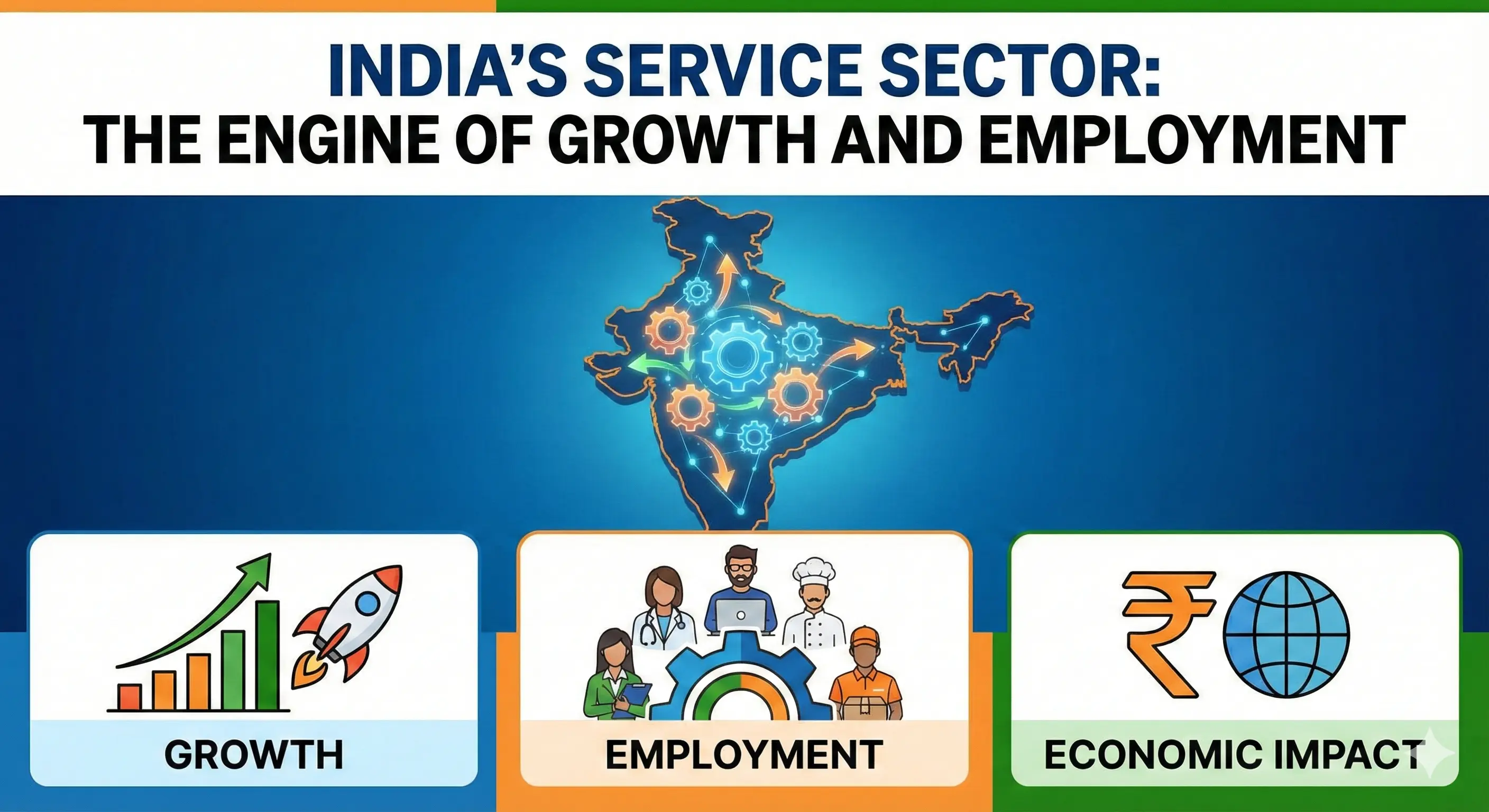
NITI Aayog’s inaugural Services Thematic Series highlights that India's service sector now contributes 55% to GVA and employs 188 million people. Despite being a major growth driver, the sector faces challenges like high informality, regional disparity, and a skills gap, necessitating a 'Build-Embed-Scale' strategy for sustainable expansion.
Introduction
Context & Background
Key Points
- •Economic Dominance: The sector contributes 55% to India's GVA, anchoring stability. It is the largest recipient of Foreign Direct Investment (FDI), attracting 19% of total inflows, which signals high global confidence in Indian services.
- •Export Powerhouse: Services drive 40% of India's total exports, earning $387.5 billion. While IT services lead, there is a push to diversify into 'invisible' exports like consulting, telemedicine, and legal outsourcing.
- •Employment Generator: Employing 188 million people, it is absorbing the surplus labor from agriculture. The Employment Elasticity (a measure of how many jobs are created for every unit of economic growth) has improved from 0.35 (pre-COVID) to 0.63, meaning growth is becoming more job-intensive.
- •Digital & Knowledge Economy: The 'Computer and Information Services' sub-sector has seen its GVA rise fourfold since 2011. Platforms like UPI and ONDC (Open Network for Digital Commerce) are essentially 'service platforms' that enable millions of small transactions daily.
- •Urban-Rural Divide: Services are largely an urban phenomenon. 60% of urban workers depend on services, compared to only 18.9% of rural workers. This creates a spatial disconnect where cities grow rich while villages lag.
- •Gender Disparity: There is a stark gender gap in rural India. Only 10.5% of rural women work in services vs. 24% of men. Furthermore, rural women earn only about half of what men earn, highlighting deep inequality.
- •Informality Challenge: Despite the glitz of IT parks, the reality is that 70–75% of service workers (shopkeepers, repairmen, drivers) are in the unorganized sector with no social security (PF, pension, insurance).
Sectoral Contribution to Indian Economy (Approx.)
| Sector | GVA Share | Employment Share | Key Characteristics | Bookmark |
|---|---|---|---|---|
| Services | 55% | 29.7% | High growth, moderate employment, high informality. | |
| Agriculture | 18% | 45% | Low growth, high employment (disguised unemployment). | |
| Industry | 27% | 25% | Stagnant share, key for 'Make in India'. |
Government Initiatives Boosting Services
| Initiative | Target Sector | Objective | Bookmark |
|---|---|---|---|
| Digital India | IT & Fintech | Expand e-governance and internet access. | |
| SWADESH Darshan | Tourism | Develop thematic tourist circuits to boost local jobs. | |
| Start-up India | Entrepreneurship | Foster innovation in EdTech, HealthTech, and Logistics. | |
| Skill India | Human Capital | Train workforce for modern service roles (AI, Hospitality). |
Related Entities
Impact & Significance
- •Convergence (Catch-up Effect): The report notes 'Beta Convergence', meaning poorer states are growing their service sectors faster than richer states. This helps reduce regional inequality over time.
- •Income Correlation: States with a high service share (Karnataka, Telangana, Delhi) have significantly higher per capita incomes, proving that services are the ladder to prosperity.
- •Resilience: During global downturns, service exports (especially digital) have proven more resilient than merchandise exports, providing a buffer for India's Balance of Payments.
Challenges & Criticism
- •Jobless Growth Concerns: While the sector contributes 55% to GDP, it employs less than 30% of people. This mismatch suggests that a lot of value is created by high-tech, low-labor industries (like software), leaving the masses behind.
- •Regional Skew: Just 6 states generate 40% of India's services output. This concentration in the South and West leaves the North and East behind.
- •Skill Gap: According to NSDC, only 4.7% of India's workforce has formal skill training. A service economy requires skilled workers (nurses, coders, teachers), not just manual labor.
- •Wage Inequality: The gap between a software engineer in Bengaluru and a domestic helper in the same city is massive, leading to dual economies within the same sector.
Future Outlook
- •NITI Aayog's Recommendation: Adopt the 'Build–Embed–Scale' framework:
1. Build: Digital and physical infrastructure (5G, Airports).
2. Embed: Link services with manufacturing (e.g., logistics for factories).
3. Scale: Expand innovations globally (e.g., taking UPI to the world). - •Export Diversification: India must move beyond IT to dominate in Medical Value Travel (Health), Legal Process Outsourcing, and Green Consulting.
- •Formalization: Incentivizing MSMEs to register on digital platforms (like ONDC) can help formalize the vast unorganized workforce.
- •Bridging the Rural Gap: Promoting 'Phygital' services (physical + digital) like telemedicine and rural BPOs can bring high-value service jobs to villages.
UPSC Relevance
- • GS-3: Indian Economy and issues relating to planning, mobilization of resources, growth, development and employment.
- • GS-3: Effects of liberalization on the economy (Service sector boom).
- • GS-2: Government policies and interventions for development in various sectors.
- • Essay: 'The soul of India lives in its villages' vs. Urban Service Economy.
Sample Questions
Prelims
With reference to the Service Sector in India, consider the following statements based on recent NITI Aayog reports:
1. The services sector currently contributes more than 70% to India's Gross Value Added (GVA).
2. The sector employs more than 50% of India's total workforce.
3. India's service sector attracts the highest share of Foreign Direct Investment (FDI) inflows.
Answer: Option 3
Explanation: Statement 1 is incorrect (It is 55%). Statement 2 is incorrect (It is roughly 30%). Statement 3 is correct (Attracts ~19%, the highest).
Mains
“While the service sector is the engine of India's growth, it has not been the engine of broad-based employment.” Analyze this statement in light of recent trends and suggest measures to make service-led growth more inclusive.
Introduction: Highlight the dichotomy: Service sector contributes 55% to GDP but employs only ~30% of the workforce.
Body:
• Analysis of Growth vs. Employment: Discuss 'Jobless Growth', high informality, and the skill mismatch preventing rural youth from entering the sector.
• Regional & Gender Disparities: Mention the concentration of services in southern/western states and the low participation of rural women.
• Roadmap: Suggest the 'Build-Embed-Scale' framework, focus on labor-intensive services (Tourism, Construction, Care Economy), and skilling initiatives (Skill India 2.0).
Conclusion: Conclude that for Viksit Bharat @2047, India needs to bridge the gap between the 'India of IT Parks' and the 'India of Villages' through inclusive service growth.