
Industrial Relations Code (Amendment) Bill, 2026
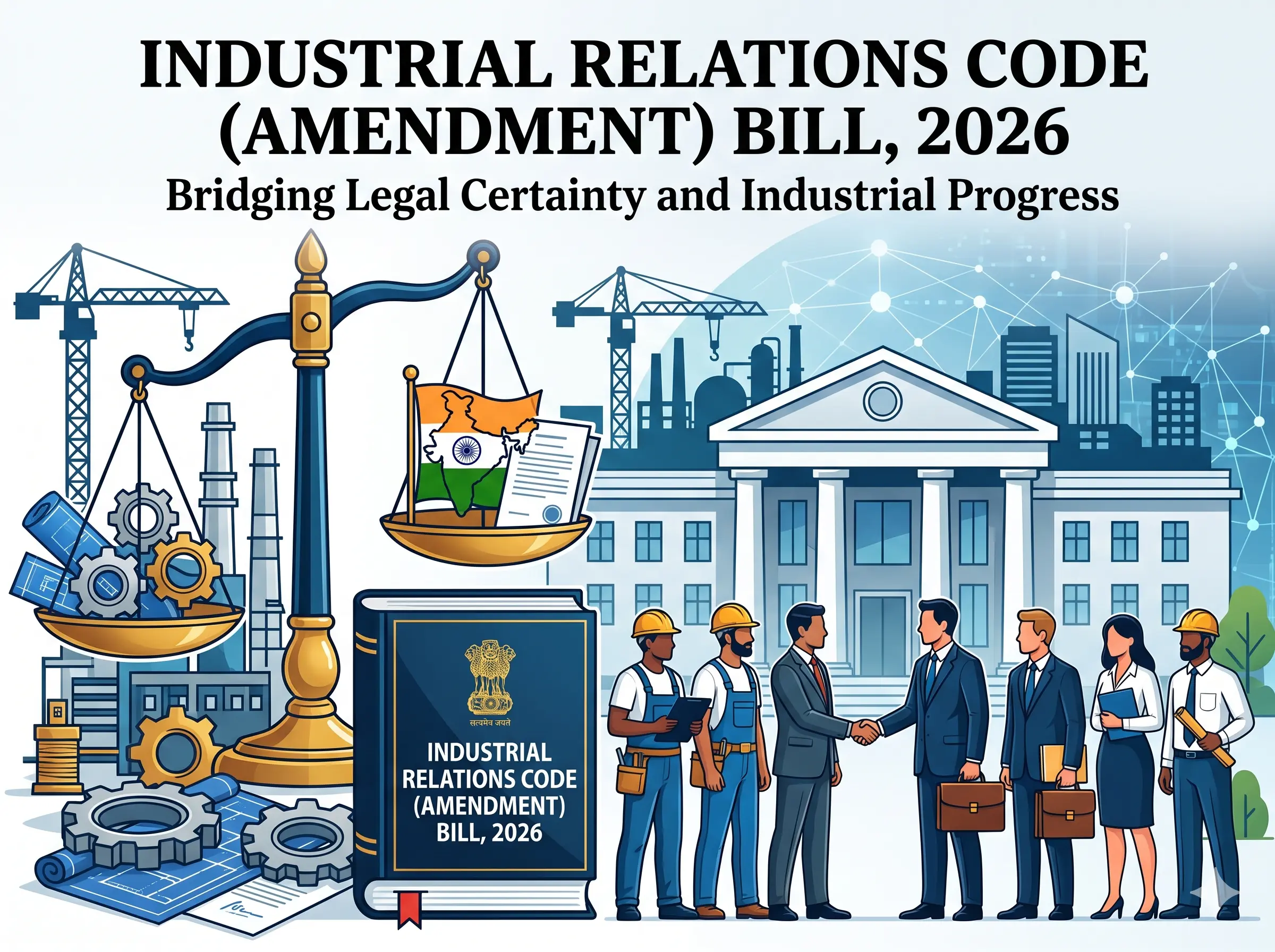
The Industrial Relations Code (Amendment) Bill, 2026 was introduced in the Lok Sabha to clarify repeal and savings provisions. It aims to prevent future legal complications and ensure a seamless transition from legacy labour laws to the unified 2020 Code.
Introduction
Context & Background
Key Points
- •Repeal Clarification: Makes it explicit that the repeal of the three legacy laws happens by the operation of Section 104 itself, not through any executive “repeal power” route.
- •Savings Continuity: Reinforces that past rights, liabilities, penalties, notifications, and ongoing proceedings continue seamlessly, ensuring the transition does not disrupt industrial adjudication.
- •Legal Certainty Shield: Tightens drafting so misconceived challenges (delegation/ultra vires arguments) don’t derail the Code’s continuity logic in the future.
- •High Litigation Load: India’s courts carry ~54 million pending cases. Even a narrow interpretational dispute regarding the new code could snowball into years of avoidable litigation over continuity.
- •Continuity Risk: Labour disputes often run for long durations; any doubt on “which law applies” can trigger preliminary objections and adjournments before the actual merits of a case are heard.
- •Compliance Scale: MSME registrations on the national dashboard show ~7.7 crore enterprises, meaning small ambiguities can multiply into massive compliance uncertainty at scale.
Legacy Laws Unified Under the Industrial Relations Code
| Legacy Act | Year | Primary Purpose | Bookmark |
|---|---|---|---|
| Trade Unions Act | 1926 | Registration and regulation of trade unions | |
| Industrial Employment (Standing Orders) Act | 1946 | Defining conditions of employment and workplace rules | |
| Industrial Disputes Act | 1947 | Investigation and settlement of industrial disputes |
Related Entities
Impact & Significance
- •Regulatory Predictability: Clear repeal mechanics stabilise the legal base for employers, unions and labour offices, reducing “first-principles” disputes during implementation.
- •Faster Dispute Handling: With continuity clarified, tribunals and courts are less likely to waste time on preliminary jurisdiction-and-applicability fights.
- •Reform Credibility: Shows course-correction to protect the labour-code architecture from technical derailment, improving trust among investors and organised labour alike.
Challenges & Criticism
- •Drafting Optics: A clarificatory amendment so soon can be read as an initial drafting vulnerability, inviting a more “technical challenge” mindset in the future.
- •Residual Ambiguities: Even with Section 104 clarified, other transition questions like rules, subordinate legislation, and forum shifts can still generate disputes.
- •Change Fatigue: Repeated small amendments can create a perception of moving goalposts, especially for MSMEs already coping with multi-layer compliance.
Future Outlook
- •Smooth Transition to Labour Codes: By proactively fixing interpretational loopholes, the government is setting a stronger foundation for the nationwide rollout of the unified Labour Codes.
- •Reduced Judicial Burden: Clearer guidelines on applicability will prevent the clogging of industrial tribunals with procedural and jurisdictional disputes.
UPSC Relevance
- • GS-3 (Indian Economy): Labour reforms, changes in industrial policy, and their effects on industrial growth.
- • GS-2 (Governance/Polity): Government policies and interventions for development in various sectors, issues arising out of their design and implementation.
- • Mains Focus: Analyzing the necessity of the Labour Codes, the challenges in their implementation, and their impact on MSMEs and the Ease of Doing Business.
Sample Questions
Prelims
Consider the following statements regarding the Industrial Relations Code, 2020: 1. It subsumed the Trade Unions Act, 1926, and the Minimum Wages Act, 1948. 2. The Industrial Relations Code (Amendment) Bill, 2026 was introduced primarily to alter the threshold limits for the applicability of standing orders. Which of the statements given above is/are correct?
1. 1 only
2. 2 only
3. Both 1 and 2
4. Neither 1 nor 2
Answer: Option 4
Explanation: Statement 1 is incorrect: It subsumed the Trade Unions Act, 1926, the Industrial Employment (Standing Orders) Act, 1946, and the Industrial Disputes Act, 1947. (The Minimum Wages Act is under the Code on Wages). Statement 2 is incorrect: The 2026 Amendment was introduced to clarify the repeal and savings clauses (Section 104) to prevent legal and interpretational complications, not to alter standing order thresholds.
Mains
Discuss the rationale behind the Industrial Relations Code (Amendment) Bill, 2026. How does addressing interpretational ambiguities in labour laws contribute to the 'Ease of Doing Business' in India?
Introduction: Briefly introduce the Industrial Relations Code, 2020 as a consolidation of three legacy labour laws and mention the 2026 Amendment aimed at fixing repeal and savings ambiguities.
Body:
• Need for Amendment: Highlight the high litigation load (~54 million pending cases), continuity risks in long-running labour disputes, and the massive compliance scale of MSMEs (~7.7 crore enterprises).
• Key Provisions: Discuss Repeal Clarification, Savings Continuity, and the Legal Certainty Shield.
• Impact on Ease of Doing Business: Explain how regulatory predictability and faster dispute handling build reform credibility and trust among investors and organized labour.
Conclusion: Conclude by noting that while the amendment prevents immediate technical derailment, long-term success requires minimizing change fatigue and addressing residual ambiguities in subordinate legislation.