
The Iran-US Conflict: Global Energy Security and India's Strategic Tightrope
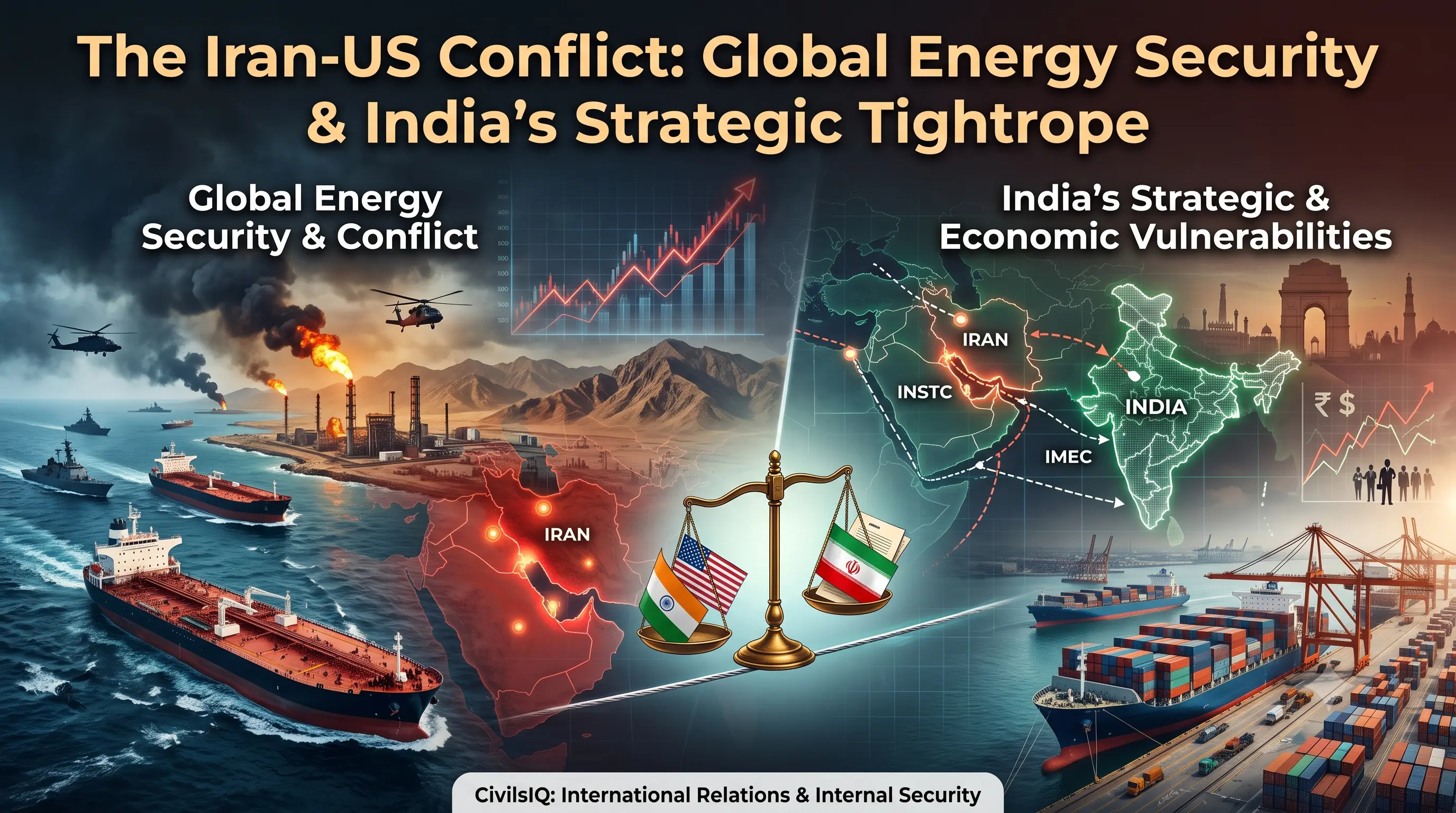
The escalating conflict between the US and Iran carries profound consequences for the global economy and geopolitics, vastly overshadowing similar tensions in nations like Venezuela. This article examines Iran's strategic importance in global energy, the 2026 crisis in the Strait of Hormuz, the drivers behind Iran's nuclear ambitions, and the widespread implications for India's economy, diaspora, and foreign policy.
Introduction
Context & Background
Key Points
- •Iran's Strategic Energy Dominance: Iran is a critical energy power, holding approximately 10% of global proven oil reserves (~1.2 trillion barrels) and 15% of global gas reserves. It historically produces 3.3–3.6 million barrels per day, servicing major markets in China, India, South Korea, and Japan.
- •The Strait of Hormuz Vulnerability: Serving as an energy lifeline, the Strait of Hormuz sees 18–20 million barrels of oil per day (20–27% of global maritime oil trade) and nearly 20% of global LNG trade. Recent 2026 conflicts and blockades have effectively halted traffic, drastically spiking global energy fear premiums.
- •Complex US Objectives: The US strategy revolves around containing Iran's nuclear and ballistic missile programs, curbing its support for regional proxy groups, and balancing diplomatic pressure with the need for energy market stability to avoid domestic inflation.
- •Drivers of Iran's Nuclear Ambitions: Tehran views its nuclear program as a security guarantee against hostile regional powers (like Israel and Saudi Arabia) and US military presence. It also serves as an ideological symbol of technological advancement and leadership in the Islamic world.
- •Global Destabilization and Multilateralism: Unilateral actions and bypassing the UN Security Council weaken multilateralism, offering authoritarian states a pretext to ignore international law. Furthermore, military strikes risk pushing Iran to accelerate its nuclear weaponization clandestinely.
- •India's Diplomatic Tightrope: India faces acute challenges, including balancing its strategic partnership with Iran against US ties, securing its diaspora in the Gulf, managing domestic inflation triggered by shipping blockades, and protecting strategic investments like Chabahar and INSTC.
Geopolitical Comparison: Why Iran Matters More Than Venezuela
| Strategic Aspect | Iran | Venezuela | Bookmark |
|---|---|---|---|
| Oil Quality & Extraction | Produces high-quality crude that is cheaper to extract and refine. | Produces heavier, harder-to-refine oil. | |
| Geographic & Strategic Location | Controls the Strait of Hormuz; highly integrated into Asian/European energy markets. | Located in the Western Hemisphere; less integrated into global maritime supply choke points. | |
| Regional Power Projection | Military reach spans the Persian Gulf; can destabilize Middle East security and threaten key maritime routes. | Interventions primarily affect Western Hemisphere dynamics with comparatively smaller global spillover. |
Impact of the US-Iran Conflict on India
| Sector | Vulnerability Level | Key Details / Data Points | Bookmark |
|---|---|---|---|
| Energy Security | High | 40-50% of India's energy imports transit the West Asian region; 54% of oil is sourced from here. | |
| Economic & Trade | High | West Asia accounts for over $170 billion in trade. Iran oil trade dropped significantly due to sanctions. | |
| Diaspora & Remittances | Critical | West Asia is the source of 40% of India's remittances; conflict threatens the safety and jobs of the Indian diaspora. | |
| Strategic Connectivity | Moderate to High | Escalations threaten investments in the Chabahar port project, INSTC, and the proposed IMEC corridor. |
Related Entities
Impact & Significance
- •Energy Crisis & Inflation: Blockades in the Strait of Hormuz threaten to severely disrupt global oil and LNG supplies, resulting in fear premiums that drastically inflate global fuel prices and shipping insurance costs.
- •Trade Disruption: Bilateral trade takes a direct hit due to sanctions and conflict. For instance, India's oil trade with Iran plummeted from $14 billion in 2017 to roughly $1.4 billion in recent years due to successive sanction regimes.
- •Diaspora Safety: The conflict directly endangers millions of Indian expatriates working in the Gulf region, risking mass evacuations and a steep decline in remittances (which form 40% of India's total).
- •Geopolitical Polarization: The U.S.-Iran conflict widens the rift between Western powers and nations advocating for diplomatic restraint, accelerating the formation of alternative geopolitical and economic blocs.
Challenges & Criticism
- •Unilateralism vs. International Law: The U.S. is heavily criticized for taking unilateral military and economic actions outside the purview of the UN Security Council, setting a dangerous precedent for other global powers.
- •Ineffectiveness of Military Strikes: Intelligence suggests that direct military interventions often fail to completely dismantle clandestine nuclear facilities, instead incentivizing Tehran to accelerate weaponization in secret.
- •Collateral Economic Damage: Comprehensive sanctions intended to cripple Iran's military supply chains simultaneously impoverish the civilian population and punish neutral third-party nations relying on Iranian energy.
- •Proxy Warfare: Iran's strategy of utilizing proxy groups across the Middle East complicates conflict resolution, as localized skirmishes constantly threaten to ignite a broader regional war.
Future Outlook
- •Diplomatic Negotiations: The world is closely watching ongoing negotiation frameworks, such as the April 2026 Islamabad talks, aiming to establish a lasting ceasefire and unhindered transit in the Strait of Hormuz.
- •Accelerated Supply Diversification: Major economies, including India and China, will likely expedite the diversification of their energy portfolios away from the volatile Persian Gulf to insulate themselves from future maritime blockades.
- •Redefining Strategic Corridors: Viability assessments for alternative trade routes like the India-Middle East-Europe Economic Corridor (IMEC) and the International North-South Transport Corridor (INSTC) will need urgent recalibration in light of the regional instability.
- •Sanctions and Economic Isolation: If diplomatic efforts fail, mechanisms like the US Treasury's 'Operation Economic Outcast' will further isolate Iran financially, likely deepening Tehran's reliance on non-Western alliances.
UPSC Relevance
- • GS-2 (International Relations): Bilateral, regional, and global groupings and agreements involving India and/or affecting India's interests.
- • GS-2 (Effect of Policies): Effect of policies and politics of developed and developing countries on India's interests, Indian diaspora.
- • GS-3 (Economy & Energy Security): Supply chain disruptions, inflation dynamics, and energy import dependency.
- • Mains Focus: Analyzing India's strategic balancing act in West Asia and the economic vulnerabilities exposed by maritime chokepoints.
Sample Questions
Prelims
Consider the following statements regarding the geopolitical significance of West Asia: 1. The Strait of Hormuz connects the Persian Gulf to the Red Sea. 2. Iran shares land borders with both Afghanistan and Pakistan. 3. The International North-South Transport Corridor (INSTC) aims to connect India to Russia via Iran. Which of the statements given above is/are correct?
1. 1 and 2 only
2. 2 and 3 only
3. 1 and 3 only
4. 1, 2, and 3
Answer: Option 2
Explanation: Statement 1 is incorrect: The Strait of Hormuz connects the Persian Gulf to the Gulf of Oman (and the Arabian Sea), not the Red Sea (which is accessed via the Bab el-Mandeb strait). Statements 2 and 3 are correct.
Mains
“The strategic importance of Iran in global geopolitics makes any conflict in the region a direct threat to India's economic and strategic interests.” Analyze this statement in the context of the recent US-Iran tensions and their impact on India.
Introduction: Briefly introduce the current US-Iran conflict and highlight Iran's strategic positioning (10% global oil reserves, control over the Strait of Hormuz).
Body:
• Global Significance: Explain why Iran matters (high-quality oil, proximity to Asian markets, capacity to project regional power vs. isolated nations like Venezuela). Discuss the threat to multilateralism and nuclear non-proliferation.
• Impact on India: Discuss vulnerabilities in Energy Security (40-50% imports through West Asia), Economic impact (inflation, increased shipping/insurance costs), Diaspora (remittances and safety), and Strategic Connectivity (Chabahar, INSTC, IMEC).
Conclusion: Conclude by emphasizing the need for India to maintain its strategic autonomy, diversify energy sources, and support multilateral diplomatic resolutions to ensure regional stability.