
Isobutanol–Diesel Blending: Opportunities and Challenges
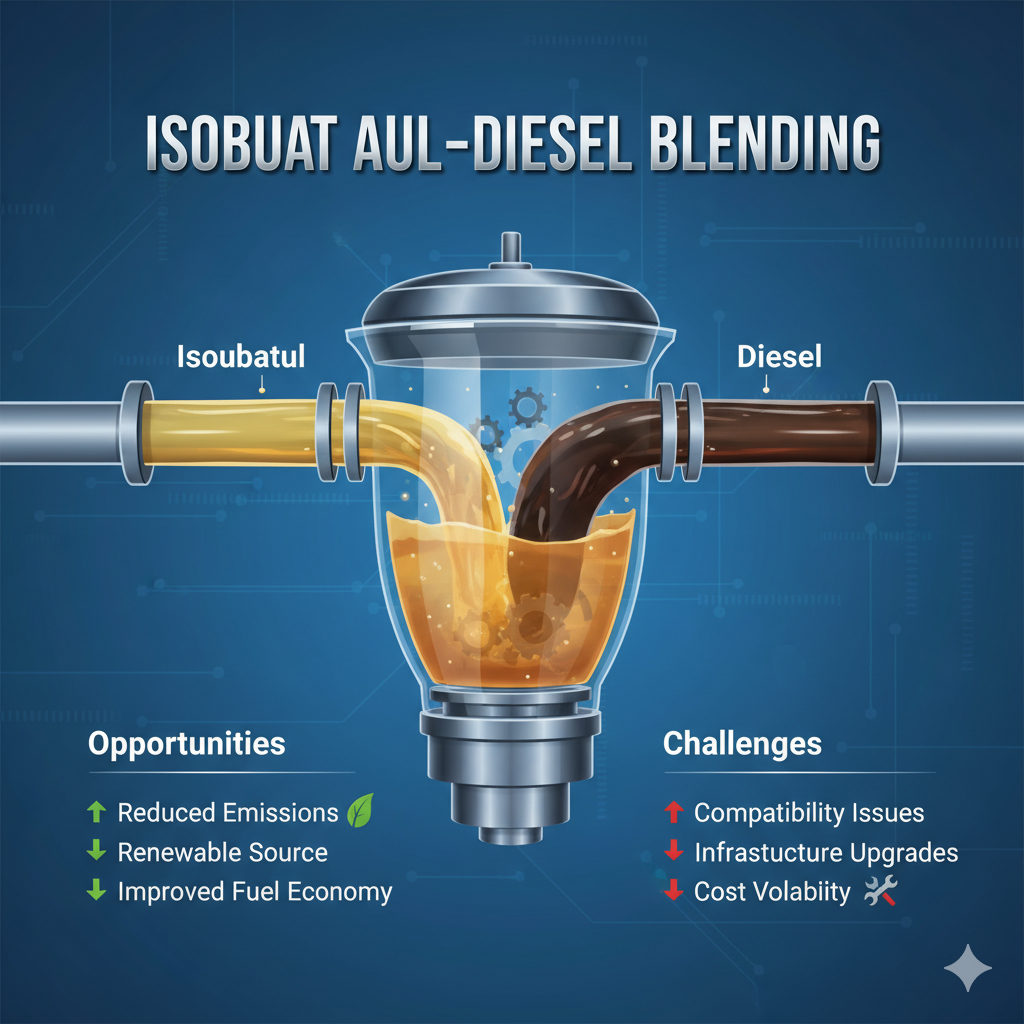
India is testing isobutanol as a diesel blending biofuel after ethanol–diesel trials failed. Isobutanol offers better miscibility and safety but faces combustion and cost challenges, shaping future biofuel diversification.
Introduction
India is piloting isobutanol–diesel blending as a new biofuel strategy after ethanol blending with diesel encountered performance and safety challenges. Isobutanol, a C4 bio-alcohol, may offer superior blending and storage stability, aligning with India's energy diversification and Net-Zero 2070 goals.
Context & Background
The Automotive Research Association of India (ARAI) has launched trials for isobutanol–diesel blending after unsuccessful ethanol-diesel trials. India already leads in ethanol blending with petrol (E20), but needs alternative biofuels for diesel, which remains the dominant transport and industrial fuel in India.
Key Points
- •Why ethanol failed for diesel — unsafe flash point, poor miscibility, higher corrosion risk, engine knocking, additives required.
- •Isobutanol advantages — higher flash point, lower water absorption, better miscibility, safer transport and storage.
- •Industrial relevance — diesel fuels heavy vehicles, generators, farm machinery; bio-diesel alternatives needed for deep decarbonisation.
- •Agricultural linkage — diversification option for surplus sugarcane and grain-based distilleries.
- •Energy security — reduced diesel imports aligns with Make in India + Atmanirbhar Bharat.
- •Biotechnology dimension — isobutanol can be bio-engineered using yeast and bacterial fermentation, enabling bio-refinery ecosystem growth.
- •Technical hurdle — significantly reduces cetane number (ignition quality), raising engine knock and performance issues.
- •Global context — US & EU exploring C4 alcohol biofuels; India aligning with advanced biofuel trends.
Related Entities
Impact & Significance
- •Energy diversification: Supports long-term biofuel mix beyond ethanol.
- •Rural income boost: Demand for agro-feedstocks and by-products.
- •Environmental gains: Potentially lower particulate and CO₂ emissions.
- •Industrial decarbonisation: Diesel-dependent sectors get cleaner alternatives.
Challenges & Criticism
- •Lower cetane number causes ignition delay and diesel knock.
- •Blending limit ~5–10% without additives to match diesel combustion quality.
- •Higher cost due to additives and limited production scale.
- •Infrastructure — need storage, refinery retrofitting, and standards.
- •Feedstock sustainability — sugarcane water use, food vs fuel debate.
Future Outlook
- •Pilot results will shape blending mandate and BIS fuel standards.
- •C4 alcohol research and biotech fermentation scale-up likely.
- •May complement biodiesel (B100) and SAF (Sustainable Aviation Fuel) pathways.
- •Potential role in agri-distillery circular economy & green hydrogen co-processing.
UPSC Relevance
- • GS-3: Bio-technology, Renewable energy, Environment
- • GS-2: Energy Policy, Atmanirbhar Bharat
- • Essay: Green energy transition, Sustainable agriculture
Sample Questions
Prelims
With reference to isobutanol as a biofuel, consider the following statements: 1) It has a higher flash point than ethanol. 2) It blends more easily with diesel than ethanol. 3) It increases the cetane number of diesel.
- (a)1 and 2 only
- (b)2 and 3 only
- (c)1 and 3 only
- (d)1, 2 and 3
Mains
Discuss the potential of isobutanol as a diesel blending biofuel in India. Highlight the technological, economic, and environmental challenges associated with its adoption.
Introduction:
Isobutanol, a C4 alcohol, is emerging as a promising biofuel alternative for diesel blending after ethanol faced limitations. It offers better storage, miscibility, and safety properties, supporting India's move toward cleaner fuels and energy self-reliance.
Body:
• Benefits:
- Higher flash point and safer handling
- Better miscibility than ethanol
- Support for surplus agricultural feedstock utilisation
- Lower emissions potential
- Strategic import reduction
• Technical challenges:
- Significant drop in cetane number → ignition delay
- Risk of diesel knock
- Blending limit of ~10% without additives
- Infrastructure & engine compatibility issues
• Economic & policy concerns:
- Higher cost due to additives and scaling constraints
- Competes with ethanol and sugarcane needs
- Need for BIS standards and blending mandates
• Way forward:
- Advanced biotech fermentation research
- Engine calibration + cetane boosters
- FPO-linked agri-feedstock supply chains
- Bio-refinery & circular economy integration
Conclusion:
Isobutanol represents a strategic next-generation biofuel option for diesel-dependent India. To unlock its potential, technology validation, commercial scaling, and regulatory alignment must converge with sustainable biomass utilisation and engine innovation.