
ISRO and the Next Big Challenge: Milestones, Constraints, and Commercialization
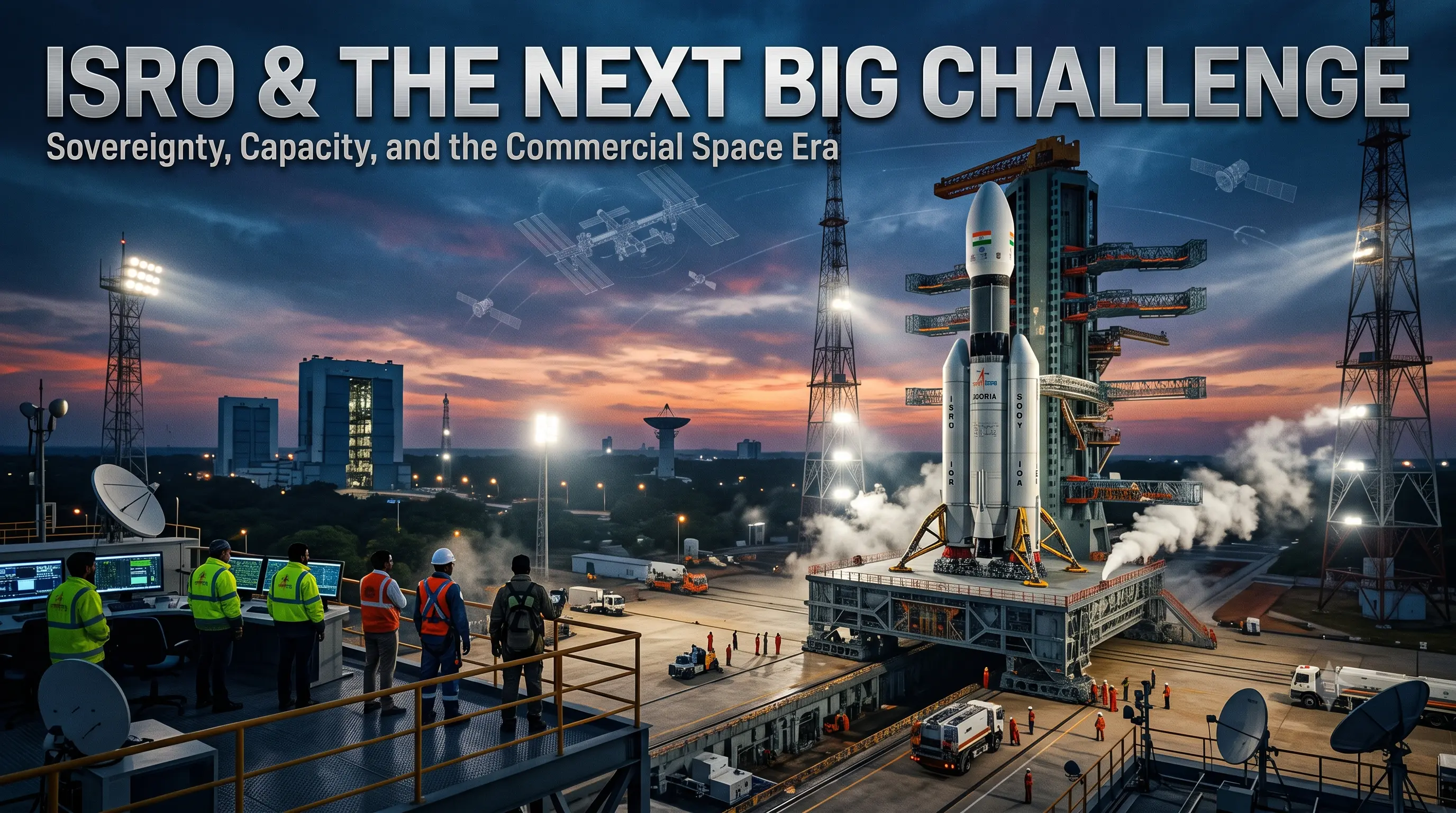
The Indian Space Research Organisation (ISRO) has achieved major milestones in lunar, solar, and Earth-observation missions while preparing for next-generation launch systems. However, as the space sector liberalizes, critical concerns are emerging around capacity constraints, infrastructure limitations, and governance clarity.
Introduction
Context & Background
Key Points
- •Capacity and Execution Constraints: ISRO's heavy focus on 'big-ticket' missions (like Gaganyaan and Chandrayaan-4) creates a 'Sovereignty Trap', delaying routine satellite replenishments and stalling private sector support. For instance, only 5 launches were managed in 2025 against a target of 8.
- •Infrastructure Deficit: India faces a severe lack of integration facilities, test stands, and supply-chain depth. Private firms like Skyroot and Agnikul rely heavily on ISRO infrastructure, meaning an ISRO mission delay cascades into an ecosystem-wide stall.
- •Governance and Legal Ambiguity: Under the 1972 UN Liability Convention, the Indian government remains liable for any private mission failure. Without a comprehensive National Space Law, private entities face massive insurance and liability uncertainties.
- •Competitiveness and Global Shifts: The global space sector is pivoting to high-frequency launches, partial reusability, and rapid satellite manufacturing. India's reliance on medium-lift vehicles (PSLV/GSLV) restricts its competitiveness in the heavy-lift market.
- •NGLV 'Soorya' Requirements: The Next-Generation Launch Vehicle demands large capital, advanced manufacturing, and deep industrial ecosystems which are still evolving, especially amidst a global cooling in private investments.
Recent Major Achievements and Future Missions
| Mission | Timeline | Objective / Achievement | Bookmark |
|---|---|---|---|
| Chandrayaan-3 | 2023 | Successful soft landing on the Moon, proving lunar-landing capability. | |
| Aditya-L1 | Jan 2024 | India's first solar observatory placed at the Sun-Earth L1 point. | |
| RLV-LEX-03 ('Pushpa') | June 2024 | Autonomous landing tests for reusable launch vehicles. | |
| SpaDeX | Dec 2024 | Space Docking demonstration for the Bharatiya Antariksh Station (BAS). | |
| NISAR | 2025 | NASA-ISRO joint Earth-observation mission for climate monitoring. | |
| Gaganyaan (Uncrewed) | By March 2026 | Uncrewed mission as part of the human spaceflight roadmap. |
Institutional Reforms and Frameworks
| Entity / Initiative | Role | Current Status / Impact | Bookmark |
|---|---|---|---|
| IN-SPACe | Regulator and promoter for private space sector activities. | Lacks formal statutory authority pending a Space Activities Bill. | |
| NewSpace India Limited (NSIL) | Commercial arm of ISRO. | Allows ISRO to offload commercial launches and focus on core R&D. | |
| VC & Technology Fund | Financial support bridging prototypes and scalable products. | ₹1,000-crore fund operationalized by IN-SPACe for 40 startups. |
Related Entities
Impact & Significance
- •Strategic Sovereignty: Advanced capabilities like the NGLV are vital for deploying heavier payloads, maintaining strategic communication assets, and ensuring independent human spaceflight.
- •Commercial Market Share: The inability to offer rapid, high-frequency, and heavy-lift launches limits India's share in the multi-billion dollar global commercial launch market.
- •Startup Viability: Without independent infrastructure, clear statutory backing, and deep-tech funding, innovative Indian space startups face a high risk of stagnation or failure.
- •Diplomatic Leverage: Continued success in deep-space missions and collaborations (like NASA-ISRO NISAR) strengthens India's soft power and geopolitical standing.
Challenges & Criticism
- •The 'Sovereignty Trap': Prioritizing high-profile national missions consumes ISRO's bandwidth, stalling routine and commercial operations.
- •Regulatory Blurring: Despite reforms, ISRO continues to act as a default regulator and certifier, leading to institutional overlap and confusion.
- •Technological Lag: Global leaders are mastering rapid reusability and heavy-lift capability, whereas India's NGLV is still in the developmental phase requiring immense capital.
- •Industrial Shallow Roots: The domestic supply chain for critical aerospace components (structures, avionics, propulsion) lacks the depth required to rapidly scale parallel to ISRO.
Future Outlook
- •NGLV (Soorya): Fast-tracking the Next-Generation Launch Vehicle, which targets a 30-tonne payload to Low Earth Orbit (LEO) featuring a reusable first stage.
- •Space Activities Bill: Enacting comprehensive legislation to give IN-SPACe clear statutory authority and resolve liability ambiguities for private enterprises.
- •Industrial Offloading: Shifting the end-to-production of established rockets like the PSLV to private consortiums (e.g., HAL-L&T), enabling ISRO scientists to focus exclusively on advanced R&D.
- •Fostering Startup Ecosystems: Deploying the ₹1,000-crore Venture Capital Fund effectively to support emerging startups and bridge the gap between initial prototypes and globally scalable products.
UPSC Relevance
- • GS-3 (Space Technology): Recent achievements of ISRO, indigenization of technology, and the role of the private sector in space exploration.
- • GS-2 (Governance): Regulatory frameworks (IN-SPACe, NSIL), necessity of a National Space Law, and international treaties like the UN Liability Convention.
- • Essay Topics: 'India's Space Odyssey: Balancing Sovereign Ambitions with Commercial Realities'.
- • Mains Focus: Analyzing the 'Sovereignty Trap', infrastructure bottlenecks, and the shift towards reusable launch vehicles (NGLV).
Sample Questions
Prelims
Consider the following statements regarding the Indian space sector: 1. IN-SPACe operates as the commercial arm of ISRO to handle routine satellite launches. 2. The Next-Generation Launch Vehicle (NGLV) 'Soorya' targets a 30-tonne payload to Low Earth Orbit (LEO) with a reusable first stage. 3. Under the 1972 UN Liability Convention, the government remains liable for damages caused by a private space mission.
1. 1 and 2 only
2. 2 and 3 only
3. 1 and 3 only
4. 1, 2, and 3
Answer: Option 2
Explanation: Statement 1 is incorrect: NSIL is the commercial arm of ISRO, while IN-SPACe acts as the regulator and promoter. Statements 2 and 3 are correct.
Mains
Despite remarkable milestones in planetary exploration, India's space sector faces systemic constraints in transitioning to a liberalized, commercially competitive ecosystem. Analyze these challenges and suggest measures to overcome them.
Introduction: Highlight ISRO's recent successes (Chandrayaan-3, Aditya-L1) and the strategic intent behind the 2020 space sector reforms. Define the transition from a purely state-led model to a liberalized space economy.
Body:
• Systemic Challenges: The 'Sovereignty Trap' leading to launch delays; over-reliance of private startups on limited ISRO testing infrastructure; regulatory overlap between ISRO, IN-SPACe, and NSIL.
• Global and Legal Hurdles: Absence of a National Space Law creates liability concerns under the UN Liability Convention; inability to compete with global heavy-lift and rapid-reusability trends using legacy PSLV/GSLV rockets.
• Measures/Way Forward: Expediting the Space Activities Bill; heavy investment in NGLV (Soorya); massive industrial offloading to HAL-L&T consortiums; optimizing the ₹1,000-crore VC Fund for deep-tech scaling.
Conclusion: Conclude by emphasizing that moving from a state-monopoly to an industry-driven ecosystem is critical for India to capture a larger share of the global space economy while securing its strategic autonomy.