
Judicial Gender Gap: Why India’s Courts Need More Women?
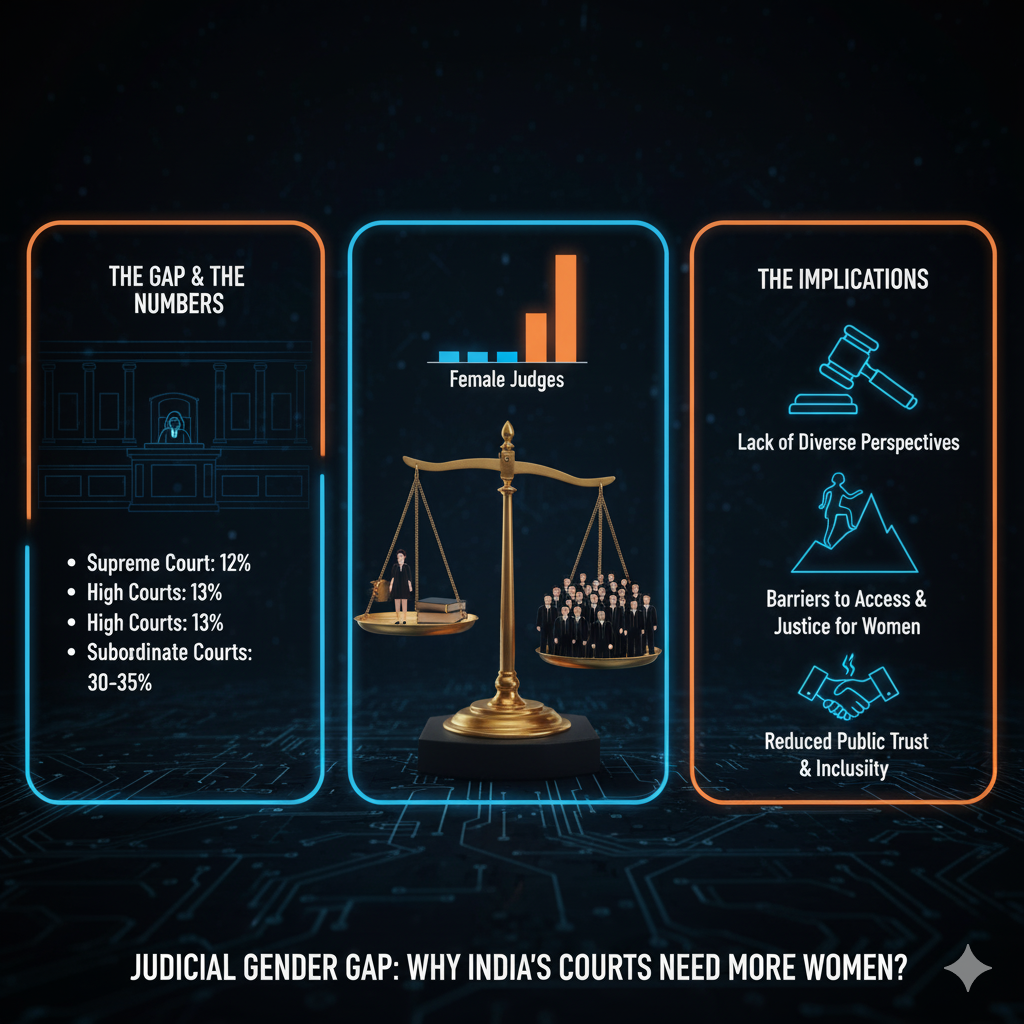
With only 1 woman judge in the Supreme Court and ~13% in High Courts, India's judiciary reflects deep gender imbalance, raising questions on constitutional morality, access to justice, diversity, and judicial legitimacy.
Introduction
India’s judiciary — a guardian of constitutional morality and gender justice — significantly lacks women. The retirement of Justice Sudhanshu Dhulia in August 2025 left only one woman judge in the Supreme Court, reigniting debate on judicial diversity, legitimacy, and inclusivity.
Context & Background
Since 1950, only 11 women out of 287 judges have been appointed to the Supreme Court. Women constitute just 13% of High Court judges and ~15% of advocates, reflecting structural and societal barriers.
Key Points
- •Constitutional Mandate of Equality: Articles 14, 15, 16 & 39A demand equal opportunity & gender-just institutions; judiciary itself must reflect constitutional values.
- •Judicial Legitimacy & Public Trust: A judiciary lacking gender diversity risks perception of bias → affects institutional credibility.
- •Diversity Enhances Reasoning: Women judges bring lived experiences, improving adjudication in gender-justice, family law, harassment & violence cases.
- •Substantive vs Formal Equality: Proof that gender-neutral appointment processes produce gender-skewed outcomes → need substantive affirmative action.
- •Glass Ceiling in Judiciary: Although 50%+ in lower judiciary in some states, women rarely rise to higher courts → structural career bottleneck.
- •Comparative Constitutionalism: Many democracies mandate judicial diversity (Canada, UK, South Africa). India lacks such institutional compulsion.
- •Collegium Opaqueness: Absence of transparent criteria → unconscious biases, old-boys network, and informal gatekeeping culture.
- •Work-Family Penalty: Rigid schedules & career breaks create professional attrition → no institutional support (crèches, flexible chambers, safety).
- •Feminist Jurisprudence Gap: Low representation weakens evolution of gender-sensitive constitutional doctrine (e.g., workplace dignity, marital rape).
- •Diversity as Judicial Reform: Strengthens justice delivery, deliberative quality, female litigant confidence & judicial empathy.
- •Ethics & Constitutional Morality: Structural exclusion contradicts Ambedkar’s vision of social & political democracy.
- •Pipeline Problem: Low senior advocate titles → small pool for elevation → need systemic nurturing.
- •Executive-Judiciary Coordination: Centre must prioritise gender appointments as part of judicial reforms & ease of justice mission.
Related Entities
Impact & Significance
- •Enhances trust in rule of law & mirrors society's diversity
- •Improves gender-justice outcomes (sexual violence, custody, property, service matters)
- •Nurtures future talent pipeline in legal profession
- •Aligns India with global democratic norms
Challenges & Criticism
- •Opaque collegium system, no diversity mandate
- •Bias against women litigators seeking senior designation
- •Institutional hostility, harassment & sexism at Bar
- •Career-family conflict without support infrastructure
- •Lack of data-driven diversity tracking & annual gender audits
Future Outlook
- •Multi-tier reforms in Bar → Bench → Collegium pipeline
- •Statutory diversity guidelines or judicial charter on representation
- •Institutional reforms for childcare, safety, and flexible legal practice
- •Mandatory gender-sensitivity training for judges & lawyers
- •Parliamentary oversight on judicial diversity metrics
UPSC Relevance
- • GS-2: Judiciary, Separation of Powers, Constitutional Values
- • GS-4: Ethical Leadership, Gender sensitivity, Accountability
- • Essay: Women in public institutions, Gender Justice
- • PSIR Optional: Political Representation & Democratic Deepening
Sample Questions
Prelims
Consider the following statements regarding women in the Indian judiciary:
- (a)Since 1950, fewer than 15 women have served as judges in the Supreme Court.
- (b)The Collegium system formally mandates gender diversity in appointments.
- (c)Women constitute less than 15% of judges in High Courts.
Mains
Despite constitutional guarantees of equality, the participation of women in India’s higher judiciary remains low. Discuss the causes and suggest reforms.
Introduction: Women form barely 4% of Supreme Court judges historically. Such under-representation undermines constitutional morality & judicial legitimacy.
Body:
• Causes: Collegium opacity, gendered career attrition, patriarchal Bar culture, eligibility bottlenecks, lack of support systems.
• Consequences: Weakened gender justice, reduced trust, democratic deficit, judicial blindness to social realities.
• Reforms: Transparent appointment norms, diversity charter, gender quotas, senior-designation reforms, infrastructure support, gender training.
Conclusion: A gender-balanced judiciary is not benevolence but constitutional duty — critical to India’s march toward substantive equality, justice & democratic legitimacy.