
Judicial Scrutiny of Artificial Intelligence in Legal Drafting
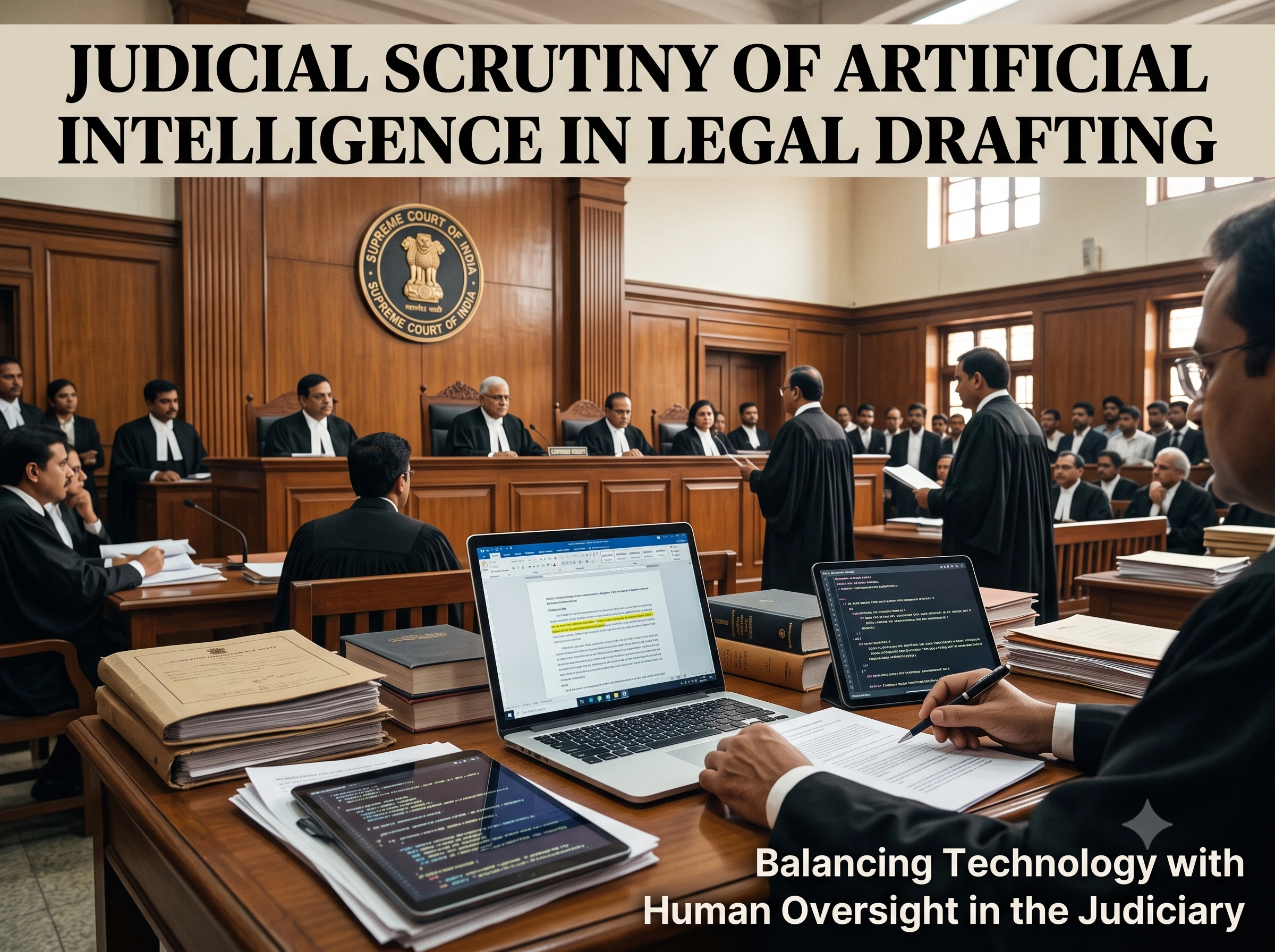
The Supreme Court of India has flagged emerging risks associated with the use of Artificial Intelligence (AI) in legal drafting. While AI offers significant advantages in reducing case pendency, translating judgments via tools like SUVAS, and improving efficiency, concerns regarding AI hallucinations, algorithmic bias, and the erosion of human judicial oversight necessitate careful, supportive integration rather than substitution.
Introduction
Context & Background
Key Points
- •Reducing Pendency and Delays: AI-enabled systems support case listing, prioritization, scheduling, and progress tracking, minimizing systemic delays.
- •Enhancing Inclusivity: Tools like the Supreme Court’s SUVAS break down linguistic barriers, translating complex legal documents into regional Indian languages.
- •Strengthening Legal Research: AI can rapidly scan massive volumes of statutes and judicial precedents to assist lawyers and judges in case preparation.
- •Predictive Analytics as an Advisory Tool: AI can evaluate past judgments to offer indicative insights on case outcomes, provided it does not substitute judicial discretion.
- •Global Precedents of Efficiency: AI is actively being utilized globally, from automating appeal examinations in Brazil to accelerating document processing in Greece.
Global Examples of AI Integration in the Judiciary
| Country / Institution | AI Application | Purpose / Benefit | Bookmark |
|---|---|---|---|
| India (Supreme Court) | SUVAS (Vidhik Anuvaad Software) | Translates judgments and legal documents into multiple Indian languages to widen public access. | |
| Brazil | AI Preliminary Examination System | Automates the preliminary examination of appeals for the Supreme Court. | |
| Greece | AI Document Processing | Accelerates case handling and reduces judicial delays. |
Key AI Capabilities in the Legal System
| Domain | Function | Impact | Bookmark |
|---|---|---|---|
| Case Management | Prioritization and scheduling of cases. | Helps courts deploy resources efficiently. | |
| Predictive Analytics | Examining trends in past judgments. | Promotes consistency in legal reasoning (remains advisory). | |
| Transparency | AI-driven dashboards (e-Courts). | Enhances visibility of court processes and accountability. |
Related Entities
Impact & Significance
- •Efficiency in Administration: Automating routine tasks and generating transcripts frees up valuable judicial time.
- •Democratization of Law: By translating complex English judgments into vernacular languages, the judiciary becomes far more accessible to the common citizen.
- •Enhanced Public Trust: Digitization and tracking dashboards make the inherently complex legal system more transparent to litigants.
Challenges & Criticism
- •Fabricated Outputs (Hallucinations): AI may invent plausible-sounding but entirely fake case laws and precedents, severely compromising court proceedings.
- •Discriminatory Algorithms: If trained on historical data containing societal prejudices, AI could inadvertently recommend biased outcomes.
- •Opacity (Black-Box Problem): The lack of transparency in how AI arrives at a conclusion makes it difficult to challenge or explain algorithmic insights.
- •Erosion of Judicial Accuracy: Over-reliance on AI for core drafting degrades the strict standards of accuracy required in formal legal representations.
Future Outlook
- •Ensuring Human Oversight: Technology must remain a supportive tool. The core of adjudication must continue to rest on human judgment and contextual understanding.
- •Developing Algorithmic Transparency: Frameworks must be established to decode 'black-box' algorithms, ensuring decisions and legal guidance remain explainable.
- •Mitigating Bias in Training Data: Future AI tools deployed in the judiciary need strict auditing to ensure they do not reinforce existing social or institutional biases.
UPSC Relevance
- • GS-II (Polity & Governance): Judiciary, e-Governance applications, models, successes, limitations, and potential.
- • GS-III (Science & Technology): Developments in Artificial Intelligence and their real-world applications/implications.
- • Essay Topics: 'Technology in the courtroom: Enabler or Disruptor?', 'The ethical dimensions of Artificial Intelligence in governance.'
Sample Questions
Prelims
Consider the following statements regarding the use of Artificial Intelligence in the Indian Judiciary:
1. SUVAS is an AI-enabled translation software launched by the Supreme Court of India.
2. Predictive analytics in the Indian judiciary is currently used to issue binding automated judgments for petty crimes.
3. The integration of AI in courts operates independently of human oversight to ensure complete neutrality.
Answer: Option 1
Explanation: Statement 1 is correct. Statement 2 is incorrect; predictive analytics is strictly advisory and does not substitute judicial discretion to issue binding judgments. Statement 3 is incorrect; the Supreme Court has stressed the necessity of constant human oversight.
Mains
“While Artificial Intelligence presents an opportunity to address the chronic pendency in the Indian judicial system, its unchecked integration poses significant ethical and institutional risks.” Analyze this statement in the context of recent observations by the Supreme Court.
Introduction: Introduce the context of the Supreme Court's recent cautions regarding AI in legal drafting. Briefly define the dual nature of AI in law.
Body:
• Opportunities (Significance): Efficient case management; Enhanced access to justice via translation (SUVAS); Expedited legal research and transparent e-Courts dashboards.
• Risks (Concerns): Threat of AI 'hallucinations' leading to fabricated precedents (e.g., UK instance); Algorithmic biases eroding equality; Opacity in decision-making.
• Way Forward: Mandating human-in-the-loop oversight; developing ethical AI guidelines for legal practitioners; preventing the substitution of human judicial discretion.
Conclusion: Conclude that AI should remain a sophisticated administrative assistant rather than a judicial substitute, ensuring the sacrosanct nature of human legal reasoning is preserved.