
Ladakh’s Quest for Statehood and Sixth Schedule Status
Protests in Ladakh demanding full statehood and Sixth Schedule status turned violent, raising concerns over federalism, tribal rights, ecological security, and strategic governance along India's Tibet & Pakistan borders.
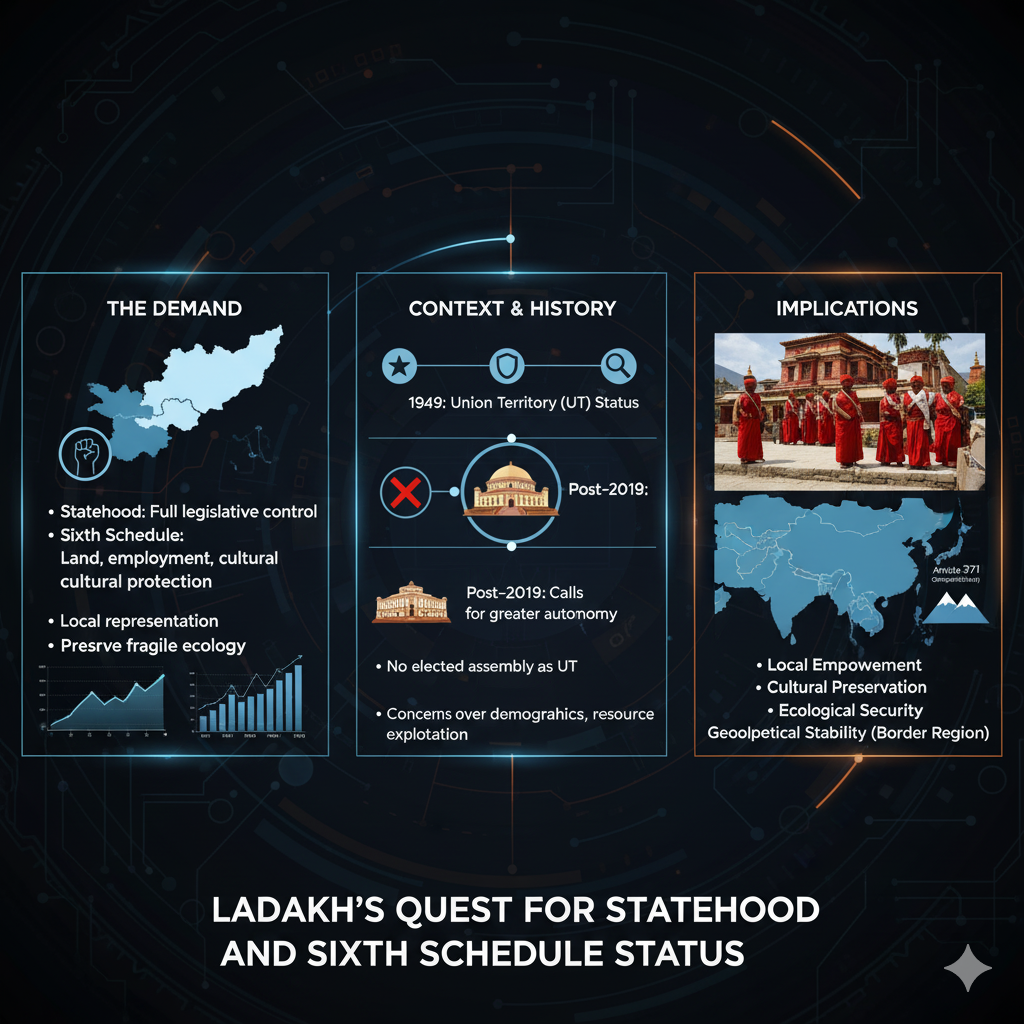
Introduction
Ladakh’s demand for statehood and Sixth Schedule autonomy reflects debates on asymmetric federalism, tribal self-governance, environmental protection, strategic frontier administration, and democratic decentralisation in India’s border regions.
Context & Background
After J&K’s reorganisation in 2019, Ladakh became a UT without legislature, concentrating powers in the LG under Article 240. In 2025, protests intensified over fears of demographic change, land alienation, unemployment, and cultural erosion.
Key Points
- •Asymmetric Federalism Case Study: Demand reflects India's multi-layered federalism (Art. 370 history, 5th & 6th Schedules, UTs, Autonomous Councils).
- •Constitutional Power Vacuum: UT without legislature has limited law-making & fiscal autonomy → governance through LG & bureaucracy.
- •Article 240 Issue: Laws for Ladakh currently via Presidential regulation → weak democratic legitimacy & participation.
- •Tribal Safeguards: 97% ST population → strong case for cultural autonomy & land protection under Sixth Schedule framework.
- •Environmental Constitutionalism: Fragile Himalayan zone → calls for local environmental veto powers, zoning, community-led tourism.
- •Strategic Border Governance: Proximity to China (LAC) & Pakistan (Siachen) → need a governance model balancing decentralisation & strategic command.
- •Civil-Military Balancing: Full statehood raises coordination questions between elected govt & armed forces in active conflict theatre.
- •Decentralised Development Need: Tailored policies for glacial water security, solar energy, nomadic pastoralism (Changpa), high-altitude agriculture.
- •Administrative Innovation: Proposal for hybrid model: statehood-lite + empowered Hill Councils + security carve-outs.
- •Dissent & Rule of Law: NSA use during protests raises civil liberties concerns → need humane protest management.
- •Youth Employment Imperative: 26.5% graduate unemployment → demand for Ladakh Public Service Commission (LPSC).
- •Identity Politics Dimension: Bhoti language recognition + monastery land rights + tribal customary laws.
- •NCST Support: Sixth Schedule recommended based on tribal majority & vulnerability.
- •Precedent Fear: Granting Sixth Schedule may trigger similar demands in Himachal, Uttarakhand tribal belts.
Related Entities
Impact & Significance
- •Federal Balance: Tests Union’s commitment to cooperative & competitive federalism.
- •Strategic Stakes: Stability in frontline Himalayan theatre crucial for national security.
- •Environmental Resilience: Landslides, glacial melt, climate-fragility → need ecological governance autonomy.
- •Social Cohesion: Prevent alienation; maintain trust with Buddhist & Shia communities.
Challenges & Criticism
- •Security Risks: Strategic border zone may require centralised command.
- •Legal Complexity: Sixth Schedule expansion needs constitutional amendment.
- •Administrative Delay: Local councils may struggle with capacity & coordination.
- •Economic Constraints: Land restrictions may deter infra & private investment.
Future Outlook
- •Hybrid autonomy model (like Bodoland/Meghalaya) with national security carve-outs.
- •Unlock green finance, glacier protection laws, sustainable tourism charter.
- •Establish Ladakh PSC to absorb educated youth.
- •Institutionalised tripartite dialogue: Centre–Leh–Kargil.
- •Community resource rights on pastures, water, monasteries, glaciers.
UPSC Relevance
- • GS-2: Federalism, UTs, Tribal Administration, Local Governance
- • GS-3: Environment, Border Management, Disaster Vulnerability
- • Essay: Identity vs Development; Federalism; Borderlands Governance
- • Ethics: Tribal rights, cultural justice, administrative accountability
Sample Questions
Prelims
With reference to Ladakh’s political status, consider the following:
- (a)Ladakh is governed under Article 240 of the Constitution.
- (b)Ladakh currently enjoys Sixth Schedule protections.
- (c)The NCST has recommended extending the Sixth Schedule to Ladakh.
Mains
Ladakh’s demand for statehood and Sixth Schedule status reflects the challenge of balancing strategic security with autonomous governance. Examine.
Introduction: Ladakh’s agitation reflects tensions between frontier security, tribal rights, and democratic autonomy.
Body:
• Drivers: land protection, identity, unemployment, ecological fragility, democratic deficit.
• Challenges: security coordination, legal amendment, administrative capacity.
• Way forward: hybrid model, empowered LAHDCs, PSC, environmental safeguards.
Conclusion: A calibrated devolution model can reconcile national security with local aspirations & ecological justice.