
Land Acquisition: A Major Hurdle in India’s Infrastructure Development
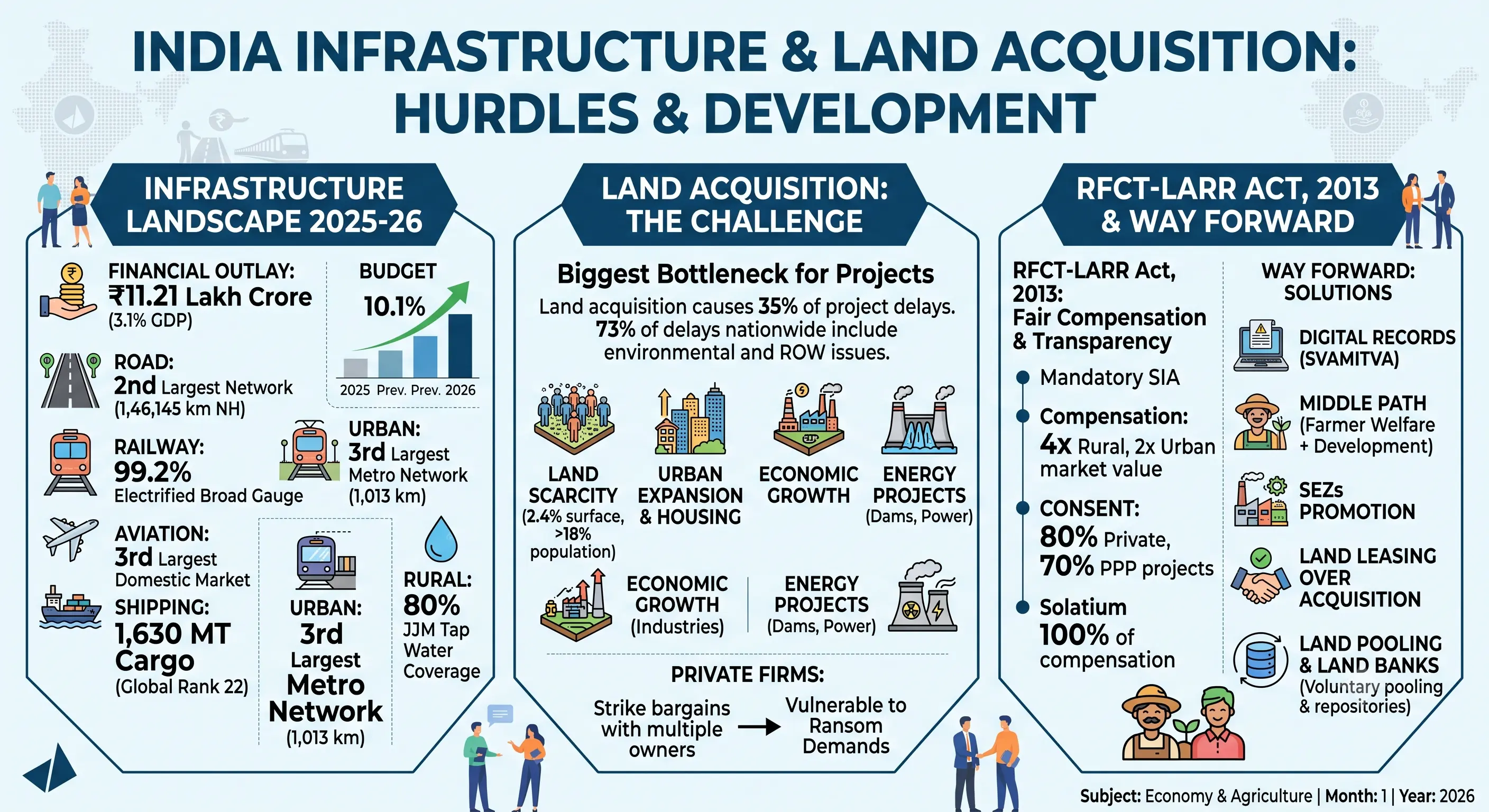
Land acquisition has emerged as the biggest bottleneck in India's infrastructure projects, causing 35% of nationwide project delays. Despite massive budgetary allocations for capital investment, overlapping jurisdictions, social protests, and complex consent norms continue to impede the pace of urban and rural development.
Introduction
Context & Background
Key Points
- •Eminent Domain vs. Land Deprivation: The state has the power to acquire private property against the owner's consent for a 'public purpose' (Eminent Domain). However, this directly conflicts with India's social structure, where land ownership is a core source of wealth, power, and social status.
- •Resource Scarcity: India holds only 2.4% of the global land surface but hosts over 18% of the world's population, making land an inherently scarce and highly contested resource.
- •Urbanization Pressures: By 2050, India is projected to have 850-900 million people living in urban spaces, making large-scale land acquisition crucial for housing, expansion, and essential utilities.
- •Overlapping Jurisdictions: While 'Land' is inherently a State subject, the 'acquisition and requisitioning of property' falls under the Concurrent List, leading to overlapping laws and administrative friction.
- •Private Sector Vulnerability: Private firms lack institutional support for land aggregation and must strike bargains directly with multiple owners, exposing them to ransom demands and project paralysis.
Landscape of Infrastructure Development in India
| Sector | Status / Achievement | Significance | Bookmark |
|---|---|---|---|
| Financial Outlay | ₹11.21 lakh crore (3.1% of GDP) | Record allocation for capital investment in 2025-26 Budget. | |
| Roadways | 1,46,145 km (National Highways) | India holds the 2nd-largest road network globally (2024). | |
| Railways | 99.2% Electrified | Broad Gauge network almost fully electrified by 2025. | |
| Aviation | 3rd Largest Market | Ranked right behind the United States and China. | |
| Shipping | 1,630 MT Cargo | India improved to 22nd globally under Sagarmala 2.0. | |
| Urban Infrastructure | 1,013 km Metro Network | 3rd-largest operational metro network across 23 cities. |
Key Provisions of the RFCT-LARR Act, 2013
| Provision | Purpose | Mandate | Bookmark |
|---|---|---|---|
| Consent Norms | Mandatory approval required from affected families. | 80% for private projects; 70% for PPP projects. | |
| Compensation Rule | Monetary payout for acquired land. | 4 times market rate in rural areas; 2 times in urban areas. | |
| Social Impact Assessment (SIA) | Evaluation of livelihood and community impact. | Mandatory for every project prior to acquisition. | |
| Solatium | Additional compensation for involuntary acquisition. | Equal to 100% of the compensation amount. |
Related Entities
Impact & Significance
- •Economic Stagnation: With land issues contributing to over a third of project delays, vast amounts of capital investment are blocked, slowing down the nation's GDP growth and capital expenditure multipliers.
- •Escalating Project Costs: Prolonged negotiations, litigation, and ransom demands significantly inflate the final cost of infrastructure projects.
- •Social Disruption: Forced or poorly compensated acquisitions trigger massive social disorder, agitations, and violence, alienating local populations from the state's development agenda.
Challenges & Criticism
- •Ambiguity of 'Public Purpose': The state's power of Eminent Domain allows it to acquire land for a 'public purpose', but the term remains legally vague and is often perceived as being misused to benefit private corporations.
- •Political Exploitation: Land acquisition is frequently politicized, turning local development issues into large-scale ideological battles between capitalism and communism.
- •Administrative Friction: The concurrent nature of property requisition laws means that State governments and the Central government frequently clash over regulatory procedures, delaying clearances.
Future Outlook
- •Digitalisation of Records: Modernization of land records through initiatives like the SVAMITVA scheme to eliminate title disputes and streamline acquisition.
- •Promoting Land Pooling: Encouraging voluntary land pooling, where landowners give land to the government for development and receive a portion of the developed land back.
- •Creating Land Banks: Establishing comprehensive land banks—a repository of industrial infrastructure information—to serve as a decision support system for investors.
- •Leasing Over Acquisition: Shifting to land leasing models to ensure sustainable project development, allowing land to return to owners at the end of the lease period.
- •Expansion of SEZs: Promoting Special Economic Zones (SEZs) to help private firms bypass the severe challenges of bulk land acquisition.
UPSC Relevance
- • GS-3 (Indian Economy): Infrastructure development (Energy, Ports, Roads, Airports, Railways), Land reforms in India.
- • GS-2 (Governance): Functions and responsibilities of the Union and the States, issues and challenges pertaining to the federal structure (Concurrent List overlaps).
- • Essay Topics: 'Development vs. Displacement: The Indian Conundrum', 'Infrastructure as the Engine of Economic Growth'.
- • Mains Focus: Analyzing the limitations of the LARR Act 2013 and evaluating alternatives like land pooling and leasing.
Sample Questions
Prelims
Consider the following statements regarding Land Acquisition in India:
1. The RFCT-LARR Act 2013 mandates the consent of 100% of affected families for Public-Private Partnership (PPP) projects.
2. Land acquisition and requisitioning of property is listed under the State List of the Seventh Schedule.
3. Landowners in rural areas are entitled to compensation up to four times the market value under the LARR Act 2013.
4. A Social Impact Assessment (SIA) is only required for projects involving defense infrastructure.
Answer: Option 3
Explanation: Statement 1 is incorrect; 70% consent is required for PPP projects (80% for private). Statement 2 is incorrect; it is in the Concurrent List. Statement 4 is incorrect; SIA is mandatory for every project. Statement 3 is correct.
Mains
“Despite robust financial outlays, land acquisition remains the Achilles' heel of India's infrastructure development.” Analyze the challenges associated with land acquisition in India and suggest viable alternatives to overcome them.
Introduction: Define the context using PRAGATI data (35% delays due to land acquisition). Mention the foundational law: RFCT-LARR Act, 2013.
Body:
• Core Challenges: Misuse of 'eminent domain' and vague 'public purpose' clauses; overlapping jurisdiction (State vs. Concurrent List); vulnerability of private firms to ransom demands; and deep-rooted socio-ideological ties to land.
• Impact on Projects: 73% of delays are linked to land and environmental clearances, leading to massive cost overruns and stalling urbanization and energy projects.
• Viable Alternatives (Way Forward): Implementation of land pooling and land banks; emphasizing land leasing rather than permanent acquisition; leveraging digital systems (SVAMITVA); and promoting SEZs.
Conclusion: Conclude that taking the 'middle path' is essential—harmonizing farmer welfare and rehabilitation with the country's strategic infrastructural demands to ensure the Ease of Doing Business.