
Maharashtra’s Muslim Quota: Policy, Constitutionality, and Recent Revocation
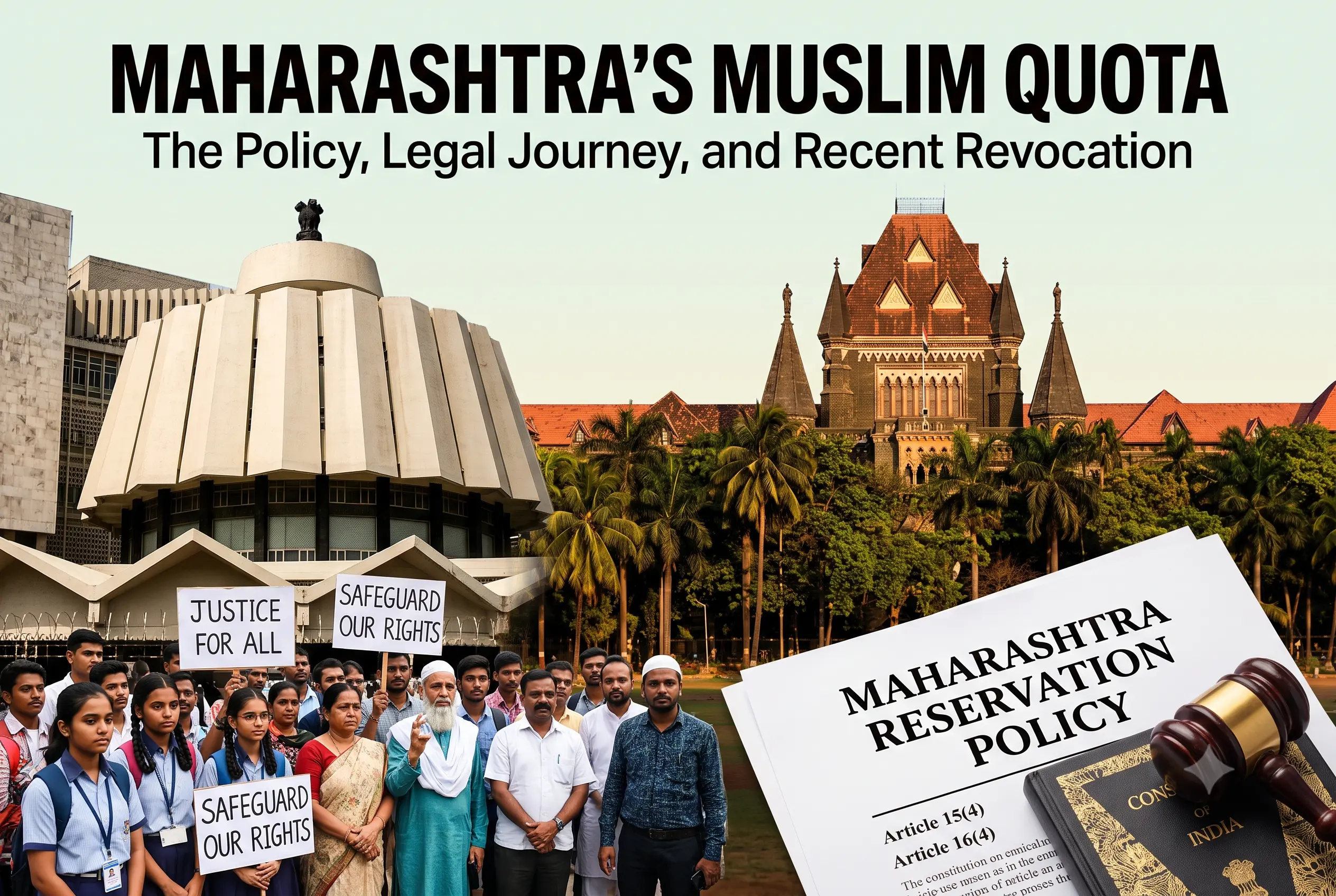
The recent withdrawal of the last administrative traces of Maharashtra’s 2014 Muslim reservation policy in February 2026 has revived discussions on the legal journey of affirmative action for Muslims. This article examines the socio-economic indicators of Muslims in India, the constitutional framework governing minority reservations, key committee findings, and the judicial stance on religion-based quotas.
Introduction
Context & Background
Key Points
- •Population Context: According to the 2011 Census, Muslims account for 14.2% of India's population. Uttar Pradesh has the largest absolute numbers, while Jammu & Kashmir records the highest percentage.
- •Maharashtra's 2014 Policy: Rooted in empirical findings by the Sachar Committee and the Mehmood-ur-Rehman study group, the state introduced a 5% reservation in education for 50 identified Muslim sub-castes under Special Backward Category A.
- •Legal and Judicial Scrutiny: The combined reservations (including Maratha quota) pushed Maharashtra's total quota to 68%, crossing the judicially mandated 50% ceiling. Courts have consistently ruled that religion cannot be the sole basis for affirmative action.
- •February 2026 Revocation: In February 2026, the Mahayuti government formally cancelled the 5% Muslim quota, citing constitutional limits and the fact that the original 2014 ordinance had already lapsed.
- •Identification of SEBCs: Classification must be based on social, educational, and economic backwardness (e.g., low literacy, limited social mobility, poverty), rather than just religious identity.
Constitutional Framework for Reservation
| Article | Provision | Significance | Bookmark |
|---|---|---|---|
| Article 15(4) | Empowers the State to introduce special measures for socially and educationally backward classes (SEBCs). | Constitutional foundation for reservations in educational institutions. | |
| Article 16(4) | Permits State reservation in public employment for inadequately represented backward classes. | Enables employment-based affirmative action. | |
| Article 340 | Authorises the President to appoint a commission to examine backward classes. | Led to the creation of the Kaka Kalelkar and Mandal Commissions. | |
| Article 342A | Empowers the President to notify SEBCs for each State/UT. | Maintains a Central List of SEBCs. |
Major Committees on Muslim Backwardness
| Committee | Key Findings | Major Recommendations | Bookmark |
|---|---|---|---|
| Sachar Committee (2006) | Highlighted low Muslim literacy, high school dropouts, and roughly 5% representation in government jobs. | Expand schooling, improve credit access, and strengthen minority region infrastructure. | |
| Ranganath Mishra Commission (2007) | Found Muslim groups comparable to or worse than SCs/STs; widespread poverty and limited government representation. | Recommended 10% reservation for Muslims under OBC framework and SC status for Dalit Muslims. |
Related Entities
Impact & Significance
- •Administrative Impact: The official revocation stops the issuance of Special Backward Category-A (SBC-A) caste and validity certificates for Muslims in Maharashtra.
- •Judicial Affirmation: Reinforces the constitutional principle and judicial precedents that affirmative action must strictly follow objective criteria of social and educational backwardness.
- •Policy Shift: Encourages governments to explore alternative welfare strategies, such as the PM's New 15-Point Programme, rather than relying on contentious quota politics.
Challenges & Criticism
- •Constitutional Constraints: The Indian Constitution does not recognise religious communities as backward per se; backwardness must be demonstrated through socio-economic indicators.
- •Internal Diversity: The Muslim community is socially heterogeneous, comprising numerous biradari groups with varying levels of disadvantage. A uniform quota risks misallocation of benefits.
- •Political Polarization: Religion-based quotas often spark intense political debate and accusations of appeasement, overshadowing genuine efforts at social justice.
Future Outlook
- •Targeted Infrastructure Development: Shifting focus to a spatial approach that improves schools, healthcare, and roads in Muslim-concentrated localities.
- •Educational and Economic Support: Expanding scholarships, self-employment programs, and skill development for economically weaker sections within the community.
- •Effective Implementation of Schemes: Better delivery of existing initiatives like the Pre-Matric/Post-Matric scholarships and Maulana Azad Education Foundation fellowships.
- •PM’s New 15-Point Programme: Expanding access to education, formal employment, and institutional credit for minority communities.
UPSC Relevance
- • GS-2 (Social Justice & Constitution): Welfare schemes for vulnerable sections, mechanisms, laws, and institutions constituted for the protection and betterment of these sections.
- • GS-2 (Polity): Significant provisions of the Constitution regarding reservation (Articles 15, 16, 340, 342A).
- • Essay Topics: Affirmative action vs. meritocracy; Social empowerment of minorities in India.
Sample Questions
Prelims
Consider the following statements regarding the framework for reservations and minority welfare in India:
1. Article 15(4) of the Constitution explicitly allows for reservations based solely on religion.
2. The 102nd Constitutional Amendment Act introduced Article 342A, empowering the President to notify SEBCs.
3. The Sachar Committee recommended 10% reservation for Muslims under the OBC framework.
Answer: Option 2
Explanation: Statement 1 is incorrect; reservations cannot be based solely on religion. Statement 3 is incorrect; it was the Ranganath Mishra Commission that recommended a 10% reservation under the OBC framework, not the Sachar Committee. Statement 2 is correct.
Mains
Analyse the constitutional and legal challenges in providing religion-based reservations in India, with special reference to the Maharashtra Muslim quota issue.
Introduction: Briefly introduce the context of Maharashtra's 2014 5% Muslim quota and its recent revocation. Mention the overarching constitutional philosophy of secularism and equality.
Body:
• Constitutional Framework: Discuss Articles 15(4) and 16(4) which emphasize 'socially and educationally backward classes' rather than religious communities.
• Judicial Precedents: Cite Indra Sawhney (1992) ruling that religion alone cannot be the criterion for backwardness, and the 50% ceiling on quotas.
• Challenges: Internal diversity among Muslims (various biradaris), political complexities, and the risk of over-inclusion or exclusion.
Conclusion: Conclude by emphasizing the need for targeted socio-economic development, scholarships, and infrastructure building in minority-concentrated areas as viable alternatives to blanket reservations.