
Ministry of Culture: Year-End Review 2025 and Key Personalities in News
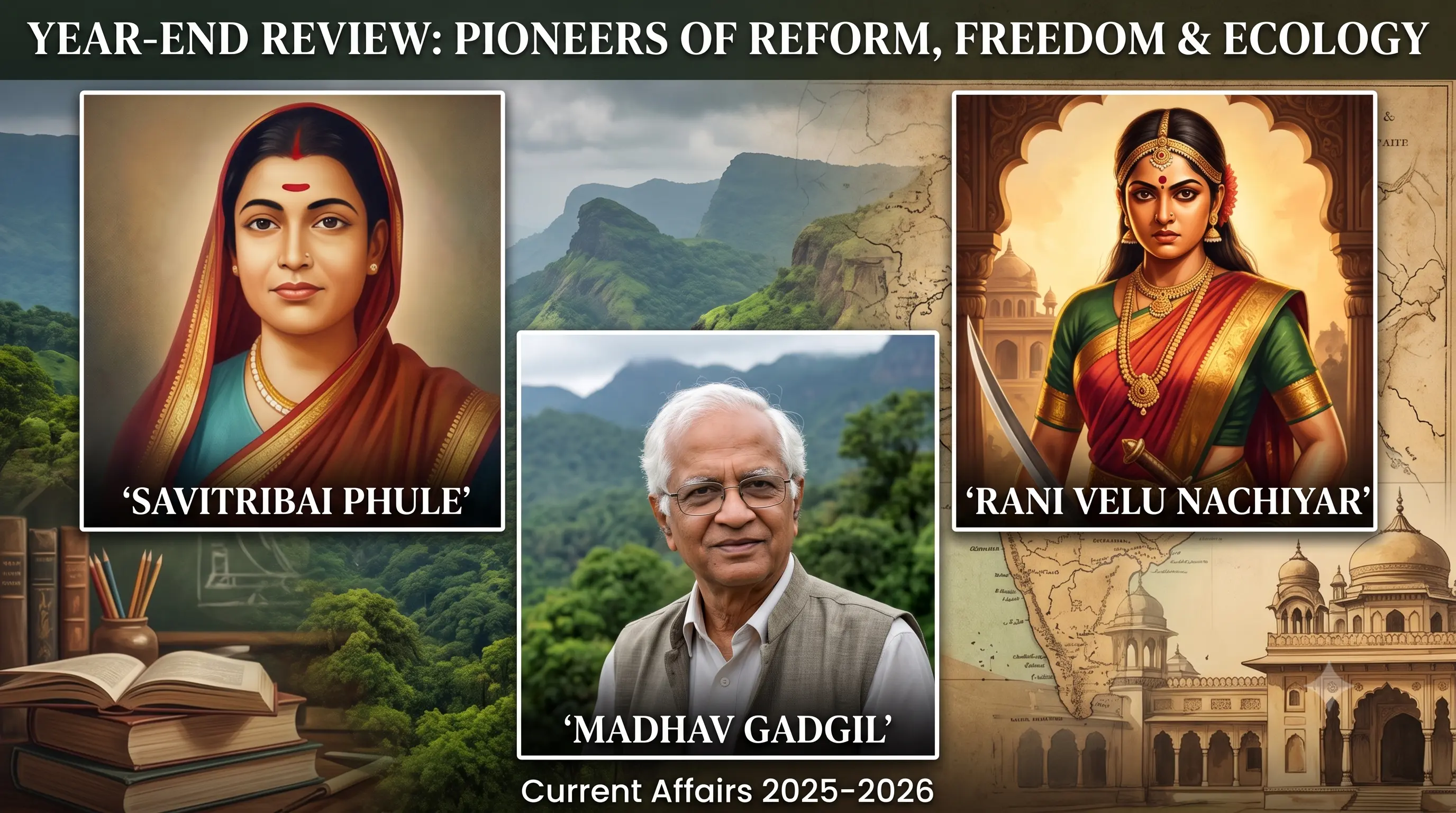
The Ministry of Culture's Year-End Review 2025 highlights achievements in heritage preservation, including the repatriation of Buddha relics and UNESCO recognition for Maratha Military Landscapes. The period also marked the birth anniversaries of social reformer Savitribai Phule and freedom fighter Rani Velu Nachiyar, as well as the passing of renowned ecologist Madhav Gadgil.
Introduction
Context & Background
Key Points
- •Heritage Repatriation & Civilisational Integration: The successful return of the 1898 Piprahwa Buddha relics and the execution of Kashi Tamil Sangamam 3.0 reflect a strong push toward reclaiming and celebrating India's unified cultural ethos.
- •UNESCO Recognition: India's cultural footprint expanded globally as the Maratha Military Landscapes secured the nation's 44th UNESCO World Heritage Site status.
- •Savitri Bai Phule's Legacy: Remembered on her birth anniversary (Jan 3), she pioneered women's education and social reform in the 19th century, founding the Mahila Seva Mandal and authoring poetic works like Kavya Phule.
- •Rani Velu Nachiyar's Resistance: Also known as Veeramangai, she successfully recaptured Sivaganga from the British East India Company and built strategic alliances with leaders like Hyder Ali.
- •Madhav Gadgil's Ecological Impact: The passing of Madhav Gadgil marks the loss of an iconic conservationist. He championed the Gadgil Committee Report, which advocated for declaring the entire Western Ghats as an Ecologically Sensitive Area (ESA) through bottom-up, participatory governance.
Key Highlights of Cultural and Heritage Initiatives in 2025
| Theme / Initiative | Key Highlights | Bookmark |
|---|---|---|
| Heritage Repatriation | The sacred Piprahwa Buddha relics (1898) were repatriated to India after 127 years through legal and diplomatic efforts. | |
| Civilisational Integration | Kashi Tamil Sangamam 3.0 celebrated the historical links between Tamil Nadu and Kashi under the Ek Bharat Shreshtha Bharat initiative. | |
| Literary Heritage Revival | Revival of the Kambh Ramayana, a 12th-century Tamil epic by Kambar interpreting Valmiki’s Ramayana. | |
| Global Heritage Recognition | Maratha Military Landscapes secured India's 44th UNESCO World Heritage status, elevating India to 6th globally. | |
| Cultural–Ecological Linkages | Project Gaja-Lok (by INTACH) documented the cultural symbolism of Asian elephants. | |
| Manuscript Heritage | Gyan Bharatam launched to preserve and digitise India’s manuscripts; culminated in the Delhi Declaration. |
Key Personalities in News (January 2026)
| Personality | Major Contributions / Legacy | Bookmark |
|---|---|---|
| Savitri Bai Phule | First female teacher in India; opened India’s first girls' school in Pune (1848); founded Balhatya Pratibandhak Griha (1863). | |
| Rani Velu Nachiyar | First Indian queen to wage war against the British; organised an early women-led military unit, Udaiyaal Padai. | |
| Madhav Gadgil | Pioneering ecologist; founded the Centre for Ecological Sciences (IISc); chaired the Western Ghats Ecology Expert Panel (WGEEP). |
Related Entities
Impact & Significance
- •Reclaiming Heritage: The successful repatriation of the Buddha relics underscores India's growing diplomatic influence in reclaiming its historical and religious artifacts.
- •Women's Empowerment: Remembering Savitri Bai Phule and Rani Velu Nachiyar serves as a powerful reminder of women's historical leadership in education, social justice, and national sovereignty.
- •Democratic Conservation: Madhav Gadgil's work established a scientific framework for conservation, emphasizing that ecological protection must inherently involve the consent and participation of local communities.
Challenges & Criticism
- •Balancing Development and Ecology: The recommendations of the Gadgil Committee on the Western Ghats have historically faced stiff resistance from state governments and local industries citing economic and developmental constraints.
- •Implementation Gaps in Heritage Laws: While digitization projects like Gyan Bharatam are visionary, executing them effectively across thousands of diverse regional archives remains a massive logistical challenge.
Future Outlook
- •Digital Preservation of Heritage: Initiatives like Gyan Bharatam are expected to accelerate the digitization of India's manuscript wealth, culminating in the Viksit Bharat 2047 vision.
- •Ecological Governance: The legacy of Madhav Gadgil's WGEEP report will continue to influence critical debates on balancing infrastructure development with the conservation of ESAs like the Western Ghats.
- •Continued Cultural Integration: Programs akin to Kashi Tamil Sangamam are likely to expand, fostering deeper connections between India's diverse linguistic and cultural landscapes.
UPSC Relevance
- • GS-1 (Art & Culture): Initiatives by the Ministry of Culture, UNESCO World Heritage Sites, classical literature (Kambh Ramayana).
- • GS-1 (Modern Indian History): Contributions of women freedom fighters and social reformers like Savitri Bai Phule and Rani Velu Nachiyar.
- • GS-3 (Environment): Biodiversity conservation, Western Ghats ecology, and the Gadgil Committee recommendations.
Sample Questions
Prelims
Consider the following statements regarding Savitri Bai Phule: 1. She established India's first home to prevent female infanticide (Balhatya Pratibandhak Griha). 2. She authored the poetry collection 'Bavan Kashi Subodh Ratnakar'. 3. She founded the Satyasodhak Samaj in 1873. How many of the above statements are correct?
1. Only one
2. Only two
3. All three
4. None
Answer: Option 1
Explanation: Statements 1 and 2 are correct. Statement 3 is incorrect because the Satyasodhak Samaj was founded by her husband, Jyotirao Phule.
Mains
Evaluate the contributions of Madhav Gadgil to environmental conservation in India. How relevant are the recommendations of the Western Ghats Ecology Expert Panel (WGEEP) in the current context of climate change?
Introduction: Introduce Madhav Gadgil as a pioneering Indian ecologist and mention his recent passing in January 2026. Highlight his role as the chairman of the WGEEP.
Body:
• Contributions of Madhav Gadgil: Founder of the Centre for Ecological Sciences (IISc); pioneered participatory environmental governance; laid the groundwork for identifying the Nilgiris as India's first biosphere reserve.
• WGEEP Recommendations: Proposed declaring the entire Western Ghats as an Ecologically Sensitive Area (ESA); suggested a graded zoning system (ESZ I, II, III); emphasized a bottom-up approach involving Gram Sabhas.
• Current Relevance: Amidst rising extreme weather events (floods, landslides) in states like Kerala and Maharashtra, the strict zoning and anti-deforestation measures proposed by the Gadgil report are highly relevant for climate resilience.
Conclusion: Conclude by stating that Madhav Gadgil's vision of 'development with ecological boundaries' remains a vital blueprint for sustainable growth in ecologically fragile zones.