
MoSPI Releases New Consumer Price Index (CPI) Series Data
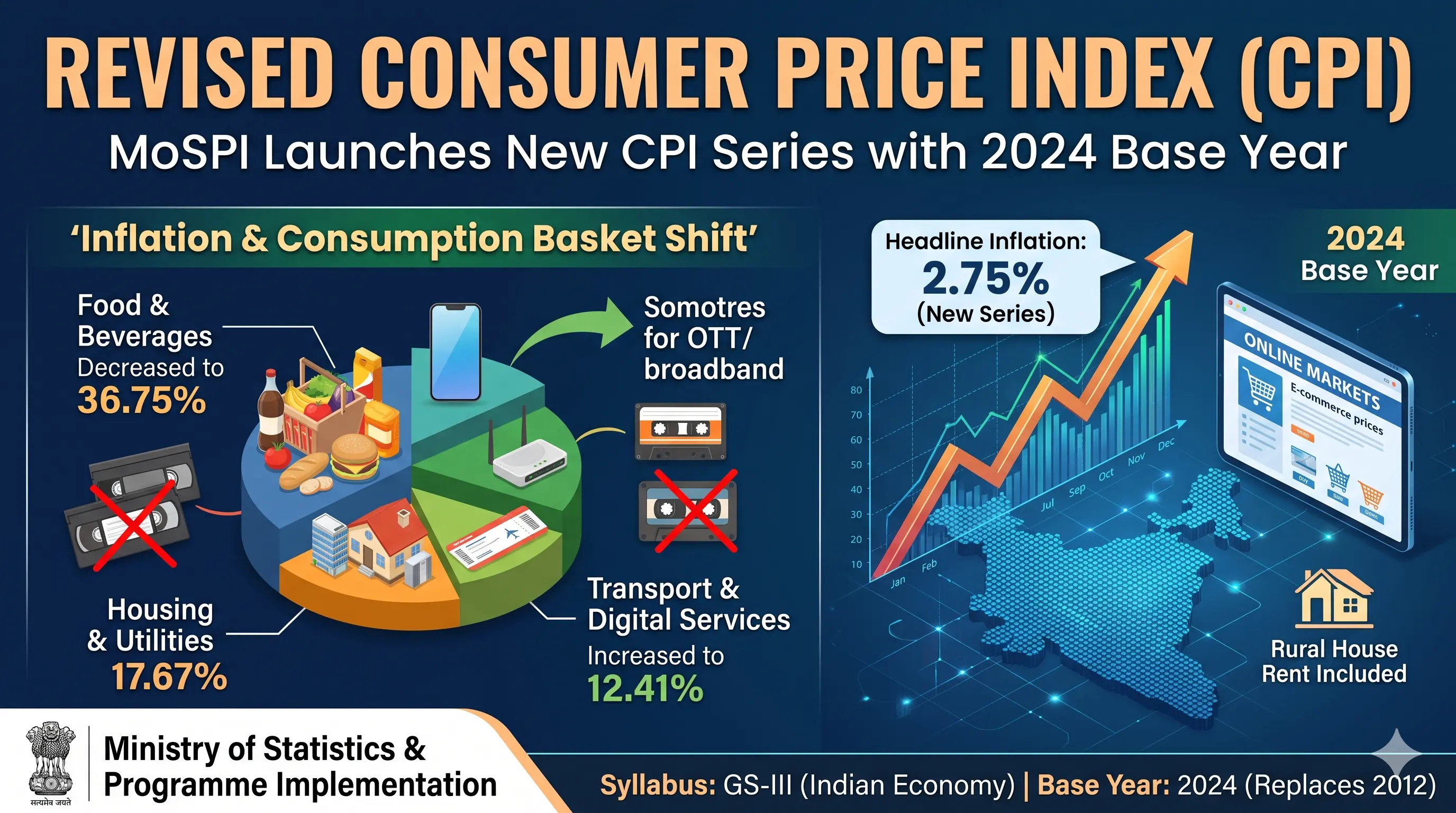
The Ministry of Statistics and Programme Implementation (MoSPI) has released the first inflation data under the new Consumer Price Index (CPI) series with a revised base year of 2024. The updated series reflects modern consumption habits, significantly lowers the weightage of food, includes digital services, and aligns with the UN COICOP 2018 global standards.
Introduction
Context & Background
Key Points
- •Base Year Revision: The CPI base year has been officially updated from 2012 to 2024 to accurately reflect current household consumption patterns, utilizing data from the Household Consumption Expenditure Survey (HCES) 2023-24.
- •Modernized Basket of Goods: The number of weighted items increased from 299 to 358. Obsolete items like VCRs and audio cassettes were removed, while modern spending habits like smartphones, OTT subscriptions, and international airfares have been added.
- •Tracking the Digital Economy: For the first time, twelve Online Markets have been set up in major cities to directly monitor prices from e-commerce platforms.
- •Housing and PDS Adjustments: The series now covers rural housing rents for the first time and excludes employer-provided housing. Additionally, free food grains received through schemes like PMGKAY are assigned zero weight.
- •Global Standard Alignment: The CPI structure has expanded from 6 to 12 distinct divisions to fully align with the UN COICOP 2018 (Classification of Individual Consumption According to Purpose) framework.
Key Weightage Shifts in CPI (Base 2012 vs Base 2024)
| Category | Old Weight (2012 Base) | New Weight (2024 Base) | Bookmark |
|---|---|---|---|
| Food and Beverages | 45.86% | 36.75% | |
| Housing, Water, Electricity, Gas | 16.91% | 17.66% | |
| Transport and Communication | 8.59% | 12.41% | |
| Rural Sector Share | 53.52% | 55.40% |
CPI Variants and Publishing Authorities
| Index Variant | Publishing Authority | Purpose | Bookmark |
|---|---|---|---|
| CPI-Rural (CPI-R), Urban (CPI-U), Combined (CPI-C) | National Statistical Office (NSO) | Measure household retail inflation; CPI-C is RBI's policy anchor. | |
| CPI-Industrial Workers (IW), Agricultural Labourers (AL), Rural Labourers (RL) | Labour Bureau | Used for wage indexation and policy planning. |
Related Entities
Impact & Significance
- •Lower Volatility: A significant drop in the food weightage means headline inflation will be less prone to sudden spikes caused by erratic monsoons or supply chain disruptions in perishable vegetables.
- •Accurate Representation of Living Costs: Including rural rent for the first time and omitting employer-provided housing fixes historical blind spots in housing inflation data.
- •Global Comparability: Restructuring the consumption basket into 12 divisions under the UN COICOP 2018 standard ensures India’s inflation data is easily comparable with international metrics.
Challenges & Criticism
- •Impact of Zero-Weighting PDS: Assigning zero weight to free food grains (like PMGKAY) may complicate the assessment of actual out-of-pocket food inflation for the lowest income deciles.
- •Urban vs. Rural Disparities: While the overall rural weightage has increased slightly to 55.4%, capturing the true cost of digital transition (like internet services and smartphones) in remote rural areas remains a logistical challenge for enumerators.
Future Outlook
- •Enhanced Monetary Policy Accuracy: With a reduced weight for volatile food items, headline inflation will be less sensitive to temporary monsoon fluctuations or vegetable price shocks, providing the RBI with a more stable anchor for its Flexible Inflation Targeting framework.
- •Reflecting Economic Evolution: The shift aligns with Engel’s Law, demonstrating that as incomes rise, the proportion of income spent on food falls while spending on non-food services (like health, transport, and digital entertainment) increases.
- •Real-time Digital Tracking: The integration of e-commerce price monitoring will likely set a precedent for future statistical revisions, making data collection faster and more reflective of middle-class and urban spending realities.
UPSC Relevance
- • GS-3 (Indian Economy): Growth and Development, Inflation and its measurement, Monetary Policy, RBI's Flexible Inflation Targeting (FIT).
- • Prelims Focus: Base year changes, difference between NSO and Labour Bureau publications, COICOP 2018, and specific weightage shifts (e.g., Food vs. Housing).
- • Mains Focus: Analyzing how the new CPI series impacts RBI's monetary policy and reflects the structural transformation of the Indian economy (Engel's Law).
Sample Questions
Prelims
Consider the following statements regarding the new Consumer Price Index (CPI) series (Base Year 2024):
1. The new CPI series incorporates the UN COICOP 2018 framework, expanding the classification from 6 to 12 divisions.
2. Under the new series, the weightage of food and beverages has decreased while the weightage of transport and communication has increased.
3. The CPI-Industrial Workers (CPI-IW) is published by the National Statistical Office (NSO).
4. Free food grains received through PMGKAY are given maximum weightage in the new CPI basket to reflect rural reliance.
Answer: Option 1, Option 2
Explanation: Statements 1 and 2 are correct. Statement 3 is incorrect because CPI-IW is published by the Labour Bureau, not NSO. Statement 4 is incorrect because free food grains through schemes like PMGKAY are assigned a zero weight in the new basket.
Mains
“The revision of the Consumer Price Index (CPI) base year to 2024 is not just a statistical update, but a reflection of India's structural economic transformation.” Analyze this statement and discuss its implications for the Reserve Bank of India's monetary policy.
Introduction: Introduce the recent release of the new CPI series by MoSPI with the 2024 base year based on the HCES 2023-24, replacing the 2012 base year.
Body:
• Structural Transformation (Engel's Law): Explain the reduction in food weightage (45.8% to 36.7%) and the rise in services/transport (8.5% to 12.4%) as indicators of rising income levels and changing consumption (OTT, smartphones).
• Statistical Modernization: Mention inclusion of e-commerce platforms, rural house rents, and alignment with UN COICOP 2018.
• Implications for RBI: Reduced volatility due to lower food weightage gives RBI a clearer picture of core inflation. Helps in better implementation of the Flexible Inflation Targeting (FIT) framework without overreacting to short-term supply shocks in agriculture.
Conclusion: Conclude that the new CPI series provides a more accurate, globally aligned barometer of living costs, ensuring that macroeconomic policies are formulated on the realities of a modern, digital-first Indian economy.