
Myanmar’s New Government and India’s Strategic Challenges
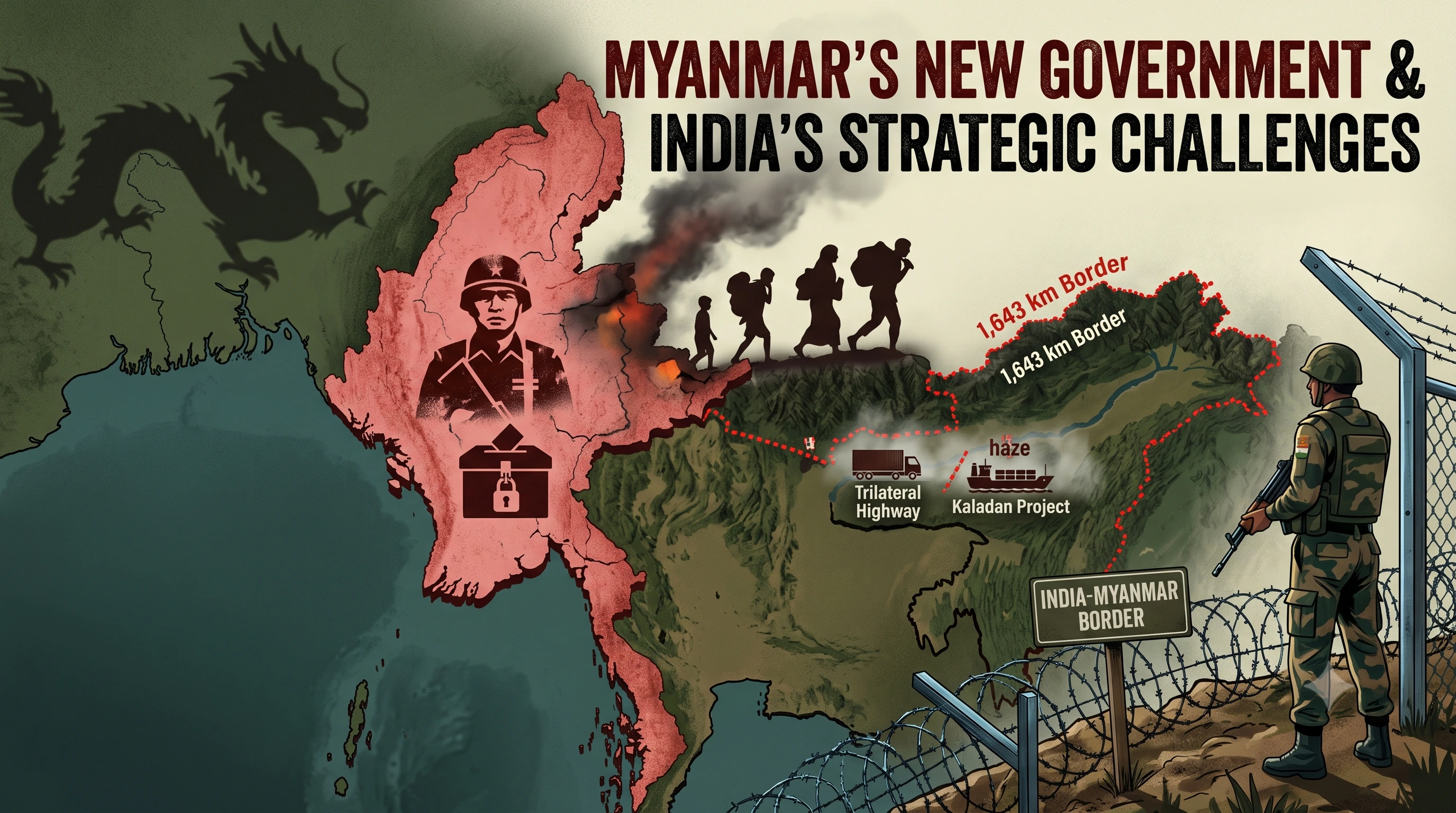
Myanmar's 2026 elections have returned the military-backed USDP to formal political control through a heavily controlled electoral process. This transition, overshadowed by the exclusion of major opposition and shrinking junta territorial control, poses profound strategic, security, and humanitarian challenges for India and disrupts its Act East Policy.
Introduction
Context & Background
Key Points
- •Consolidation of Military Control: The regime aims to institutionalise its dominance through constitutional engineering, bureaucratic reshuffles, and the expansion of digital surveillance to suppress domestic dissent.
- •Selective Regional Engagement: While continuing to face Western sanctions, the newly formed government is actively seeking issue-based engagement with India, China, and ASEAN members to gain international legitimacy.
- •Eroded Territorial Control: Despite winning the election, the military's grip on the ground is weak. Ethnic armed organisations and rebel forces now control nearly 40% of Myanmar’s territory, undermining the central authority.
- •Strategic Competition with China: China continues to maintain robust ties with Myanmar’s military junta, escalating India’s strategic concerns regarding Chinese influence in the Bay of Bengal and the broader Indo-Pacific.
- •Myanmar as a Weak Security Partner: Because the junta lacks effective control over vast swathes of its territory, it is increasingly incapable of guaranteeing security cooperation or protecting bilateral infrastructure projects with India.
Key Infrastructure and Security Challenges
| Challenge / Project | Description | Impact on India | Bookmark |
|---|---|---|---|
| Kaladan Multi-Modal Project | Transit transport network linking India and Myanmar. | Delayed due to instability and lack of junta territorial control. | |
| Trilateral Highway | Highway connecting India, Myanmar, and Thailand. | Faces security risks; disrupts India's Act East connectivity goals. | |
| Refugee Influx | Civilians fleeing military junta crackdowns. | Over 31,000 refugees in Mizoram; creates humanitarian & political strain. | |
| Organised Crime | Narcotics and arms smuggling across the 1,643 km border. | Significant increase in synthetic drug seizures and insurgent movement. |
Related Entities
Impact & Significance
- •Humanitarian Crisis: Over 31,000 refugees fleeing violence have entered Mizoram, presenting India with significant demographic, political, and resource challenges.
- •Internal Security Threats: The porous and difficult terrain of the 1,643 km border is being exploited by insurgent groups operating from Myanmar (such as the NSCN-IM), directly threatening the peace in Northeast India.
- •Transnational Crime Surge: UN data points to a massive spike in the smuggling of synthetic drugs and illegal arms across the India-Myanmar border.
- •Economic & Connectivity Setbacks: Crucial infrastructure initiatives that serve as the backbone of India's regional economic integration are stalled, bleeding capital and losing strategic momentum.
Challenges & Criticism
- •The Democracy vs. Realpolitik Dilemma: India is caught in a difficult diplomatic bind—between actively supporting democratic values for the Myanmar people and maintaining pragmatic ties with the military junta to secure its borders.
- •Eroded Central Authority: Negotiating exclusively with the central government in Naypyidaw is becoming less effective, as the junta cannot enforce security or protect Indian assets in territories held by ethnic rebel forces.
- •Chinese Strategic Encirclement: Beijing's unhesitant support for the military regime risks turning Myanmar into a Chinese satellite state, undermining India's maritime security in the Indian Ocean and Bay of Bengal.
Future Outlook
- •Recalibrate Myanmar Policy: Shift diplomatic focus from solely seeking regime stability to promoting inclusive political dialogue and expanding grassroots engagement.
- •Strengthen Border Management: Enhance border surveillance, install fencing where feasible, and improve coordinated intelligence sharing to neutralize insurgency and smuggling risks.
- •Engage Ethnic Stakeholders: Open back-channel communication with ethnic armed groups to protect critical infrastructure projects and ensure local-level stability near the Indian border.
- •Coordinate with ASEAN: Work closely with ASEAN nations to encourage a peaceful, democratic transition in Myanmar while safeguarding broader regional stability.
- •Humanitarian Diplomacy: Expand humanitarian support, including medical aid and disaster relief, to build goodwill directly among the people of Myanmar.
UPSC Relevance
- • GS-2 (International Relations): Neighbourhood of India, bilateral groupings, and the impact of the policies of neighbouring countries on India's interests.
- • GS-3 (Internal Security): Border management challenges, linkages of organized crime with terrorism, and security in border areas.
- • Essay Topics: 'Balancing Democracy and Realpolitik in Foreign Policy', 'India's Act East Policy: Hurdles and Horizons'.
- • Mains Focus: Analyzing the security implications of Myanmar's internal instability on Northeast India.
Sample Questions
Prelims
Consider the following statements regarding India-Myanmar relations and border geography:
1. The Kaladan Multi-Modal Transit Transport Project connects Kolkata seaport with Sittwe seaport in Myanmar.
2. Myanmar shares its border with four Indian states: Arunachal Pradesh, Nagaland, Manipur, and Mizoram.
3. The India-Myanmar-Thailand Trilateral Highway is a key component of India's Act East Policy.
Answer: Option 1, Option 2, Option 3
Explanation: All statements are correct. The Kaladan project links Kolkata to Sittwe. India shares a 1,643 km border with Arunachal Pradesh, Nagaland, Manipur, and Mizoram. The Trilateral Highway is fundamental to connecting India to Southeast Asia under the Act East Policy.
Mains
The recent political developments in Myanmar present a complex matrix of strategic and internal security challenges for India. Discuss. What measures should India adopt to safeguard its border interests?
Introduction: Briefly introduce the context of the 2026 Myanmar elections, noting the military-backed USDP's return to power and the junta's shrinking territorial control (loss of ~40% territory to rebels).
Body:
• Strategic Challenges: Disruption of the Act East Policy (connectivity via Myanmar to Southeast Asia); Growing Chinese leverage in Naypyidaw; Stalling of flagship projects like the Kaladan Project and Trilateral Highway.
• Internal Security Challenges: Exploitation of the porous 1,643 km border for synthetic drug and arms smuggling; Influx of over 31,000 refugees into Mizoram causing humanitarian strain; Safe havens for Indian insurgent groups (e.g., NSCN-IM) in the Sagaing region.
• Way Forward: Recalibrating foreign policy to engage both the central junta and ethnic stakeholders; enhancing border surveillance networks; expanding humanitarian diplomacy; and leveraging ASEAN for regional stability.
Conclusion: Conclude by emphasizing the need for a pragmatic balancing act—upholding democratic ideals while executing realpolitik strategies to ensure the security of India's Northeast and the success of its Indo-Pacific vision.