
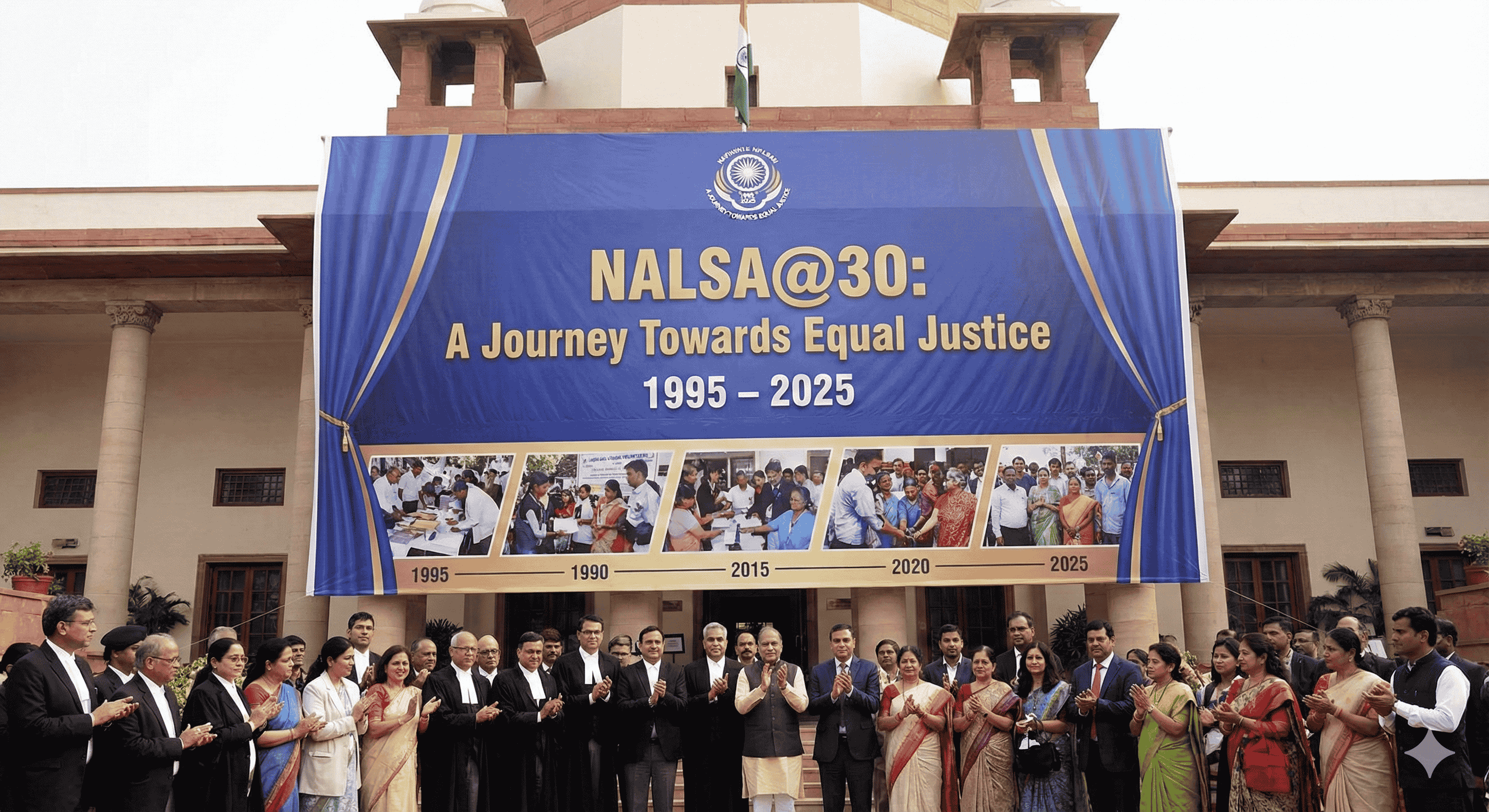
NALSA@30: A Journey Towards Equal Justice
The National Legal Services Authority (NALSA) celebrated its 30th anniversary on November 9, 2025. Mandated by Article 39A of the Constitution and set up under the Legal Services Authorities Act, 1987, NALSA leads a nationwide network that provides free legal aid, legal awareness, and dispute resolution mechanisms for the poor and marginalised. Despite serving millions through Legal Aid Clinics, Lok Adalats, Tele-Law and the Legal Aid Defence Counsel System (LADCS), it continues to grapple with low awareness, inadequate funding, limited quality control, and shortages of motivated lawyers and para-legal volunteers.
Introduction
Context & Background
Key Points
- •Constitutional & Statutory Safeguards:
1. Article 39A: Directs the State to provide free legal aid by suitable legislation or schemes.
2. Article 14: Guarantees equality before the law and equal protection of laws, which is meaningless without equal access to courts.
3. Article 21: Interpreted by the Supreme Court to include the right to free legal aid as part of fair procedure and speedy trial.
4. Article 22(1): Ensures the right to consult and be defended by a legal practitioner of one's choice upon arrest.
5. Legal Services Authorities Act, 1987: Provides the detailed framework, structure and powers of legal services authorities across the country. - •Who is Eligible? (Section 12, LSA Act): Free legal services are available to: (i) persons belonging to SCs/STs, (ii) women and children, (iii) victims of trafficking / beggar, (iv) persons with disability, (v) industrial workmen, (vi) persons in custody (including prisoners, juveniles in homes, etc.), and (vii) persons with annual income below a prescribed threshold. This means that a very large proportion of India's population is technically eligible for free legal aid.
- •Core Functions of NALSA:
1. Policy & Coordination: Framing policies, schemes and guidelines for giving legal services across India and coordinating their implementation through SLSAs, DLSAs and TLSCs.
2. Funding & Monitoring: Receiving funds from the Central Government and distributing Grant-in-Aid to State authorities; monitoring utilisation and outcomes.
3. Lok Adalats: Organising Lok Adalats (including Permanent and National Lok Adalats) for pre-litigation and pending cases to enable speedy, consensual resolution and reduce court pendency.
4. Alternate Dispute Resolution (ADR): Promoting mediation, conciliation and negotiation as cost-effective and time-efficient methods of dispute settlement.
5. Legal Literacy & Awareness: Conducting legal literacy camps, school and college programmes, publications (like 'Nyaya Deep'), street plays, and social media campaigns. - •Specific Roles & Flagship Campaigns:
1. For Prisoners: Campaigns such as 'Haq Hamara Bhi To Hai' and legal aid clinics in jails inform inmates of their rights, help them apply for bail, parole, remission, and ensure no one is detained beyond the legal limit.
2. For Gender Justice: Schemes for survivors of domestic violence, sexual offences, trafficking and acid attacks; support to women through helplines like 15100 (in some states). NALSA has also framed schemes for transgender persons, victims of HIV/AIDS discrimination and sex workers.
3. For Children and Senior Citizens: Legal representation in child protection matters (e.g., before Juvenile Justice Boards) and assistance to senior citizens in maintenance cases and property disputes; reported assistance to over 1 lakh seniors in some recent years.
4. For Rural & Tribal Communities: Use of Para-Legal Volunteers (PLVs) and village-level clinics to reach remote, tribal and conflict-affected areas. - •Institutional Network: NALSA operates through a multi-tier system: 1 NALSA at national level, 36 SLSAs (for States/UTs), hundreds of DLSAs (one in each district), numerous TLSCs, thousands of Legal Aid Clinics (at courts, jails, law colleges, villages) and a large cadre of Para-Legal Volunteers (PLVs). This makes it one of the largest legal outreach networks in the world on paper.
- •Data Reality Check (2025): According to the India Justice Report 2025, while around 80% of Indians are eligible for free legal aid under Section 12, only about 15.5 lakh people actually accessed legal aid services in 2023–24. This reveals a massive gap between eligibility and utilization, pointing to issues of awareness, trust, accessibility and quality.
- •Lok Adalats – Mass Disposal Mechanism: Lok Adalats (including National Lok Adalats held on specific days across the country) have disposed of crores of cases over the years, especially in areas like traffic challans, bank recovery, motor accident claims and matrimonial disputes. Awards of Lok Adalats are deemed decrees of courts and are final (no appeal), which saves time and cost for both litigants and the system.
- •Government-Linked Schemes & Digital Tools: NALSA works along with several government initiatives like Tele-Law, Nyaya Bandhu, LADCS and DISHA (see table below) to expand reach using technology, full-time legal aid defenders and mobile-based access.
Challenges vs. Recommendations (Parliamentary Committee 2025)
| Issue | Description | Recommendation | Bookmark |
|---|---|---|---|
| Low Awareness | Millions eligible for free legal aid are unaware of their rights or of NALSA’s existence. | Launch sustained mass media campaigns in regional languages; integrate legal aid information into school curriculum; use PLVs, ASHA workers, Anganwadi workers and panchayats as awareness multipliers; targeted outreach in prisons and police stations. | |
| Low Funding | India spends very little per capita (e.g. less than ₹1 per person) on legal aid; NALSA’s budget has seen fluctuations and cuts in some years. | Substantially increase Grant-in-Aid; earmark 2–3% of the overall justice sector budget; introduce outcome-based funding linked to quality indicators, not just number of cases. | |
| Lawyer Compensation | Honorarium to panel lawyers is low (often in the range of ₹1500–₹7500 per case or sitting) and payments are delayed, which discourages experienced practitioners from joining panels. | Revise fee structure to match at least local minimum fee norms; ensure timely digital disbursal; create separate panels of senior advocates for complex cases with higher honorarium and recognition. | |
| Lok Adalats | Inadequate infrastructure, limited ability to handle complex disputes, and concerns that poor litigants are pressured into compromise. | Upgrade infrastructure with better seating, digital case listing and online Lok Adalats; provide training to conciliators; ensure informed consent and safeguard rights in settlement processes; explore sector-specific Lok Adalats (e.g., environment, labour). | |
| Para-Legal Volunteers (PLVs) | Number of PLVs reportedly dropped by nearly 38% in some regions; they are paid below minimum wage, leading to high attrition. | Provide structured training, certification, and a minimum-wage–linked honorarium; create a clear career pathway (e.g., preference in recruitment for clerical or field posts). | |
| Quality Monitoring | Focus often on quantity (number of cases disposed) rather than quality of legal representation; limited feedback or audit of performance. | Introduce quality assessment tools, random case audits, client feedback forms, and periodic performance reviews of panel lawyers and PLVs. |
Government Initiatives for Legal Aid & Access to Justice
| Initiative | Purpose | Bookmark |
|---|---|---|
| Tele-Law | Provides legal advice through video conferencing and telephone at over 2.5 lakh Common Service Centres (CSCs) in Gram Panchayats, connecting citizens to panel lawyers. | |
| Nyaya Bandhu (Pro Bono Legal Services) | Mobile app and platform that connects pro-bono advocates with eligible beneficiaries, encouraging a culture of voluntary legal service among lawyers. | |
| LADCS (Legal Aid Defence Counsel System) | Establishes full-time public defenders in district courts (currently rolled out in 600+ districts) to provide continuous, high-quality representation in criminal cases, similar to public defender systems in some other countries. | |
| DISHA (Designing Innovative Solutions for Holistic Access to Justice) | Umbrella scheme to integrate various access to justice initiatives (legal aid, legal literacy, ADR, Tele-Law, Nyaya Bandhu) for a holistic approach; focuses on vulnerable groups and under-served regions. |
Related Entities
Impact & Significance
- •Access to Justice: NALSA is a critical instrument for turning the constitutional promise of "Justice, social, economic and political" in the Preamble into reality. For millions of poor Indians, NALSA-funded lawyers are the only realistic route to courts, especially in criminal cases where liberty is at stake.
- •Reducing Court Burden: By disposing of large numbers of cases through Lok Adalats and pre-litigation settlements, NALSA helps reduce the caseload in already overburdened courts. This allows judges to devote more time to complex and serious matters.
- •Social Justice & Inclusion: NALSA’s schemes specifically target vulnerable groups: women facing domestic violence, SC/ST communities facing atrocities, migrant workers, persons with disabilities, victims of trafficking, transpersons, and prisoners. This aligns with the Directive Principles and fundamental rights aimed at dismantling structural inequalities.
- •Human Rights Protection: Legal aid in cases of illegal detention, custodial violence, land acquisition, labour exploitation and eviction directly contributes to the protection of human rights and the rule of law.
- •Democratic Legitimacy: A justice system that is accessible only to the rich lacks legitimacy. NALSA’s work ensures that courts and tribunals remain institutions for all citizens, strengthening faith in constitutional democracy.
Challenges & Criticism
- •Quality of Legal Aid: Free legal aid is often perceived as 'second-class' representation. Many panel lawyers are inexperienced, overburdened or poorly motivated due to low and irregular payments, leading to mechanical representation and frequent adjournments.
- •Centralised & Bureaucratic Decision-Making: State and District Legal Services Authorities may face delays because they depend on NALSA or state governments for approvals and funds; this slows down local innovation and responsiveness.
- •Underutilisation & Trust Deficit: The fact that only a small fraction of eligible persons actually use legal aid indicates not just lack of awareness but also a trust deficit—people may prefer private lawyers or local intermediaries even when they cannot really afford them.
- •Lawyer Apathy & Pro-bono Culture: While some lawyers are highly committed, many established practitioners are reluctant to take up legal aid or pro-bono cases. Legal aid work is often delegated to juniors, which can compromise quality.
- •Urban–Rural and Digital Divide: Urban litigants and those with smartphone/internet access may benefit more from Tele-Law and digital platforms, whereas remote tribal areas, conflict zones and urban slums remain hard to reach without intensive field-based PLVs and clinics.
- •Data & Evaluation Gaps: Reporting often focuses on aggregate numbers of cases handled, without detailed data on outcomes (success rates, client satisfaction, impact on livelihoods or liberty), making policy evaluation difficult.
Future Outlook
- •Decentralisation with Accountability: Empowering DLSAs and TLSCs with greater financial and functional autonomy while building robust monitoring and audit systems to ensure funds are used effectively for genuine legal aid work.
- •Digital Integration & Real-Time Tracking: A unified national portal/dashboards for NALSA that tracks each legal aid case in real time—from allocation of lawyer to final outcome—can improve transparency, reduce delays, and flag non-performing lawyers or units.
- •Scaling & Strengthening LADCS: Expanding the Legal Aid Defence Counsel System so that every district has a cadre of full-time, well-trained public defenders, particularly in cases involving serious offences, undertrials, and vulnerable accused.
- •Integrating Legal Aid with Welfare Schemes: Linking NALSA’s work with social welfare programmes (PDS, pensions, labour schemes, housing schemes) so that legal aid becomes an entry point for securing a range of entitlements for the poor.
- •Capacity Building & Specialisation: Regular training of panel lawyers and PLVs on new laws (e.g., POCSO, domestic violence, cybercrimes, environment), soft skills (client counselling, gender sensitivity) and use of technology.
- •Fiscal Boost & Innovative Funding: Sustained increases in budgetary allocations and exploration of innovative funding models (such as CSR partnerships, dedicated Access to Justice funds) can provide the financial backbone needed to deepen outreach and improve quality.
UPSC Relevance
- • GS-2 (Polity & Governance): Judiciary, legal aid, Social Justice, welfare schemes for vulnerable sections, statutory bodies and mechanisms for delivery of justice.
- • GS-2 & GS-3 (Data Use): India Justice Report indicators on legal aid, pendency, and access to justice; role of Lok Adalats and ADR.
- • Essay: Themes like 'Justice delayed is justice denied', 'Access to Justice', 'Role of State in empowering the marginalised', and 'Rule of Law vs Rule by Law'.
- • Prelims: Article 39A, basic features of the Legal Services Authorities Act, hierarchy (NALSA–SLSA–DLSA–TLSC), eligibility for free legal aid under Section 12.
- • Statutory provisions and case law relating to legal aid (Hussainara Khatoon, Khatri, Suk Das).
- • Practical understanding of Lok Adalats, mediation and public defender models.
- • Contemporary debates on quality of representation and access to justice reforms.
Sample Questions
Prelims
With reference to the National Legal Services Authority (NALSA), consider the following statements:
- (a)Its objective is to provide free and competent legal services to the weaker sections of society.
- (b)It lays down policies and principles for making legal services available under the Legal Services Authorities Act, 1987.
- (c)The Chief Justice of India is the Patron-in-Chief of NALSA.
- (d)Only persons below the poverty line are eligible for free legal aid under NALSA.
Mains
“Free legal aid is not a charity but a constitutional mandate.” In light of NALSA completing 30 years, evaluate its performance in ensuring ‘Access to Justice’ for all. What are the key bottlenecks impeding its effectiveness, and how can they be addressed?
Introduction: Begin with Article 39A and the statutory creation of NALSA in 1995 as a response to the constitutional vision of equal justice.
Body:
• Achievements: Nationwide institutional network (NALSA–SLSA–DLSA–TLSC), millions of cases settled through Lok Adalats, legal aid for prisoners and vulnerable groups, use of Tele-Law and LADCS, involvement of PLVs and legal literacy initiatives.
• Evidence-Based Bottlenecks: Large gap between eligibility and utilisation (India Justice Report data), low budget and per capita spending, poor quality perception of legal aid, low and delayed honorarium for lawyers, declining numbers and morale of PLVs, urban–rural and digital divides.
• Reform Measures: Higher and stable funding; better fee and timely payment to panel lawyers; scaling up LADCS as a full-time public defender model; decentralised decision-making with strong monitoring; digital real-time tracking of cases; intensive awareness campaigns and integration with other welfare schemes.
Conclusion: Conclude that NALSA has laid a strong institutional foundation, but the next phase must focus on deepening outreach, improving quality and building trust so that free legal aid becomes a robust instrument of substantive justice rather than a symbolic promise.