
Government Approves National Logic Stack (NLiS) Policy for AI-led Governance
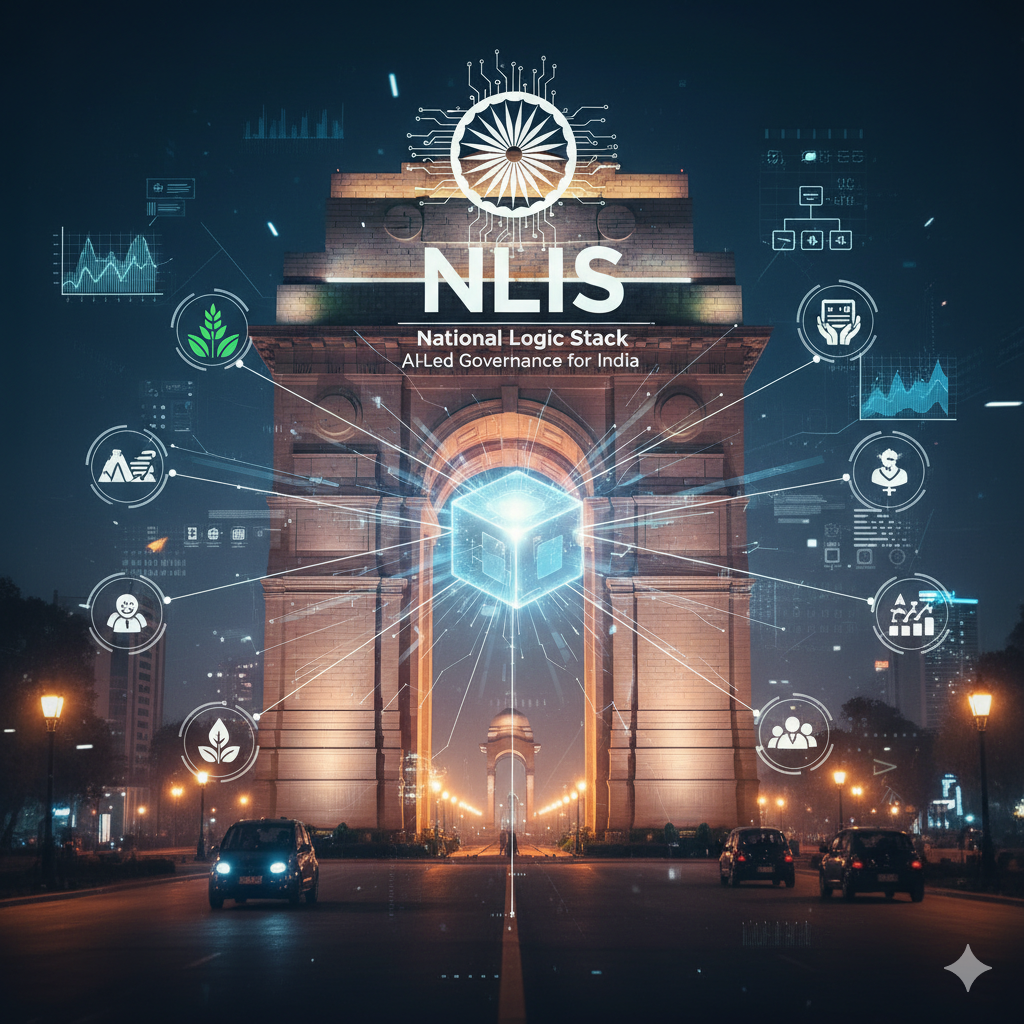
The Union Cabinet has approved the National Logic Stack (NLiS) policy, aiming to create a unified AI-powered ecosystem for real-time data analysis and decision-making across government departments, building upon the success of India Stack.
Introduction
Context & Background
Key Points
- •Three Layers: The NLiS will be built in three layers: 1) The Data Layer (accessing anonymized data, meaning personal details like name and Aadhaar are removed to protect privacy), 2) The AI/ML Layer (hosting pre-trained models for tasks like fraud detection), and 3) The Service Layer (providing secure APIs for government apps to use).
- •Core Objective: To enable 'data-driven policymaking' and deliver 'proactive public services' (e.g., instead of you applying for a scholarship, the system sees you are eligible and notifies you automatically).
- •Nodal Agency: A new 'National AI Governance Agency (NAIGA)' will be established under the Ministry of Electronics and Information Technology (MeitY) to set standards and oversee NLiS development.
- •Phased Rollout: Phase 1 will focus on integrating three high-impact sectors: Health, Agriculture, and Finance.
Related Entities
Impact & Significance
- •Better Welfare Delivery: Boosts efficiency and reduces leakages in welfare schemes by proactively identifying the correct beneficiaries.
- •Smarter Economy: Enhances economic monitoring and fraud detection (e.g., finding fake GST invoices or income tax evasion).
- •Global Leadership: Positions India as a global leader in building Digital Public Infrastructure (DPI) (shared digital systems, like public roads, but for technology) for Artificial Intelligence.
- •Economic Boost: Creates a large domestic market for Indian AI startups and service providers to build and offer services for the government.
Challenges & Criticism
- •Privacy Concerns: There are significant risks of mass surveillance given the interlinking of many different government databases (health, finance, etc.).
- •Data Security: A centralized system holding so much data would be a high-value target for sophisticated cyber-attacks.
- •Algorithmic Bias: There is a potential for AI models to perpetuate or amplify existing social biases. (e.g., if an AI is trained on old data where fewer women got loans, it might unfairly deny loans to eligible women now).
- •Digital Divide: Citizens with low digital literacy may be unable to access, understand, or consent to AI-driven services, leading to their exclusion.
- •Federalism: Potential friction with states over data sharing (disagreements between the Central government and State governments on who controls the data).
Future Outlook
- •The new agency, NAIGA, is expected to be formed by early 2026.
- •Pilot projects for AI-based crop health monitoring (for farmers) and GST fraud detection (for finance) are set to launch in mid-2026.
- •A key immediate step will be integrating this system with the new Digital India Act's data privacy framework to build public trust.
- •India will look to export the NLiS model to other developing nations as part of its 'DPI diplomacy' (using its successful digital systems as a tool of foreign policy).
UPSC Relevance
- • GS Paper 2: E-Governance (applications, models, successes, limitations), Transparency & Accountability
- • GS Paper 3: Science & Tech (AI, Computers), Digital Economy, Inclusive Growth
- • Essay: AI and Society, Privacy vs. Development, The Future of Governance
Sample Questions
Prelims
With reference to the newly approved 'National Logic Stack (NLiS)' policy, consider the following statements:
- (a)It is an AI-powered 'logic layer' built on top of the existing India Stack.
- (b)It will be managed by NITI Aayog.
- (c)Its primary goal is to replace UPI with a more secure system.
Mains
What is the National Logic Stack (NLiS) policy? While it promises to revolutionize e-governance, discuss the significant privacy and ethical challenges it poses.
Introduction: The NLiS policy is a new government initiative to create an AI-based 'logic layer' over the India Stack, aiming to enable data-driven policymaking and proactive public service delivery, moving from simple digital transactions to digital intelligence.
Body:
• Promise of Revolution: NLiS can improve efficiency, reduce welfare leakages by precise targeting, and enhance fraud detection by analyzing data across sectors like health and finance.
• Privacy Challenges: It involves linking multiple government databases (health, finance, education), raising fears of a surveillance state and the potential for massive data breaches.
• Ethical Challenges: The primary risk is 'algorithmic bias,' where the AI could discriminate against certain groups. Furthermore, the 'digital divide' may further marginalize those without digital literacy, creating an 'AI divide'.
• Institutional Challenges: Success requires robust data protection laws (like the new Digital India Act) to be in place and enforced. It also needs strong cooperation between the Center and States (data federalism).
Conclusion: NLiS represents a significant leap for e-governance in India. However, its success will depend not just on technology, but on a 'human-centric' approach that builds strong institutional and legal safeguards to protect citizen rights and ensure inclusivity.