
National Monetisation Pipeline 2.0 (NMP 2.0) Rollout
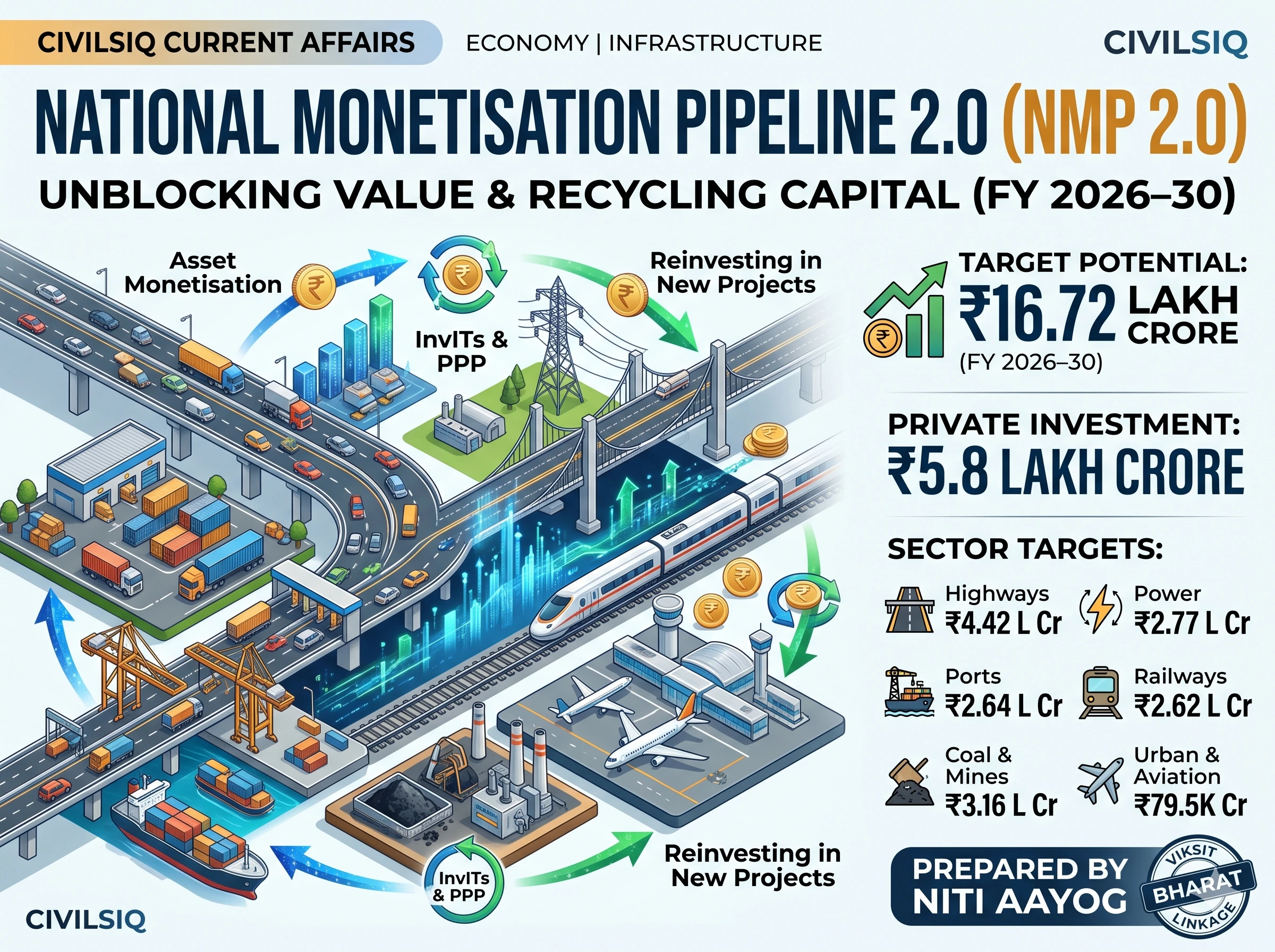
The Union Finance Minister has launched the National Monetisation Pipeline 2.0 (NMP 2.0), prepared by NITI Aayog. Targeting a monetisation potential of ₹16.72 lakh crore over FY 2026–30, the initiative aims to unlock value from operational public infrastructure assets to fund fresh public capital expenditure.
Introduction
Context & Background
Key Points
- •Core Concept: NMP 2.0 aims to monetise operational public infrastructure assets (brownfield assets) to unlock value and recycle capital into fresh public capital expenditure.
- •Monetisation Tools: The pipeline utilises various methods, including the transfer of assets for a limited period, securitisation of cash flows, strategic commercial auctions, and select divestment or dilution routes.
- •Instrument Mix: It heavily leverages Public-Private Partnership (PPP) concessions and capital market vehicles such as Infrastructure Investment Trusts (InvITs) to encourage large-scale private participation.
- •Governance & Monitoring: The progress of NMP 2.0 is closely monitored by an empowered Core Group of Secretaries on Asset Monetisation (CGAM), functioning under the Cabinet Secretary.
- •Scale of Ambition: The aggregate monetisation value is pegged at ₹16.72 lakh crore for the period FY26–FY30, which is a massive scale-up from the ₹6 lakh crore target of NMP 1.0.
NMP 2.0 Sector-Wise Monetisation Targets (FY26–FY30)
| Sector | Target Value | Key Focus/Components | Bookmark |
|---|---|---|---|
| Highways | ₹4.42 lakh crore | 26% of target; includes 21,300 km highways, 15 MMLPs, and 6 ropeways. | |
| Power | ₹2.77 lakh crore | Focus on brownfield monetisation of generation and transmission assets. | |
| Ports | ₹2.64 lakh crore | Capacity expansion and operational leasing. | |
| Railways | ₹2.62 lakh crore | Brownfield monetisation of rail infrastructure and stations. | |
| Coal & Mines | ₹3.16 lakh crore | Coal (₹2.16L cr) and Mines (₹1L cr) via auctions, leasing, and royalty-linked flows. | |
| Urban Infra & Aviation | ₹79,500 crore | Urban infrastructure (₹52,000 crore) and civil aviation (₹27,500 crore). |
Related Entities
Impact & Significance
- •Capital Recycling: Converts idle or underutilised public assets into investible resources, significantly reducing the government's dependence on pure budgetary financing for new greenfield projects.
- •Investor Deepening: The framework encourages participation by long-term institutional investors, such as pension funds and sovereign wealth funds, especially through TOT (Toll-Operate-Transfer) and InvIT routes.
- •Service Quality Push: Bringing in private sector operations and maintenance helps improve asset upkeep, utilisation efficiency, and the overall user experience, particularly in transport and logistics networks.
- •Viksit Bharat Linkage: Provides the financial backbone for accelerated infrastructure expansion goals, vital for India's transition to a developed economy.
Challenges & Criticism
- •Execution Capacity: Managing a multi-ministry pipeline requires fast procurement, highly standardised contracts, and predictable, time-bound approvals to prevent delays and subsequent value erosion.
- •Sector Underperformance Risk: Sectors that lagged during NMP 1.0, such as railways, civil aviation, and telecom, have been assigned ambitious targets, significantly increasing delivery and structuring pressure.
- •Market Appetite Volatility: The success of these monetisation efforts heavily depends on prevailing market conditions, investor confidence, stable regulatory signals, and the creation of bankable, risk-balanced concession structures.
Future Outlook
- •Integrating with Viksit Bharat: NMP 2.0 is closely aligned with the long-term vision of a developed India by accelerating infrastructure expansion across highways, ports, rail connectivity, logistics platforms, and airports.
- •Deepening Capital Markets: The push for tools like InvITs and Toll-Operate-Transfer (TOT) models is expected to continuously attract patient capital from long-term global investors, pension funds, and sovereign wealth funds.
- •Improving Standardisation: To meet these massive targets, the government will likely move towards standardising PPP contracts and procurement processes to ensure predictable approvals and limit execution delays.
UPSC Relevance
- • GS-3 (Indian Economy): Mobilisation of resources, growth, development, and employment.
- • GS-3 (Infrastructure): Energy, Ports, Roads, Airports, Railways, etc., and Investment Models (PPP, InvITs).
- • Prelims Focus: Institutional frameworks (NITI Aayog, CGAM), financial instruments (InvITs), and objectives of Asset Monetisation.
Sample Questions
Prelims
Consider the following statements regarding the National Monetisation Pipeline 2.0 (NMP 2.0):
1. NMP 2.0 focuses primarily on the monetisation of greenfield (new) infrastructure projects.
2. The progress of the pipeline is monitored by the Core Group of Secretaries on Asset Monetisation (CGAM).
3. The ownership of the monetised assets is permanently transferred to the private sector under this framework.
Answer: Option 2
Explanation: Statement 1 is incorrect; NMP focuses on brownfield (operational) assets, not greenfield. Statement 3 is incorrect; asset monetisation under NMP involves transferring revenue rights for a limited period (not permanent ownership). Statement 2 is correct.
Mains
“Asset monetisation is not merely a funding mechanism, but an overall paradigm shift in infrastructure operations.” Analyze this statement in the context of the newly launched National Monetisation Pipeline 2.0 (NMP 2.0) and discuss the execution challenges it faces.
Introduction: Define Asset Monetisation and introduce NMP 2.0 (launched by FM, prepared by NITI Aayog, targeting ₹16.72 lakh crore over FY26-30). Briefly mention how it recycles capital.
Body:
• Paradigm Shift in Operations: Move from government monopoly to private efficiency; Improved service quality and maintenance; 'Capital Recycling' rather than just 'Privatization' (ownership remains with the government).
• Role of NMP 2.0: Ambitious ₹16.72 lakh crore target; Broadening focus beyond highways to power, ports, coal, and urban infra; Utilizing InvITs and PPPs to bring in patient capital.
• Execution Challenges: Bureaucratic bottlenecks and execution capacity; Underperformance risks in traditionally sluggish sectors (railways/telecom); Volatility in market appetite and the need for bankable concession structures.
Conclusion: Conclude by stating that the success of NMP 2.0 lies in robust regulatory frameworks, independent dispute resolution, and transparent contract enforcement, which are essential to sustain investor confidence and realize the 'Viksit Bharat' infrastructure goals.