
35 Years After the New Economic Policy (1991): Triumphs, Failures, and the 2026 Reform Agenda
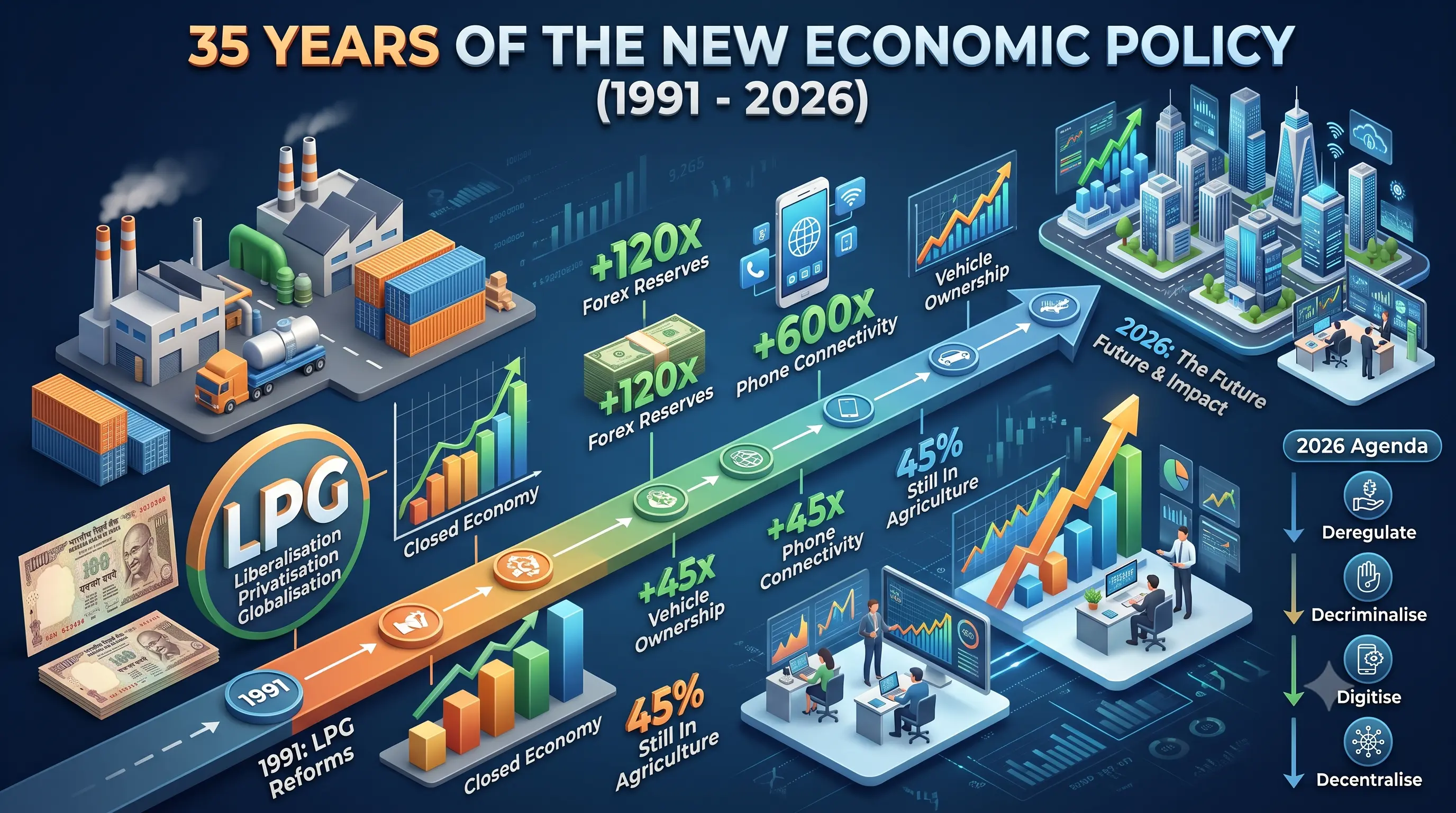
As 2026 marks 35 years since India's landmark New Economic Policy (NEP) of 1991, its legacy of mass non-farm job creation remains substantial but incomplete. This article evaluates the core LPG reforms, subsequent economic achievements, persistent structural failures, and the urgent reform agenda needed for India to bridge the per-capita GDP gap with peers like China.
Introduction
Context & Background
Key Points
- •Wealth Creation ('Ameeri Banao'): To sustain welfare and job creation, India must shift its mindset from 'Garibi Hatao' (removing poverty) to expanding incomes, formalizing firms, and broadening the tax base.
- •Policy Experimentation: Following the philosophy of 'crossing the river by feeling the stones,' the government must shift from policy paralysis to calibrated trials—piloting reforms in select states or sectors and scaling what works fast.
- •Pragmatism Over Ideology: Embracing the 'Black/white cat' approach: the State should back any sector or firm (whether manufacturing or services, domestic or foreign) that successfully delivers high-wage, non-farm job creation.
- •Risk Acceptance: Acknowledging that 'when you open the window, some flies will always get in.' Business fraud should be handled through smarter enforcement rather than blanket over-criminalisation that terrifies and discourages honest investment.
- •The Informality Trap: Out of India's 6.3 crore enterprises, a mere 8 lakh are Provident Fund-paying employers, showcasing a dangerously thin formal economic base.
Key Features of the New Economic Policy (1991)
| Sector | Key Reform Measure | Primary Objective | Bookmark |
|---|---|---|---|
| Trade & Forex | Devalued the rupee by ~18% and eased import restrictions. | Boost exports and liberalise capital goods imports. | |
| Industrial Policy | Abolished industrial licensing for most sectors; reduced PSU exclusivity. | Increase competition and encourage private entry. | |
| MRTP & SSI | Removed expansion approvals for large firms; allowed small enterprises (SSI) to sell up to 44% equity. | Enable firms to scale up and attract larger investments. | |
| FDI Reforms | Raised FDI cap from 40% to 51% in priority industries; created FIPB. | Attract foreign capital and ensure faster clearances. | |
| Banking Liberalisation | Gave banks autonomy to set deposit interest rates and maturity terms. | Move away from heavy administrative control. |
Achievements of the 1991 Reforms (1991 vs Present)
| Indicator | Magnitude of Change | Economic Implication | Bookmark |
|---|---|---|---|
| Mobility | Vehicle ownership increased ~45 times. | Rising income capability of the middle class. | |
| Formal Savings | Provident Fund subscriptions rose ~75 times. | Gradual expansion of formal wage employment. | |
| External Strength | Foreign exchange reserves jumped ~120 times. | Vastly improved macroeconomic stability. | |
| Capital Markets | Stock market value expanded ~500 times. | Deepening of the investment ecosystem. | |
| Connectivity | Phone connections rose ~600 times. | Powered productivity and services-led growth. |
Related Entities
Impact & Significance
- •Macroeconomic Resilience: By increasing foreign exchange reserves by ~120 times, the reforms shielded India from future balance of payment crises.
- •Wealth Generation: Expanding the stock market value by ~500 times democratized investment and provided capital for corporate expansion.
- •Rise in Living Standards: The 45-fold increase in vehicle ownership and 600-fold increase in telecom connectivity fundamentally upgraded the quality of life and business efficiency.
- •Formal Sector Expansion: A 75-fold increase in Provident Fund accounts indicated a steady shift toward formal wage employment, even though it remains a fraction of the total workforce.
Challenges & Criticism
- •Premature Deindustrialisation: Despite opening up the economy, the manufacturing workforce share is stagnated at a mere 11%, forcing a transition directly to services and leaving semi-skilled labor behind.
- •Enduring Farm Dependence: The failure to create mass non-farm jobs means 45% of India's workforce is still trapped in low-yield agriculture.
- •Trust Deficit on Enterprise: Over-regulation and systemic suspicion toward entrepreneurs have kept Indian firms artificially small (dwarfs rather than giants).
- •Job Supply Mismatch: The demographic dividend is at risk of becoming a disaster, as India adds roughly 20 million job seekers annually but generates only 2 million jobs.
Future Outlook
- •Deregulation: Slashing licensing, inspections, and notices to eliminate compliance fear. Implementation of frameworks like the Jan Vishwas Siddhant as a single-source regulatory truth system is essential.
- •Decriminalisation: Transitioning from jail-based compliance to civil penalties and graded deterrence. Expanding frameworks like Jan Vishwas 2.0/3.0 to rationalize economic offences.
- •Digitisation: Making government interfaces entirely paperless and cashless to cut transaction costs. This includes single-window approvals and faceless compliance mirroring GST portal workflows.
- •Decentralisation: Devolving funds, functions, and functionaries to local levels to build local job creation ecosystems. Utilizing the 15th Finance Commission grants and the SVAMITVA Scheme to strengthen Panchayat revenues.
UPSC Relevance
- • GS-3 (Indian Economy): Economic growth, effects of liberalisation on the economy, changes in industrial policy, and employment challenges.
- • GS-2 (Governance): Decentralisation of power (Panchayati Raj), government policies and interventions for development in various sectors.
- • Essay Topics: '35 Years of Economic Reforms: A Balance Sheet', 'The Paradox of Jobless Growth in India'.
- • Mains Focus: Analyzing the causes of 'premature deindustrialisation' and suggesting institutional reforms (like decriminalisation and deregulation) for the future.
Sample Questions
Prelims
Consider the following statements regarding the New Economic Policy of 1991 and its economic outcomes: 1. Industrial licensing was abolished entirely for all sectors without exception. 2. The Monopolies and Restrictive Trade Practices (MRTP) Act was amended to remove expansion approvals for large firms. 3. The share of the manufacturing sector workforce in India currently exceeds 25%.
1. 1 and 2 only
2. 2 only
3. 1 and 3 only
4. 1, 2, and 3
Answer: Option 2
Explanation: Statement 1 is incorrect: Licensing was abolished for most sectors, but a few strategic/hazardous sectors retained it. Statement 2 is correct: MRTP was amended to ease expansion. Statement 3 is incorrect: India suffers from 'premature deindustrialisation', with the manufacturing workforce share hovering around just 11%.
Mains
“While the New Economic Policy of 1991 transformed India's macroeconomic landscape, it remained incomplete in addressing the structural issues of employment and industrialization.” Critically analyze this statement and suggest a reform agenda to overcome these failures by 2026.
Introduction: Introduce the context of the 1991 BoP crisis and the subsequent LPG reforms. Note that 2026 marks 35 years of these reforms, providing a juncture to evaluate their mixed legacy on job creation.
Body:
• Successes of 1991: Highlight macroeconomic stability (Forex reserves jumped ~120x), deep capital markets (value expanded ~500x), and the boom in mobility/connectivity due to deregulation and LPG reforms.
• Structural Failures: Mention the Informality Trap (only 8 lakh formal employers out of 6.3 crore enterprises); Farm Dependence (45% workforce still in agriculture); Premature Deindustrialisation (manufacturing stuck at 11%); and Job Supply Mismatch (2 million jobs created vs 20 million entrants).
• Reform Agenda (2026): Suggest the 4Ds: Deregulation (cutting licenses), Decriminalisation (civil penalties over jail via Jan Vishwas), Digitisation (paperless interfaces), and Decentralisation (empowering local bodies via SVAMITVA).
Conclusion: Conclude that to bridge the per-capita GDP gap with nations like China, India must pivot from an ideological approach to a pragmatic one ('Ameeri Banao'), prioritizing wealth creation and restoring trust in entrepreneurship.