
New CPI Series (Base Year 2024): Food Weight Drops to 36.75% from 45.86%
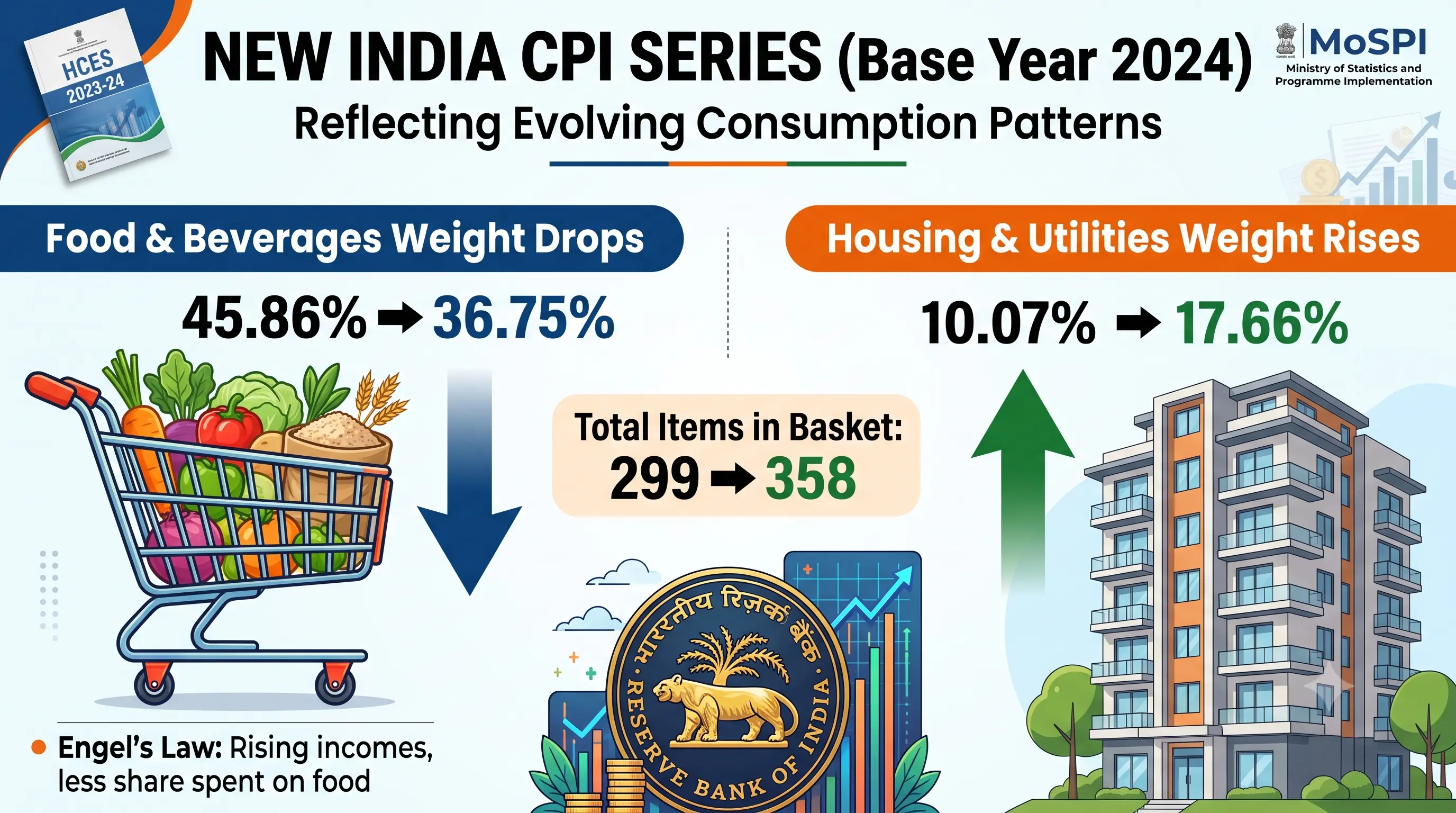
The Ministry of Statistics and Programme Implementation (MoSPI) has updated the Consumer Price Index (CPI) with 2024 as the new base year. The revised series significantly reduces the weight of food and beverages from 45.86% to 36.75%, aligning the inflation basket with the latest Household Consumption Expenditure Survey (HCES) 2023-24 and reflecting changing consumption patterns as incomes rise.
Introduction
Context & Background
Key Points
- •Base Year Update: MoSPI released documents on January 29, 2026, detailing the updated CPI basket, shifting the base year from 2012 to 2024.
- •Food Weight Reduction: The most significant change is the reduction of the food and beverages weight from 45.86% to 36.75%.
- •Housing and Utilities: The housing category weight sharply increased from 10.07% to 17.66%, reflecting higher rent spending and expanded coverage of residential utilities.
- •Expanded Basket: The total number of items tracked in the basket has increased from 299 to 358, accompanied by category re-organizations (e.g., 'education services' is now a standalone category at 3.33%).
- •Engel's Law Demonstrated: The updated weights, rooted in the HCES 2023-24, reflect Ernst Engel's economic theory: as household incomes rise, the proportion of income spent on food declines while spending on non-food items increases.
Changes in Major CPI Category Weights
| Category/Metric | Old Series (2012 Base) | New Series (2024 Base) | Bookmark |
|---|---|---|---|
| Food & Beverages | 45.86% | 36.75% | |
| Housing | 10.07% | 17.66% | |
| Total Items in Basket | 299 | 358 |
Consumption Pattern Shifts (HCES 2011-12 vs 2023-24)
| Metric | 2011-12 | 2023-24 | Bookmark |
|---|---|---|---|
| Rural Households - Food Share | 52.9% | 47.04% | |
| Urban Households - Food Share | 42.62% | 39.68% | |
| Rural Households - Rent Share | 0.45% | 0.56% | |
| Urban Households - Rent Share | 6.24% | 6.58% |
Related Entities
Impact & Significance
- •Monetary Policy Flexibility: By reducing the outsized influence of volatile food prices, the RBI gains better visibility into core economic pressures, allowing for more precise interest rate adjustments.
- •Improved Credibility: Aligning the inflation basket with the latest spending realities of 2023-24 reinforces the credibility of India's macroeconomic data and its inflation-targeting framework.
- •Accurate Market Signalling: A more representative index provides policymakers, investors, and markets with a clearer picture of actual cost-of-living changes across both rural and urban demographics.
Challenges & Criticism
- •Upward Pressure from Housing: While food volatility is minimized, the significantly higher weight given to housing (17.66%) alongside methodological changes—such as excluding employer-provided accommodations—is expected to exert upward pressure on measured inflation.
- •Loss of Direct Comparability: The re-categorisation of items (e.g., separating education from the miscellaneous bracket) means a direct, category-by-category comparison with the old 2012 series is no longer always possible.
Future Outlook
- •Muted Headline Volatility: The lower food weight will dampen the wild swings in headline CPI typically caused by transient agricultural supply shocks (like vegetable or cereal price spikes).
- •First Data Release: The first inflation print under this new 2024 series (reflecting January 2026 data) is scheduled for release on February 12, 2026.
- •Inflation Target Review: The Flexible Inflation Targeting (FIT) framework (4% ± 2%) is currently under review, with the mandate for the next 5 years expected to be announced by March 2026. The RBI is expected to retain the target in its current form.
UPSC Relevance
- • GS-3 (Indian Economy): Growth, development, inflation targeting, and monetary policy.
- • Prelims Focus: Understanding the components of CPI, base year revisions, the concept of Engel's Law, and shifts in consumption patterns.
- • Mains Focus: Analyzing the implications of the new CPI series on RBI's monetary policy space and macro-economic stability.
Sample Questions
Prelims
Consider the following statements regarding the new Consumer Price Index (CPI) series with the base year 2024: 1. The weight assigned to food and beverages has been increased compared to the 2012 base year to account for rising agricultural costs. 2. The revised weights are based on the latest Household Consumption Expenditure Survey (HCES) 2023-24. Which of the statements given above is/are correct?
1. 1 only
2. 2 only
3. Both 1 and 2
4. Neither 1 nor 2
Answer: Option 2
Explanation: Statement 1 is incorrect; the weight of food and beverages has been reduced from 45.86% to 36.75% in accordance with Engel's Law. Statement 2 is correct; the new weights are derived from the HCES 2023-24.
Mains
The recent revision of the Consumer Price Index (CPI) base year to 2024 reflects the structural transformations in the Indian economy. Discuss the key changes in the new CPI basket and its implications for the Reserve Bank of India's monetary policy formulation.
Introduction: Introduce the MoSPI's initiative to update the CPI base year to 2024. State that an accurate measure of retail inflation is critical for effective economic governance and monetary policy.
Body:
• Key Changes in CPI Basket: Reduction in the weight of Food & Beverages (45.86% to 36.75%); sharp increase in Housing weight (10.07% to 17.66%); expansion of total items from 299 to 358; re-categorization of services.
• Drivers of Change: The changes are rooted in the HCES 2023-24, proving Engel's Law in the Indian context, where rising per capita income has reduced the proportional expenditure on food.
• Implications for RBI: The outdated 2012 series made headline CPI overly sensitive to supply-side food shocks. The new series reduces this volatility, giving the RBI more policy space to conduct counter-cyclical monetary policy and effectively address demand-side pressures.
Conclusion: Conclude by highlighting that modernizing the inflation measurement aligns it with ground realities, thereby strengthening the credibility of India's Flexible Inflation Targeting (FIT) regime.