
NITI Aayog Sector-wise Green Transition Roadmaps
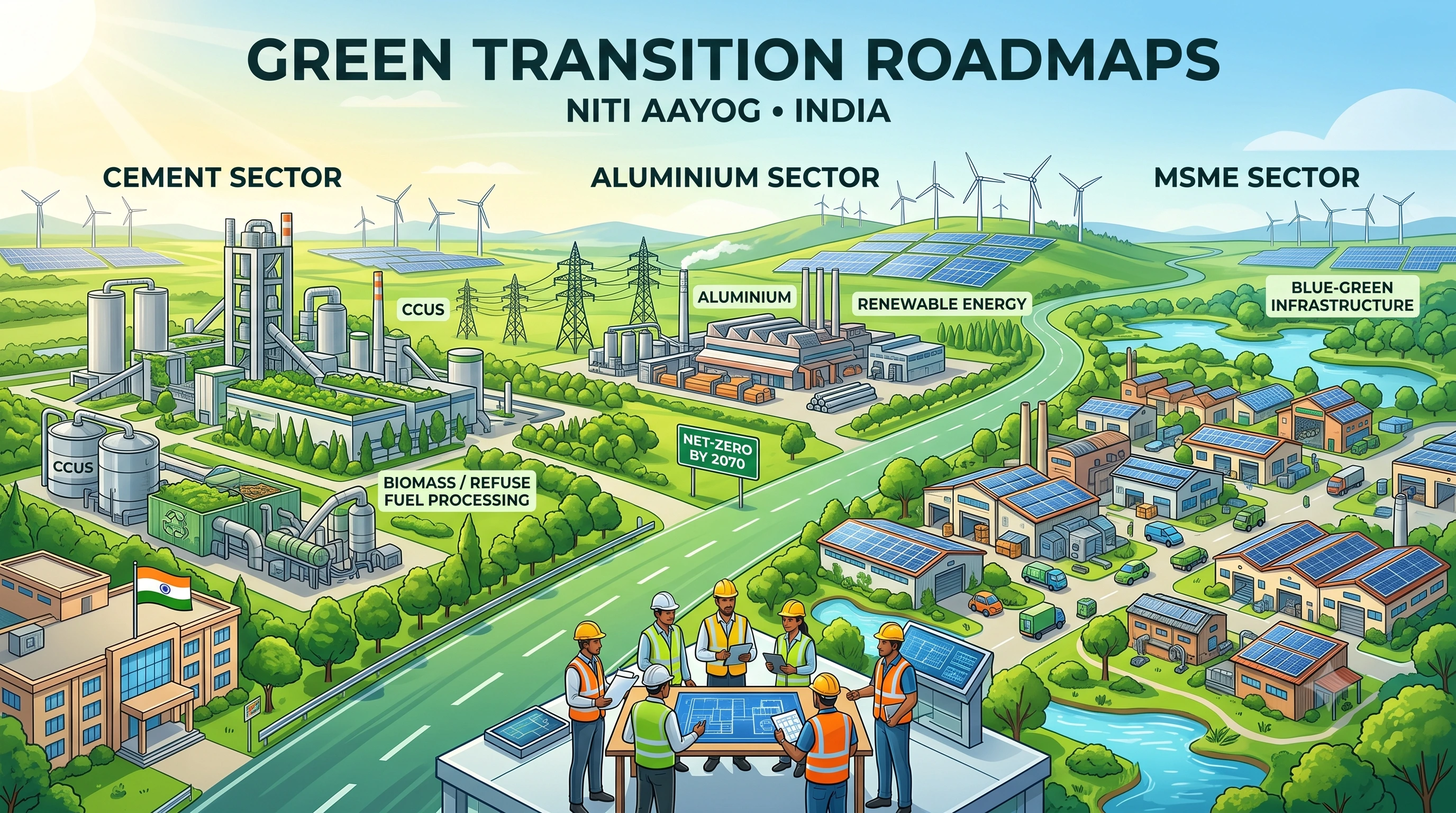
NITI Aayog has released three landmark reports outlining decarbonisation roadmaps for India’s cement, aluminium, and MSME sectors. These blueprints provide sector-specific pathways for India to achieve its goal of becoming a developed nation by 2047 while simultaneously reducing industrial emissions to meet its net-zero target by 2070.
Introduction
Context & Background
Key Points
- •National Context (Viksit Bharat): India aims to become a developed, USD 30 trillion economy by 2047, intending to raise the manufacturing sector's share from 17% to 25% of GDP. This necessitates profound industrial decarbonisation to honor India's pledge of net-zero emissions by 2070.
- •Cement Sector Decarbonisation: India is the world's second-largest cement producer. Output is projected to surge from 391 MT in 2023 to ~2,100 MT by 2070. The strategy focuses on dropping carbon intensity from 0.63 tCO2 to 0.09-0.13 tCO2 per tonne using clinker substitution and RDF.
- •Aluminium Sector Overhaul: The sector has a high current emission intensity of 20-21 tCO2 per tonne (compared to a global average of 15 tCO2). The roadmap recommends shifting to Round-the-Clock Renewable Energy (RE-RTC), and eventually small modular nuclear reactors for a stable, zero-carbon baseload.
- •Empowering MSMEs: Although they drive 30% of the GDP, MSMEs lack the capital and technical know-how for a green transition. Key levers include setting up a National Project Management Agency (NPMA), facilitating green open-access power, and creating targeted credit guarantees.
Key Recommendations for Heavy Industries
| Sector | Emission Burden & Output | Short/Medium-Term Strategy | Long-Term Strategy | Bookmark |
|---|---|---|---|---|
| Cement | 391 MT (7% of total GHG), projected to reach ~2,100 MT by 2070 | Clinker reduction using fly ash/slag, Refuse-Derived Fuel (RDF) from municipal waste | Carbon Capture, Utilisation, & Storage (CCUS) | |
| Aluminium | 4 MT (2.8% of national emissions); highly carbon-intensive | Renewable Energy Round-the-Clock (RE-RTC) | Small modular reactors (nuclear baseload), CCUS, scrap recycling |
Green Transition in the MSME Sector
| Area | Current Status | Key Recommendations | Bookmark |
|---|---|---|---|
| Sector Size & Impact | 69 million MSMEs; contributing 30% of GDP & 45.7% of exports. | Establish a National Project Management Agency (NPMA) for coordination. | |
| Emission Share | 135 million tonnes in 2022 (approx. 3-4% of national emissions). | Shift to natural gas/biomass; deploy energy-efficient equipment. | |
| Finance & Power | High upfront costs for green tech; limited access to clean power. | Utilize Green Open Access Rules; allocate dedicated credit-guarantee funds. |
Related Entities
Impact & Significance
- •Climate Commitments: These roadmaps translate India's broad 2070 net-zero pledge into actionable, granular sector-level targets, which is crucial for demonstrating global climate leadership and accountability.
- •Economic Competitiveness: As global markets begin implementing mechanisms like the EU’s Carbon Border Adjustment Mechanism (CBAM), decarbonising exports (like aluminium and MSME goods) ensures they remain financially viable and globally competitive.
- •Resource Efficiency: Substituting traditional coal with refuse-derived fuels (RDF) and increasing scrap recycling will significantly reduce raw material imports and alleviate pressure on domestic natural resources.
- •Employment & Skilling: The green transition will demand a structural shift in the workforce, creating green jobs while requiring massive, systematic re-skilling programs, particularly in the MSME landscape.
Challenges & Criticism
- •Financing the Transition: Green technologies like CCUS, small modular reactors, and advanced energy-efficient machinery require massive upfront capital, which is especially prohibitive for credit-starved MSMEs.
- •Technology Readiness: Crucial solutions like CCUS and commercial-scale small modular nuclear reactors are currently nascent, expensive, and not yet deployed at scale within the Indian industrial ecosystem.
- •Implementation Bottlenecks: For MSMEs, well-intentioned policies often fail at the ground level due to a lack of awareness, bureaucratic hurdles, and the highly decentralized, informal nature of the sector.
- •Policy Coherence: Ensuring consistent electricity pricing, functional green open access rules, and grid reliability is challenging given that electricity falls under the concurrent list, leading to complex and varying state-level regulations.
Future Outlook
- •Carbon Capture Integration: Large-scale deployment of Carbon Capture, Utilisation, & Storage (CCUS) technologies across major cement and aluminium plants to neutralize residual emissions.
- •Nuclear Energy for Industry: Utilizing small modular reactors or captive nuclear power plants to provide the stable, uninterrupted, zero-carbon electricity required for energy-intensive aluminium smelting.
- •Standard and Regulatory Reform: Shifting from input-based norms to performance-based standards to encourage low-carbon cement blends and implementing a robust Carbon Credit Trading Scheme.
- •Cluster-Based MSME Interventions: Implementing a cluster-based framework through a National Project Management Agency (NPMA) to streamline technological adoption, skilling, and green finance directly to localized MSMEs.
UPSC Relevance
- • GS-3 (Environment and Ecology): Decarbonisation pathways, Net-Zero targets by 2070, CCUS technology, and climate change mitigation strategies in hard-to-abate sectors.
- • GS-3 (Economy): Industrial policy, MSME sector's contribution to GDP/exports, green finance, and circular economy.
- • Essay Topics: 'Balancing Economic Growth with Environmental Sustainability: The Indian Context', 'The Role of Technology in Industrial Decarbonisation'.
- • Mains Focus: Analyzing the specific challenges of transitioning MSMEs to green energy and critically evaluating the proposed NITI Aayog roadmaps.
Sample Questions
Prelims
With reference to the NITI Aayog's sector-wise green transition roadmaps, consider the following statements:
1. The cement sector contributes to over 25% of India's total Greenhouse Gas (GHG) emissions.
2. India aims to achieve Net-Zero greenhouse gas emissions by the year 2070.
3. NITI Aayog’s roadmap for the aluminium sector proposes a complete shift to solar power for all baseload requirements by 2030.
Answer: Option 2
Explanation: Statement 1 is incorrect; the cement sector accounts for roughly 7% of India's GHG emissions. Statement 2 is correct as India pledged net-zero by 2070 at COP26. Statement 3 is incorrect; the roadmap suggests Renewable Energy Round-the-Clock (RE-RTC) in the short term, but advocates for small modular nuclear reactors for a stable zero-carbon baseload in the medium term, recognizing solar alone cannot provide uninterrupted baseload for smelting.
Mains
“Industrial growth and environmental sustainability must go hand in hand for India to achieve its Viksit Bharat 2047 and Net-Zero 2070 targets.” Discuss the challenges and strategies for decarbonising hard-to-abate sectors like cement and aluminium in India.
Introduction: Highlight the dual goals of India—a developed economy by 2047 and net-zero emissions by 2070. Mention NITI Aayog’s recent roadmaps as a strategic framework to reconcile these goals in emission-heavy industries.
Body:
• The Need for Decarbonisation: Manufacturing must grow from 17% to 25% of GDP for Viksit Bharat. However, sectors like cement (7% of GHG) and aluminium are highly energy and carbon-intensive, threatening the 2070 net-zero targets if left unchecked.
• Challenges: High initial capital cost for green tech, reliance on coal for baseload power (essential for smelting), the unorganized/fragmented nature of MSMEs, and the current lack of commercial viability for CCUS technologies.
• Strategies (NITI Aayog Roadmaps): Cement: Clinker substitution and use of refuse-derived fuels. Aluminium: Shift to RE-RTC, nuclear energy for captive power, and enhanced recycling. MSMEs: Cluster-based green finance, alternative fuels, and setting up an NPMA.
Conclusion: A seamless green transition requires robust institutional mechanisms, accessible green finance, and the proactive adoption of CCUS and nuclear technologies, ensuring that India remains globally competitive while meeting its climate pledges.