
Scenarios Towards Viksit Bharat and Net Zero: NITI Aayog's Vision
NITI Aayog's study, released in February 2026, highlights that India can simultaneously achieve developed-economy status (Viksit Bharat) by 2047 and net-zero emissions by 2070. The report outlines the core strategies, investment needs, and structural transformations required, along with the macroeconomic and social implications of this transition.
Introduction
Context & Background
Key Points
- •Investment-Led Rebalancing: The economic growth structure must shift from consumption-driven patterns toward capital-intensive, technology-led, and infrastructure-heavy development pathways.
- •Structural Adjustment: Transitioning away from fossil fuels poses challenges; coal mining alone supports ~12 million livelihoods, necessitating significant reskilling efforts.
- •Energy Security: Coal currently supplies ~70% of India's electricity. The pace of decarbonisation must not risk energy supply instability.
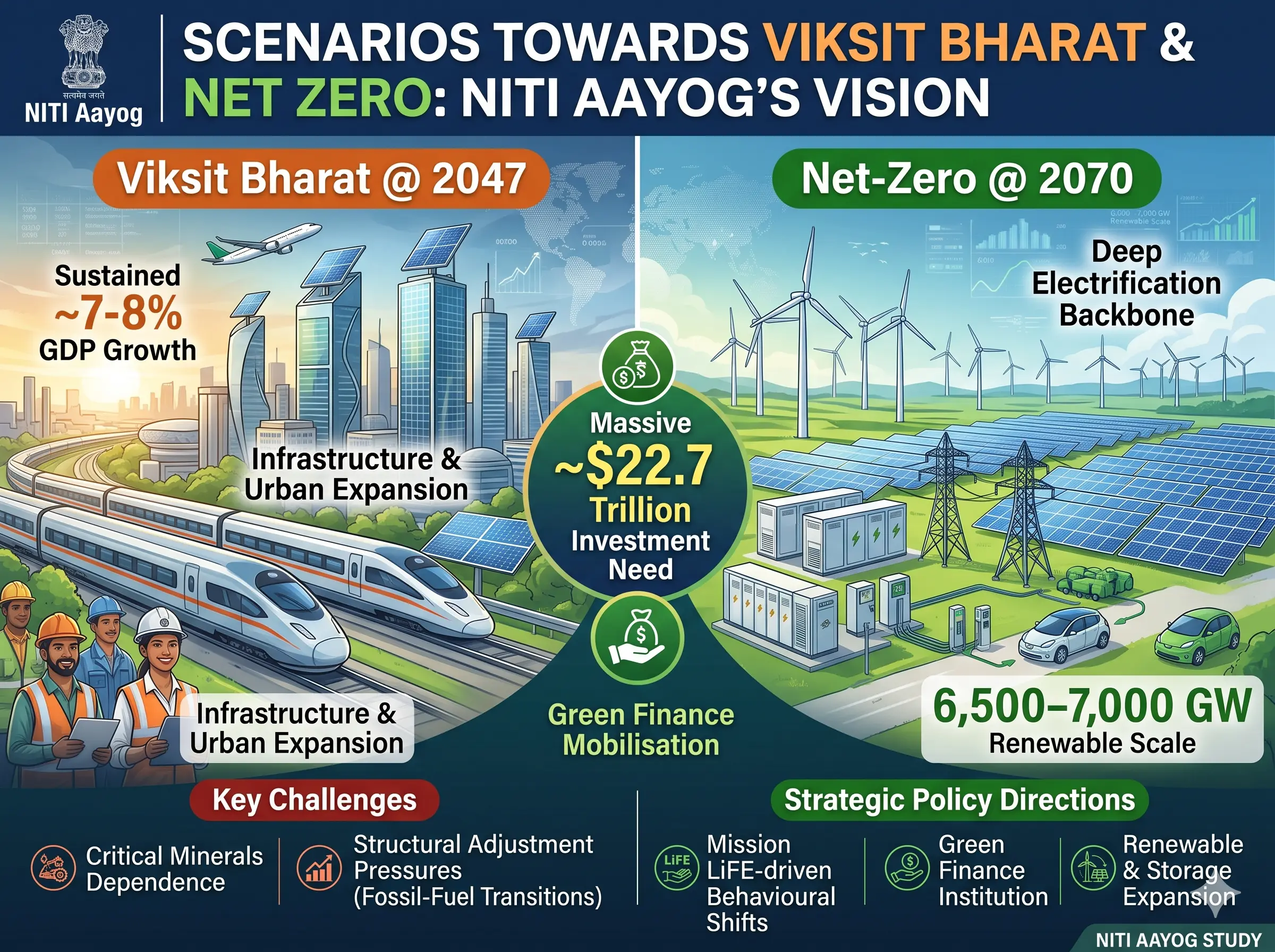
- •Strategic Policy Directions: NITI Aayog suggests institutionalising Mission LiFE for demand moderation, accelerating electrification, and establishing a national green finance institution.
Core Strategy for Viksit Bharat @ 2047
| Requirement | Description | Bookmark |
|---|---|---|
| High Growth Requirement | Sustained real GDP growth of ~7–8% to become a high-income developed economy. | |
| Infrastructure Expansion | Nearly 85% of India's 2047 infrastructure is yet to be built, offering a chance for low-carbon urbanisation. | |
| Demographic Dividend | Productive absorption of the large working-age population is critical. |
Core Strategy for Net-Zero Emissions @ 2070
| Key Driver | Details | Bookmark |
|---|---|---|
| Electrification Backbone | Deep electrification across sectors is the main driver for long-term emissions reduction. | |
| Massive Investment | Achieving net-zero requires ~$22.7 trillion, implying a massive long-term climate capital mobilisation. | |
| Energy System Transformation | Scaling renewables to 6,500–7,000 GW to reshape the power mix, storage, and grid architecture. |
Related Entities
Impact & Significance
- •Macroeconomic Rebalancing: The transition will shift India's growth model towards a capital-intensive, technology-led framework.
- •Social Transitions: With climate shocks compounding existing challenges (40% of districts facing high climate risks), building resilience, especially for the ~45% workforce in agriculture, is essential.
- •Equity and Affordability: Ensuring that the transition does not disproportionately burden lower-income groups, who account for a significant share of growing electricity demand, is critical.
Challenges & Criticism
- •Critical Minerals Dependence: Clean energy technologies could increase lithium demand by over 40 times by 2040, exposing India to import concentration risks and supply chain vulnerabilities (China controls ~60-70% of refining capacity).
- •Insufficient Climate Investment: Current climate investment flows of ~$135 billion annually remain far below the required levels for long-term decarbonisation.
- •Financial System Constraints: India's corporate bond market (~16% of GDP) and household financialisation (~60%) are currently too shallow for the scale of capital needed.
- •Rising Energy Demand: Electricity demand is projected to grow at ~6-7% annually this decade, driven by cooling, industrial expansion, and digital infrastructure.
Future Outlook
- •Demand Moderation: Using Mission LiFE-driven behavioural shifts, efficiency standards, and lifestyle nudges to control long-term energy demand.
- •Green Finance Institution: Establishing a dedicated national green finance institution to mobilise, aggregate, and de-risk large-scale transition capital.
- •Renewable Expansion: Scaling solar, wind, and storage capacity alongside strengthening grid and transmission networks.
- •International Finance Mobilisation: Deepening integration with global capital markets to bridge the ~$6.5 trillion financing gap through concessional climate finance flows.
UPSC Relevance
- • GS-3 (Economy & Environment): Indian Economy and issues relating to planning, mobilization of resources, growth, development and employment. Conservation, environmental pollution and degradation.
- • Mains Focus: Analyzing India's pathways to Net-Zero and Viksit Bharat, including challenges like financing, critical mineral dependency, and structural transition.
Sample Questions
Prelims
With reference to the core strategy for India's net-zero transition as highlighted in NITI Aayog studies, consider the following statements:
1. India aims to achieve Net-Zero emissions by 2047.
2. Under the proposed net-zero pathway, India's electricity demand will decrease due to energy efficiency.
3. Deep electrification across sectors is identified as the single largest driver of long-term emissions reduction.
Answer: Option 3
Explanation: Statement 1 is incorrect; India aims for Viksit Bharat by 2047 and Net-Zero by 2070. Statement 2 is incorrect; electricity demand is projected to grow sharply, driven by cooling needs, digitalisation, and green hydrogen production. Statement 3 is correct as deep electrification is a central component of the net-zero pathway.
Mains
Achieving 'Viksit Bharat' by 2047 and 'Net-Zero' by 2070 presents both synergistic opportunities and complex structural challenges. Discuss in light of the recent NITI Aayog study.
Introduction: Introduce NITI Aayog's recent study which charts India's dual objectives. State the targets: Developed economy status by 2047 and Net-Zero emissions by 2070.
Body:
• Opportunities (Synergies): 85% of 2047 infrastructure is yet to be built (low-carbon urbanisation chance); integration of renewables; massive investment avenues in green technologies.
• Challenges: Critical mineral dependency (e.g., lithium import risks); ~$22.7 trillion investment required; structural adjustments for fossil-fuel-linked sectors (~12 million livelihoods in coal); underdeveloped green finance markets.
• Policy Directions: Institutionalizing Mission LiFE; establishing green finance institutions; expanding domestic corporate bond markets; pushing deep electrification.
Conclusion: Conclude that a coordinated, investment-led approach that balances growth with green transition is essential for India to serve as a role model for the Global South.