
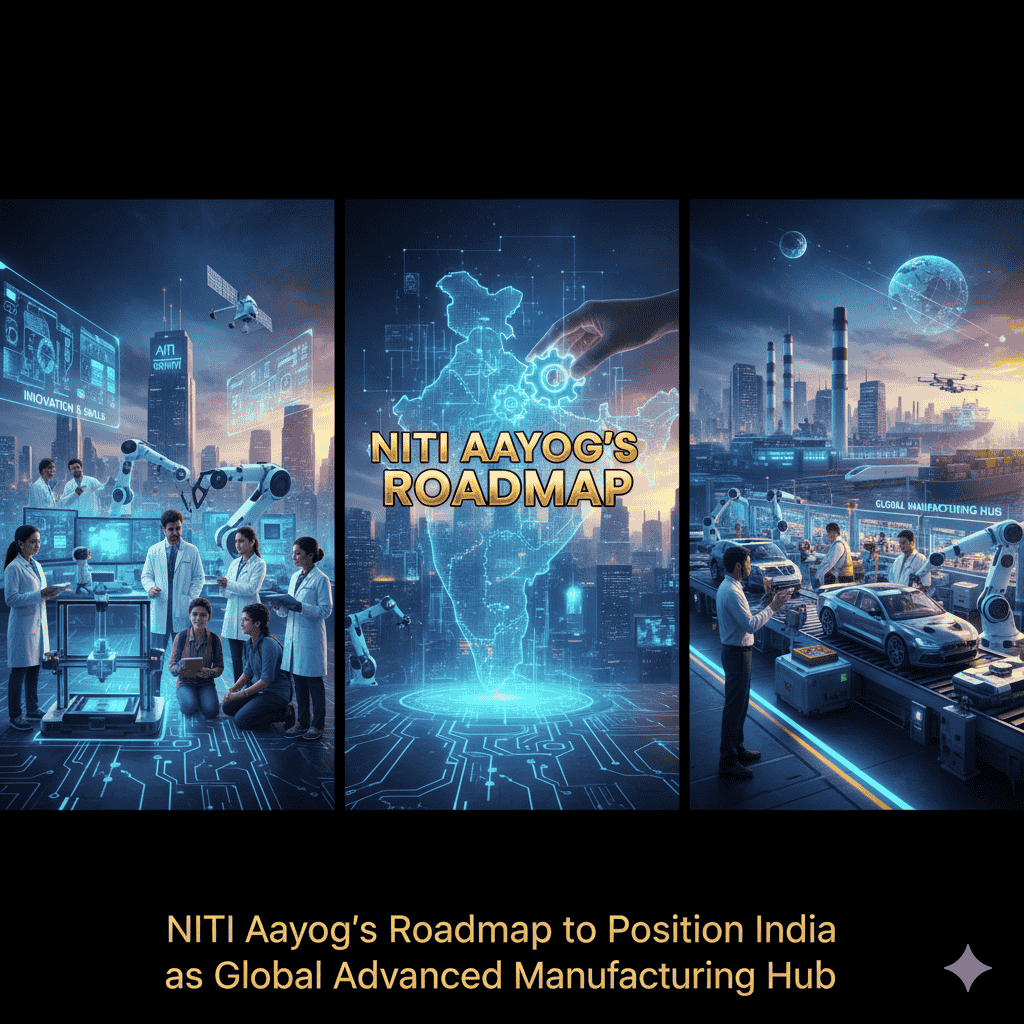
NITI Aayog’s Roadmap to Position India as a Global Advanced Manufacturing Hub
NITI Aayog’s Frontier Tech Hub (2025) report sets out a roadmap to make India a top global advanced manufacturing hub by 2035 through integration of frontier technologies — AI, robotics, digital twins and advanced materials — backed by skilling, cluster-based adoption and infrastructure investments.
Introduction
Context & Background
Key Points
- •Definition — Advanced Manufacturing: Use of digital tools, automation, data and new materials to design, produce and service products with precision, low waste and high customization.
- •Four Frontier Technologies: AI & ML (predictive analytics, optimisation), Robotics (automation, cobots), Digital Twins (real-time virtual replicas for testing/maintenance), and Advanced Materials (lightweight, high-performance, bioengineered materials).
- •Economic Promise: Adopting frontier tech could add $270 billion to GDP by 2035 and up to $1 trillion by 2047; failure to adopt risks losing up to $1.1 trillion in potential manufacturing GDP.
- •Phased Roadmap: Phase 1 (2026–2028) — ecosystem building (NMM, GFTI, tech parks, skilling); Phase 2 (2029–2031) — acceleration and servicification; Phase 3 (2032–2035) — sustainment, indigenous IP, exports.
- •Plug-and-Play Parks & Platforms: 20 frontier-tech parks, shared AI/simulation platforms, and technology access platforms for MSMEs to lower adoption costs.
- •Champion Enterprises: Large firms mentor clusters and MSMEs, providing technology transfer, certification and market linkages.
- •Servicification: Manufacturing + services (remote diagnostics, pay-per-use) increases lifetime value of products and creates steady revenue streams.
- •Skill & Jobs: Focus on modular skilling — robotics, AI, materials science — to reskill the workforce and create higher-quality jobs.
- •Sustainability & Resilience: Advanced manufacturing emphasises circular practices, energy efficiency and supply-chain traceability to meet global ESG requirements.
- •Global Partnerships: Collaboration with Japan, Germany, South Korea, and the U.S. for technology exchange and supply chain relocation.
Frontier Technologies — Core Functions & Impact
| Technology | Core Functions | Impact Areas | Bookmark |
|---|---|---|---|
| AI & ML | Predictive analytics, quality control, design automation | Productivity, defect reduction, energy optimisation | |
| Digital Twins | Real-time virtual replica of machines/processes | Faster R&D, predictive maintenance, lower downtime | |
| Robotics | Automated and collaborative machines (cobots) | Precision, speed, worker safety, lower manual drudgery | |
| Advanced Materials | Lightweight, high-performance, bioengineered materials | Aerospace, defence, green manufacturing |
Phased Strategic Roadmap (2026–2035)
| Phase | Years | Key Actions | Bookmark |
|---|---|---|---|
| Phase 1 — Ecosystem Building | 2026–2028 | NMM, GFTI, skilling missions, technology access platforms, 20 plug-and-play parks | |
| Phase 2 — Acceleration | 2029–2031 | Servicification, GCC integration, scale pilot deployments, expand frontier tech parks | |
| Phase 3 — Sustenance | 2032–2035 | Continuous monitoring, indigenous IP, export of frontier manufacturing solutions |
Related Entities
Impact & Significance
- •GDP & Employment: Potential to add $270 billion to GDP by 2035 and create 100 million skilled jobs, shifting employment from low-productivity to higher-productivity roles.
- •Higher Value Exports: Advanced manufacturing enables production of high-value components (semiconductors, aerospace parts) that can raise India’s export basket quality.
- •Improved Productivity: Adoption of AI, robotics and digital twins can significantly raise factory productivity and reduce defect rates and downtime.
- •Regional Industrialisation: Plug-and-play parks and corridor-linked clusters can spread industrial growth beyond metros, aiding balanced regional development.
- •Strategic Autonomy: Indigenous capabilities in advanced materials and frontier tech reduce dependence on critical imports and strengthen national security supply chains.
- •ESG & Sustainability Gains: Circular practices and energy-efficient processes reduce carbon footprint, helping Indian firms meet global buyer standards.
Challenges & Criticism
- •Low R&D Intensity: India invests under 1% of GDP in R&D (vs 2–4% in peers), slowing technology development and commercialisation.
- •Fragmented Industry–Academia Linkages: Weak collaboration reduces translation of research into scalable manufacturing solutions.
- •Infrastructure & Logistics Costs: High logistics costs (~13–14% of GDP) and unreliable last-mile connectivity increase production costs.
- •Skill Gaps: Only a small fraction of workforce is formally skilled; rapid upskilling is needed for AI/robotics/materials roles.
- •MSME Technology Divide: MSMEs (≈99% of units) lack capital and access to expensive Industry 4.0 tools — risk of widening digital divide.
- •Dependence on Imports: Heavy reliance on imported semiconductors, specialty chemicals and defence components undermines strategic goals.
- •Regulatory & Institutional Friction: Complex approvals, overlapping state regulations, and inconsistent standards slow scaling.
- •Financing Gaps for Deep-Tech: Deep-tech manufacturing requires patient capital and venture-stage funding which is currently limited.
- •IP & Standards: Need faster patent processing, consistent technical standards and certification regimes to support exports.
Future Outlook
- •Institutionalise Advanced Manufacturing: Make the Advanced Manufacturing pillar central to the National Manufacturing Mission (NMM) with clear KPIs for jobs, R&D intensity and exports.
- •Create Global Frontier Technology Institute (GFTI): A centre for R&D, testing, certification and standard-setting to accelerate commercialisation of deep-tech.
- •Scale Plug-and-Play Parks: Rapidly deploy 20 frontier-tech parks with shared equipment, testing labs and workforce training centres to lower adoption barriers for MSMEs.
- •Finance & Incentives: Launch dedicated deep-tech manufacturing funds, production tax incentives for early adopters, and subsidised credit for MSME modernisation.
- •Skilling & Apprenticeships: Integrate frontier tech modules into vocational and engineering curricula; subsidise apprenticeships with champion enterprises.
- •Cluster-Based AI Sandboxes: Establish regional AI and digital-twin sandboxes where MSMEs can safely experiment with low-cost pilots.
- •Localise Critical Inputs: Support domestic ecosystems for semiconductors, specialty polymers and advanced alloys through strategic industrial policy and public–private partnerships.
- •Regulatory Simplification: Implement single-window clearances, harmonise state standards, and fast-track IP processing to reduce compliance drag.
- •Global Partnerships: Secure technology partnerships with Japan, Germany and Korea, and use India’s G20 leadership to attract supply-chain relocations.
- •Measurement & Monitoring: Set up an advanced manufacturing dashboard (KPIs: productivity, export value-add, R&D spend) and conduct periodic third-party evaluations.
UPSC Relevance
- • GS-3: Industrial policy, manufacturing competitiveness, technology and R&D.
- • GS-2: Role of institutions, public–private partnerships and governance.
- • Essay: Technology-led development, Make in India, job creation and strategic autonomy.
Sample Questions
Prelims
With reference to India’s Frontier Tech Hub roadmap, consider the following statements:
- (a)Digital twins are real-time virtual replicas used for predictive maintenance and R&D.
- (b)NITI Aayog’s roadmap proposes 20 plug-and-play frontier tech parks in Phase 1.
- (c)Advanced materials have no role in defence and aerospace manufacturing.
Mains
Discuss how frontier technologies can transform India’s manufacturing sector. Identify major bottlenecks that could hinder this transformation and suggest policy measures to ensure India becomes a leading advanced manufacturing hub by 2035.
Introduction: Frontier technologies (AI, robotics, digital twins, advanced materials) can raise productivity, product quality and global competitiveness in manufacturing.
Body:
• Transformational impacts: Explain productivity gains, reduction in defects, servitisation, export potential and sustainability benefits.
• Bottlenecks: Low R&D, infrastructure and logistics deficits, skill gaps, MSME divide, financing and regulatory friction.
• Policy measures: Institutionalisation under NMM, GFTI, plug-and-play parks, targeted funds, skilling missions, cluster sandboxes, regulatory simplification and international partnerships.
Conclusion: With calibrated policy action and private sector engagement, India can leverage frontier tech to reach a 25% manufacturing share of GDP and emerge as a global advanced manufacturing hub by 2035.