
Pakistan’s Paradox: Concerns for India
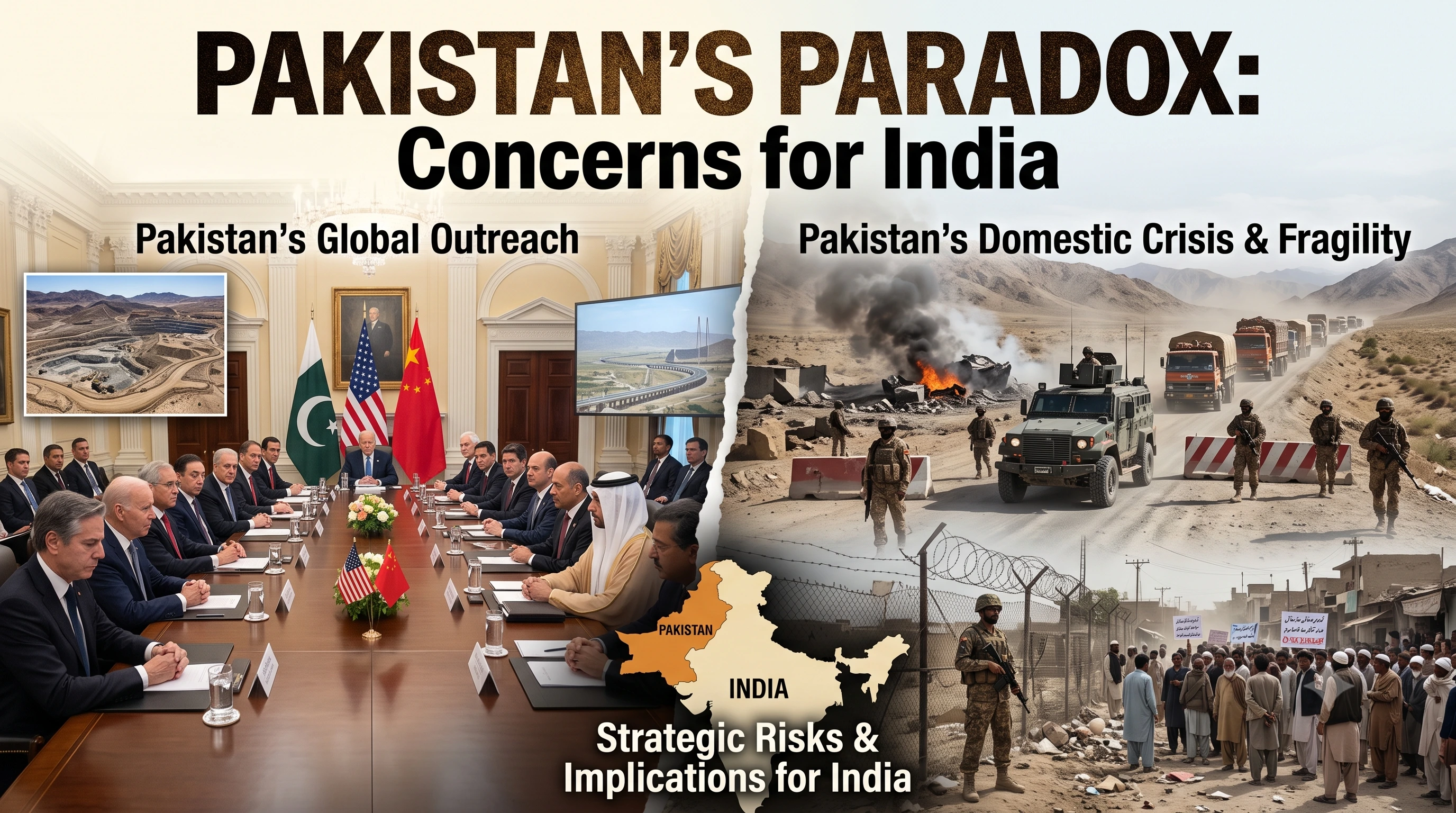
This article explores Pakistan's strategic paradox: its expanding global diplomatic and defence engagements contrast sharply with its deepening domestic security crises, structural economic vulnerabilities, and military dominance. It analyzes the implications of this instability for India and suggests a comprehensive diplomatic and security way forward.
Introduction
Context & Background
Key Points
- •The Strategic Paradox: Pakistan is actively expanding its global footprint—positioning itself as a bridge between Washington and Beijing while securing defence pacts globally—even as it struggles with profound internal security and economic instability.
- •Rising Militancy: The security crisis is deepening with a surge in attacks by the Tehrik-e-Taliban Pakistan (TTP) and the Baloch Liberation Army (BLA), fueled by the ideological spillover of the Taliban's takeover in Afghanistan.
- •Severe Economic Vulnerability: The country remains heavily dependent on a $7 billion IMF stabilization program, facing sluggish GDP growth (3.2% projected for 2026) and a desperate need to create 2.5–3 million jobs annually to avert social unrest.
- •Military Dominance: Army Chief Asim Munir's prominent role underscores the military's total consolidation of power over foreign and security policy, relegating the civilian government to a secondary role.
- •Historical Proxies: Historically, when Pakistan faces internal stress under military leadership, it frequently resorts to proxy warfare and cross-border militancy to project influence, as seen during the 1999 Kargil conflict.
Pakistan's Expanding Global Outreach
| Country / Region | Key Engagements & Pacts | Bookmark |
|---|---|---|
| United States | Board of Peace participation; $1.3B backing for Reko Diq mining project. | |
| China | Sustaining the China-Pakistan Economic Corridor (CPEC) and strategic balancing. | |
| Saudi Arabia & Others | Defence pacts and arms deals with Sudan, Libya, and Bangladesh. |
Dimensions of the Domestic Security Crisis
| Crisis Vector | Impact & Characteristics | Bookmark |
|---|---|---|
| TTP & BLA Surge | Over 2,400 estimated fatalities in 2025; rising militant attacks. | |
| Taliban Spillover | Ideological and logistical emboldenment post-2021 Afghan takeover. | |
| Balochistan Insurgency | Separatist violence fueled by economic marginalisation and enforced disappearances. | |
| Urban Insecurity | Suicide attacks and mosque bombings spreading to Islamabad. |
Related Entities
Impact & Significance
- •Proxy and Cross-Border Risk: A Pakistan led by a strong military facing internal stress frequently resorts to proxy tools or limited military adventurism (e.g., Kargil in 1999) to project influence and distract from domestic failures.
- •Arms and Technology Flows: Renewed defence ties and third-country arms deals (with Gulf nations, China, and the US) could improve Pakistani military capabilities, altering the regional security balance.
- •Instability Spillovers: Internal destabilization in Pakistan threatens India with refugee flows, heightened cross-border militancy, and illicit trafficking, placing a massive security burden on India's western states.
- •Diplomatic Openings: Pakistan’s multi-aligned engagement strategy (US, China, Gulf) simultaneously provides India with a window to coordinate with shared partners to stabilize the region and mitigate adverse outcomes.
Challenges & Criticism
- •IMF Dependency & Debt: Pakistan's economy is highly fragile, relying on a $7 billion IMF stabilization program with modest growth projections that cannot sustain its demographic pressures.
- •Defence vs. Development: Expanding defence partnerships enhances global visibility but completely fails to address core domestic issues like massive unemployment and inflation.
- •Alienation through Force: Heavy-handed military operations in provinces like Balochistan and Khyber Pakhtunkhwa risk deepening civilian alienation and accelerating radicalization.
- •Erosion of Civilian Governance: The overarching dominance of the military establishment has relegated the civilian leadership to a secondary role, undermining democratic accountability and structural reform.
Future Outlook
- •Vigilant Defence Posture: India must maintain strong deterrence along its western borders, strengthen coastal and border surveillance, and deepen counter-terror intelligence cooperation.
- •Diplomatic Engagement: New Delhi should work with international partners (such as the US, GCC, and China) to ensure that investments in Pakistan are conditional on inclusive governance and strict anti-terror safeguards.
- •Humanitarian Preparedness: India needs proactive contingency planning in its western states to handle potential refugee inflows and cross-border humanitarian emergencies stemming from Pakistan's destabilization.
- •Economic Containment & Cooperation: India must closely monitor global arms transfers to Pakistan while simultaneously expanding its own economic ties with regional partners to reduce incentives for instability.
- •Track Civil-Military Dynamics: Diplomatic channels should be leveraged to emphasize the value of civilian governance and inclusive solutions, while carefully avoiding steps that could be construed as direct interference.
UPSC Relevance
- • GS-2 (International Relations): India and its neighborhood- relations; Bilateral, regional and global groupings and agreements involving India and/or affecting India's interests.
- • GS-3 (Internal Security): Challenges to internal security through communication networks, role of media and social networking sites; Security challenges and their management in border areas.
Sample Questions
Prelims
With reference to Pakistan's current strategic scenario, consider the following statements: 1. The Reko Diq mining project is located in the Khyber Pakhtunkhwa province. 2. The China-Pakistan Economic Corridor (CPEC) positions Pakistan as a strategic bridge between Washington and Beijing. 3. Historically, military-dominated regimes in Pakistan have often seen increased proxy activity against India. Which of the statements given above is/are correct?
1. 1 and 2 only
2. 3 only
3. 2 and 3 only
4. 1, 2, and 3
Answer: Option 2
Explanation: Statement 1 is incorrect: The Reko Diq mining project is located in Balochistan. Statement 2 is incorrect in its phrasing: CPEC is strictly a China-Pakistan initiative, though Pakistan independently tries to act as a bridge between Washington and Beijing. Statement 3 is correct: Periods of military rule (e.g., Musharraf during Kargil) have frequently coincided with heightened proxy attacks against India.
Mains
Pakistan’s expanding global diplomatic outreach stands in stark contrast to its deepening domestic security and economic crises. Analyze this paradox and discuss the strategic implications and the recommended way forward for India.
Introduction: Introduce the paradox: Pakistan's recent global engagements (US investments, CPEC, defence pacts) juxtaposed against rising internal militancy (TTP/BLA) and economic reliance on the IMF.
Body:
• The Domestic Crises: Highlight the surge in terror attacks, ideological spillover from Afghanistan, the Balochistan insurgency, and structural economic vulnerabilities (IMF dependency, unemployment).
• Implications for India: Discuss cross-border proxy risks (drawing parallels to Kargil), potential refugee spillovers, and the shifting regional balance due to foreign arms flows.
• Way Forward: Suggest a vigilant defence posture, global diplomatic engagement to ensure conditional investments, humanitarian preparedness, and monitoring of civil-military dynamics.
Conclusion: Conclude that while Pakistan's internal fragility offers diplomatic openings for India to coordinate with global partners, it requires a robust, proactive security apparatus to insulate India from spillover effects.