
Parliamentary Diplomacy in India: Mechanisms, Roles, and Limitations
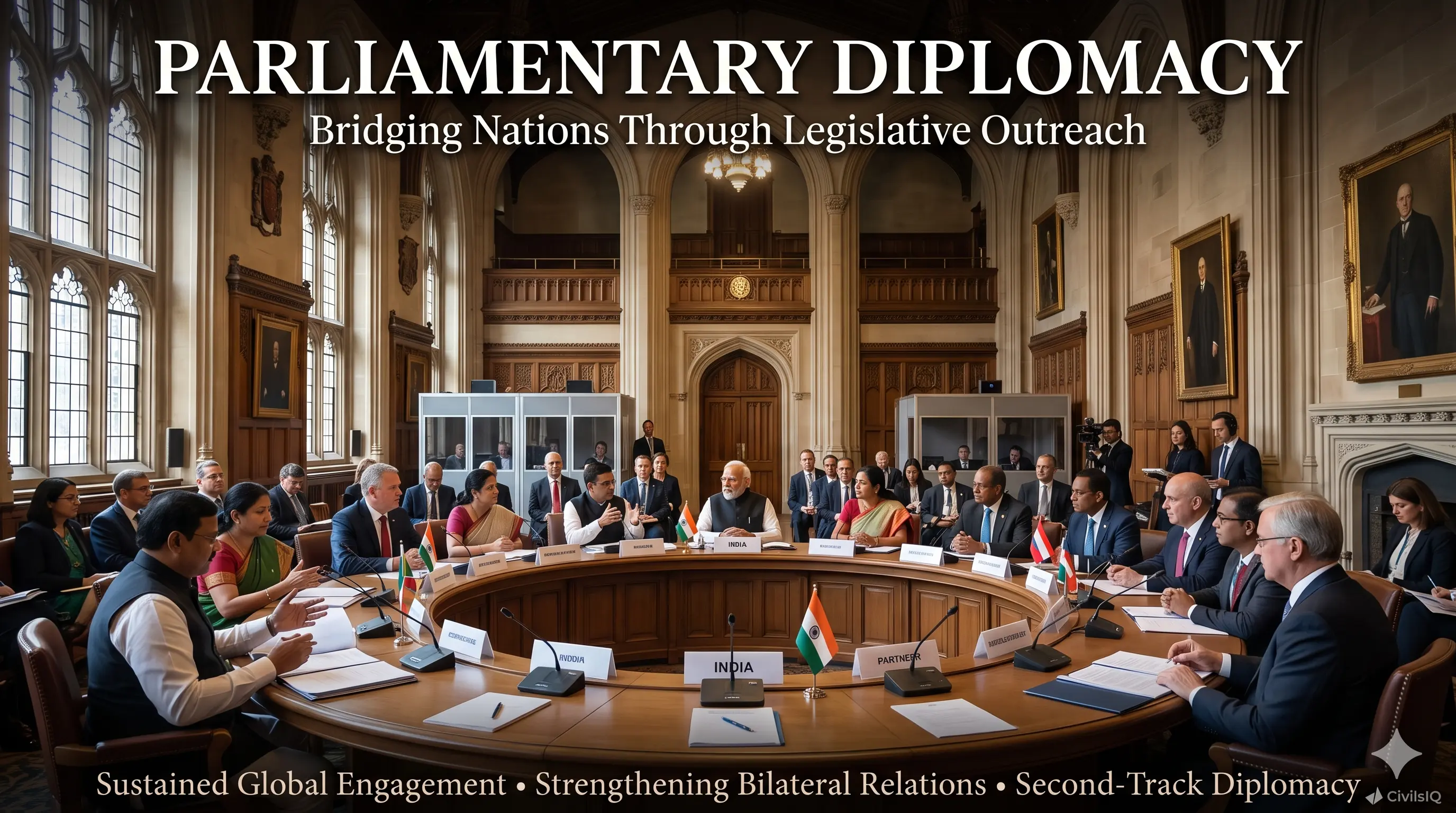
In a major initiative to strengthen India's global outreach, Lok Sabha Speaker Om Birla has constituted Parliamentary Friendship Groups with over 60 countries. This underscores the growing importance of parliamentary diplomacy as a 'second-track' diplomatic channel that supplements traditional executive-led foreign policy.
Introduction
Context & Background
Key Points
- •Second-Track Diplomacy: Parliamentary diplomacy acts as an essential 'second-track' channel that supplements traditional government-to-government diplomacy, leveraging the representative legitimacy of elected officials.
- •The PFG Initiative: The recent constitution of Parliamentary Friendship Groups (PFGs) with over 60 countries aims to institutionalize sustained, direct dialogue between Indian lawmakers and their global counterparts.
- •Broadening Engagements: Discussions extend beyond traditional politics to encompass trade, technology cooperation, social policies, and shared global democratic challenges.
- •Public and Diaspora Diplomacy: Legislators serve as informal ambassadors, engaging with foreign think tanks, universities, and the Indian diaspora to project India's soft power and address community concerns.
- •Navigating Sensitive Geopolitics: The relatively informal setting of parliamentary exchanges allows for confidence-building conversations on politically delicate matters that formal diplomatic routes might find challenging.
Mechanisms of Parliamentary Diplomacy in India
| Mechanism | Description | Key Function | Bookmark |
|---|---|---|---|
| Parliamentary Delegations | Reciprocal visits by Indian and foreign legislators. | Facilitate structured dialogue on political, economic, and security issues. | |
| Inter-Parliamentary Forums | Global and regional bodies like IPU and SAARC Parliamentary Forum. | Exchange legislative practices and build consensus on multilateral issues. | |
| Parliamentary Friendship Groups | Structured bilateral engagement with partner countries. | Enable sustained interaction and long-term networks beyond episodic visits. | |
| Hosting Foreign Parliamentarians | Visits by foreign legislators and parliamentary officials to India. | Expose delegates to India's democratic practices and provide informal policy dialogue spaces. |
Illustrative Examples of Parliamentary Engagement
| Partnership | Key Areas of Focus | Impact | Bookmark |
|---|---|---|---|
| India–Bangladesh | Border management, water sharing, connectivity. | Complements formal diplomacy between the two nations. | |
| India–Africa | Development cooperation, capacity building, trade and investment. | Reinforces India's broader Africa partnership strategy. | |
| India–European Union | Trade negotiations, regulatory cooperation, strategic issues. | Helps sustain momentum in India–EU bilateral relations. |
Related Entities
Impact & Significance
- •Strengthening Bilateral Relations: Direct engagement builds institutional familiarity and personal rapport, creating a supportive political environment for executive agreements (e.g., India-US strategic partnership).
- •Promoting India's Perspective: Parliamentarians use their democratic mandate to present India's views credibly in foreign legislatures and multilateral forums.
- •Addressing Sensitive Issues: The informal settings allow legislators to discuss politically delicate matters that are difficult to address through official executive channels.
- •Supporting Diaspora Engagement: MPs interact with Indian diaspora communities abroad, addressing their concerns and reinforcing emotional and economic ties.
- •Enhancing Public Diplomacy: Lawmakers extend India's footprint by engaging with foreign universities, think tanks, civil society, and media, broadening diplomacy beyond official messaging.
Challenges & Criticism
- •Absence of Binding Authority: Exchanges are fundamentally non-binding; they cannot produce enforceable outcomes without subsequent follow-up by governments.
- •Political Polarisation: Domestic ideological differences between political parties can sometimes spill over into international interactions, potentially hindering consensus-building.
- •Resource and Logistical Constraints: Effective and sustained diplomatic engagements require significant financial, institutional, and administrative support.
- •Coordination Gaps: A lack of seamless institutional coordination between Parliament, the Ministry of External Affairs, and other executive agencies can reduce overall policy coherence.
Future Outlook
- •Institutionalizing Coordination: Establishing a formalized coordination mechanism between the Parliament, the Ministry of External Affairs (MEA), and other agencies to ensure policy coherence.
- •Resource Enhancement: Allocating dedicated administrative and financial resources to sustain the frequency, depth, and geographic spread of parliamentary engagements.
- •Expanding Geographic Footprint: Gradually expanding the PFG network to include more countries, particularly in strategically vital and emerging regions.
- •Action-Oriented Dialogues: Evolving these friendship groups from mere dialogue platforms to mechanisms that follow up on specific bilateral agreements and developmental goals.
UPSC Relevance
- • GS-II (International Relations): Bilateral, regional and global groupings and agreements involving India and/or affecting India's interests.
- • GS-II (Polity & Governance): Parliament and State legislatures—structure, functioning, conduct of business, powers & privileges and issues arising out of these.
- • Interview/Personality Test: Understanding the nuances of soft power, track-two diplomacy, and the evolving role of Parliament in foreign affairs.
Sample Questions
Prelims
Consider the following statements regarding Parliamentary Diplomacy in India: 1. Decisions and agreements reached during parliamentary exchanges are legally binding on the executive. 2. India is a participant in global parliamentary bodies like the Inter-Parliamentary Union (IPU). 3. Parliamentary Friendship Groups (PFGs) are primarily constituted and managed by the Ministry of External Affairs.
1. 1 and 2 only
2. 2 only
3. 2 and 3 only
4. 1, 2, and 3
Answer: Option 2
Explanation: Statement 1 is incorrect: Parliamentary exchanges are non-binding and rely on the executive for implementation. Statement 2 is correct: India actively participates in the IPU. Statement 3 is incorrect: PFGs are constituted by the Parliament (Lok Sabha Speaker), not the MEA.
Mains
"Parliamentary diplomacy has emerged as a crucial 'second-track' channel in India's foreign policy matrix." Discuss the mechanisms of parliamentary diplomacy in India and evaluate its role and limitations in strengthening bilateral relations.
Introduction: Define parliamentary diplomacy and contextualize it with the recent constitution of Parliamentary Friendship Groups by the Lok Sabha Speaker.
Body:
• Mechanisms: Parliamentary delegations, Inter-Parliamentary forums (like IPU), Parliamentary Friendship Groups (PFGs with 60+ nations), and hosting foreign MPs.
• Role & Significance: Builds personal rapport, addresses sensitive issues informally, enhances public diplomacy (engaging diaspora/think tanks), and promotes India's democratic credibility.
• Limitations: Non-binding nature of outcomes, domestic political polarization affecting consensus, resource/logistical constraints, and coordination gaps with the MEA.
Conclusion: Conclude by highlighting that while parliamentary diplomacy cannot replace traditional executive diplomacy, institutionalizing better coordination can make it a formidable tool for advancing India's strategic objectives.