
Safeguarding Personality Rights in India
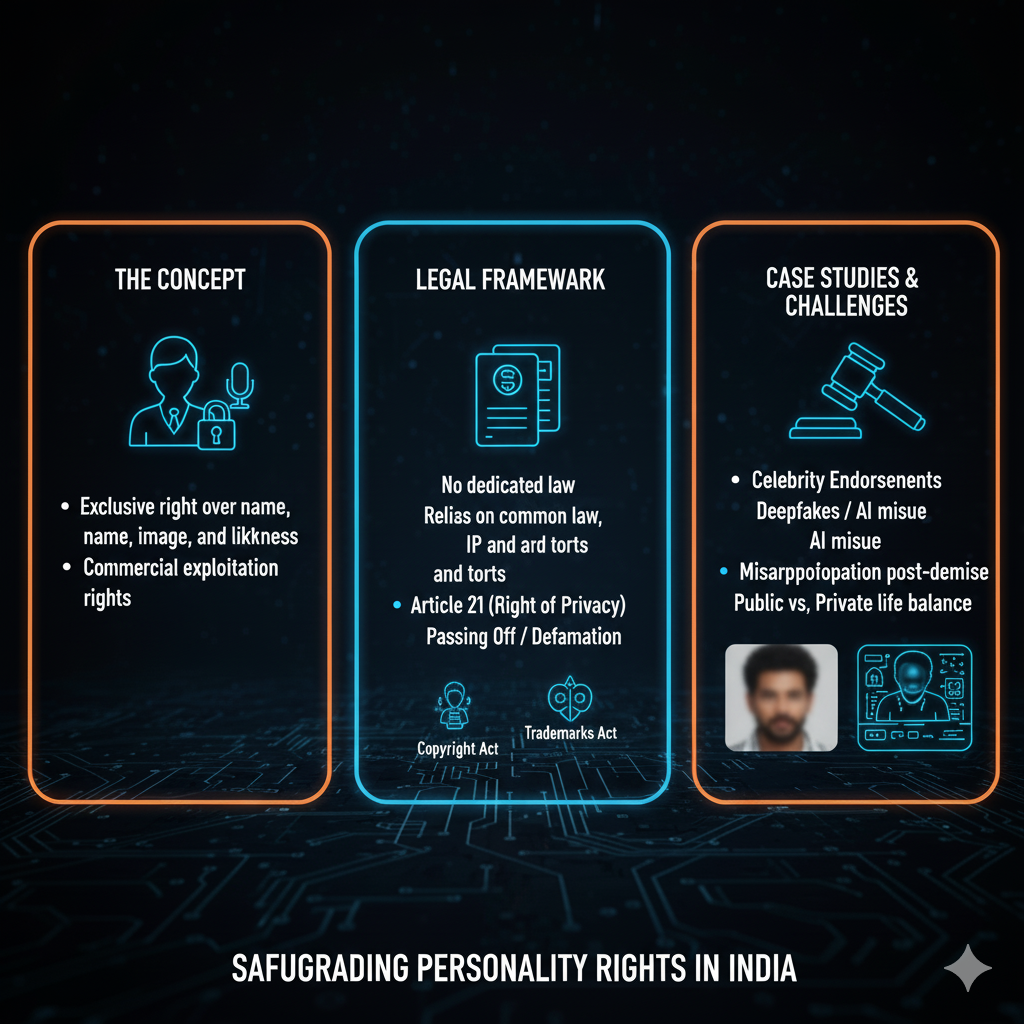
Indian courts are increasingly protecting personality rights including name, image, voice and likeness amid rising misuse through AI deepfakes. Constitutional courts have recognized the right to control one's persona as part of Article 21. However, India still lacks a dedicated statutory framework balancing privacy, dignity, free speech and technological disruption.
Introduction
The proliferation of AI, deepfakes, audio cloning, and digital monetisation platforms has created new vulnerabilities for individuals' identity and reputation. Recent Delhi and Bombay High Court orders protecting the personality rights of Aishwarya Rai Bachchan, Abhishek Bachchan, Anil Kapoor, Arijit Singh and Jackie Shroff mark a judicial push towards digital dignity and identity autonomy in India.
Context & Background
While courts have expanded Right to Privacy (Art. 21) to include personal identity control, the absence of a dedicated law leaves gaps in enforcement, especially against cross-border AI misuse and social media exploitation.
Key Points
- •Constitutional Anchoring: Personality rights derive from Article 21 (privacy, dignity, autonomy) and intersect with Article 19(1)(a) (speech vs dignity balance), reflecting India's evolving dignitarian jurisprudence post-Puttaswamy.
- •Right to Control Identity: Courts recognise control over name, face, voice & likeness as essential to dignity—extending to both celebrities and ordinary individuals.
- •Digital & AI Disruption: Generative AI enables hyper-real deepfakes, synthetic voices and avatar cloning → risk of fraud, defamation, sexism, political manipulation.
- •Economic Dimension: Persona as commercial property (endorsement, merchandising, NFTs, gaming avatars) → violation causes economic loss.
- •Consumer Protection: Prevents fake endorsements & fraudulent ads → protects public trust & market integrity.
- •Balancing Rights: Courts must balance dignity vs satire, parody, academic use to avoid chilling effect on speech.
- •Global Comparative Insight: US has state-wise 'Right of Publicity'; Germany protects dignity under BGB; EU pushing AI Act; India lacks codified equivalent.
- •Need for Uniform Legal Framework: Current protection scattered across privacy law, IP law & torts → need consolidated regime.
- •Cyber Enforcement Challenge: Cross-border servers, anonymity & platform immunity strain enforcement—need real-time digital takedown.
- •Vulnerable Groups: Women disproportionately targeted via non-consensual deepfake porn, revenge porn—must extend remedy beyond celebrities.
Related Entities
Impact & Significance
- •Strengthens dignity-based rights framework
- •Helps counter misinformation & fraud
- •Boosts entertainment & creator economy
- •Creates safeguards for vulnerable citizens against tech abuse
Challenges & Criticism
- •No dedicated legislation → fragmentation across Copyright & Trademarks Acts
- •Tension with free speech/parody & artistic freedom
- •Slow takedown mechanisms vs viral deepfake spread
- •Cross-border enforcement limitations
- •Lack of digital forensics capacity in police & judiciary
Future Outlook
- •Dedicated Personality Rights Act
- •Regulation & watermarking of AI content
- •Platform liability and real-time takedown system
- •Judicial training in cyber forensics & AI-law
- •Inclusion of non-celebrity victims and gendered deepfake crimes
UPSC Relevance
- • GS-2: Fundamental Rights, Judiciary, Digital Governance
- • GS-3: Cybersecurity, Technology Ethics
- • GS-4: Dignity, Autonomy, Privacy Ethics
- • Essay: AI, Rights, Democracy & Technology
Sample Questions
Prelims
Personality rights primarily relate to which constitutional protection?
- (a)Article 14
- (b)Article 19(1)(a)
- (c)Article 21
- (d)Article 32
Mains
In the context of emerging AI technologies, critically examine the need to codify personality rights in India.
Introduction: AI-generated deepfakes and identity cloning threaten individual dignity, democratic trust & economic value of persona.
Body:
• Constitutional basis → Art 21 dignity & privacy + economic rights
• Current gaps → no unified statute, tech-platform challenge, free-speech tension
• Reforms → Personality Rights Act, AI regulation, fast takedown, global cooperation
Conclusion: India must adopt a balanced, rights-protective statutory framework safeguarding identity while preserving legitimate speech & innovation.