
PLI Scheme under WTO Scrutiny: India vs. China Dispute
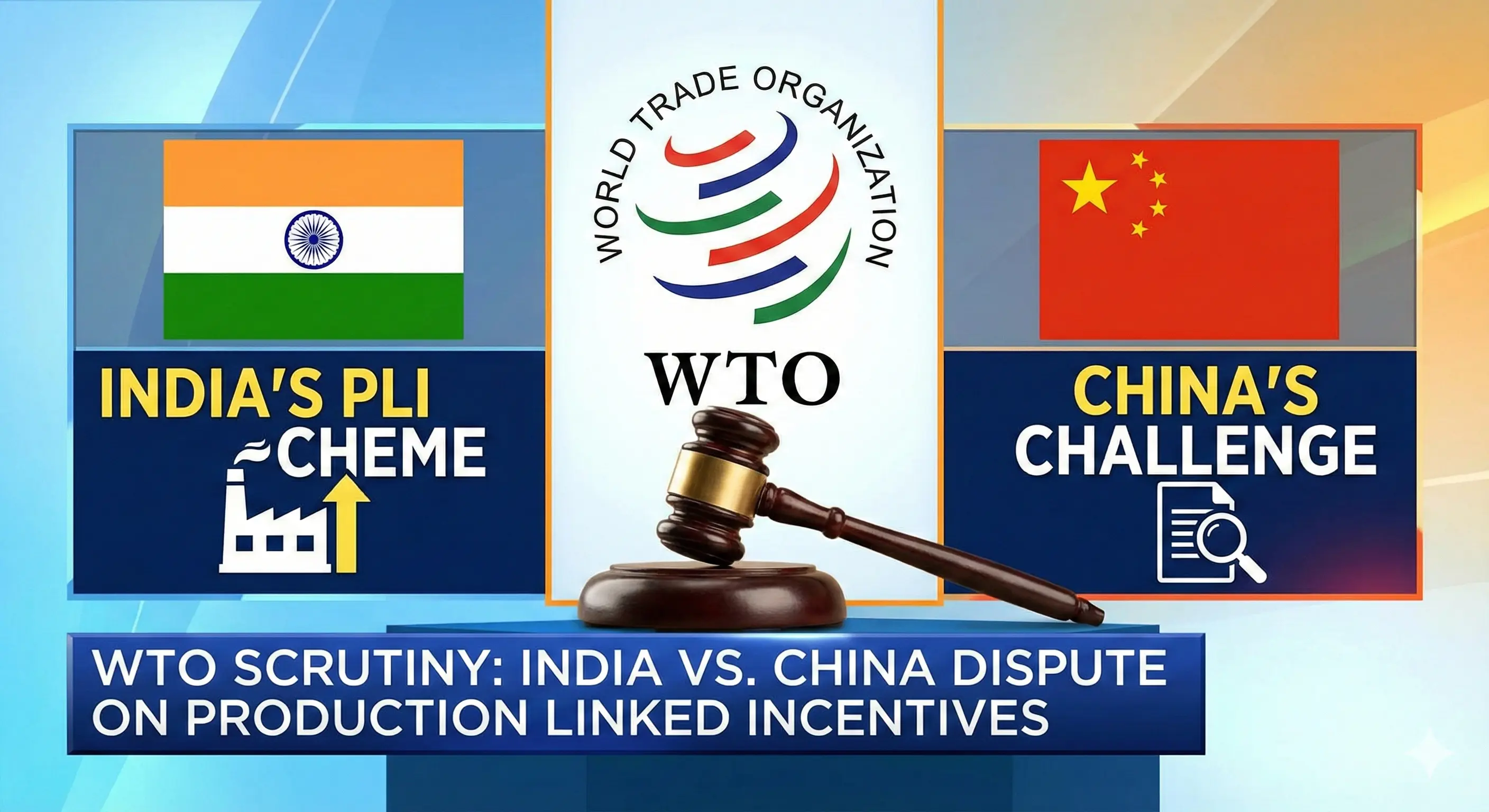
China has filed a complaint at the WTO alleging that India's Production-Linked Incentive (PLI) schemes violate international trade rules by favoring domestic goods over imports. This dispute highlights the tension between India's 'Atmanirbhar Bharat' manufacturing push and global fair trade obligations.
Introduction
Context & Background
Key Points
- •The Core Allegation (Domestic Value Addition): China argues that the PLI schemes mandate Domestic Value Addition (DVA) targets (e.g., 50% for Autos). This means a company cannot just import kits from China and assemble them in India ('screwdriver technology') to claim the subsidy. They must source parts locally. China claims this creates a 'Prohibited Subsidy' under WTO rules because it is legally contingent upon the use of domestic goods over imported ones.
- •The Legal Framework (SCM Agreement): The WTO's Agreement on Subsidies and Countervailing Measures (SCM) is the rulebook for industrial subsidies. Article 3.1(b) is the 'Red Light' provision—it explicitly prohibits subsidies that require using local goods instead of imports. This is different from subsidies based on just production or R&D, which are generally allowed.
- •Specific Sectors Targeted:
1. ACC Batteries: India wants to make its own EV batteries to reduce reliance on China (China controls ~75% of global battery manufacturing).
2. Automobiles: Incentives for making advanced car components in India.
3. Electric Vehicles: Attracting global giants (like Tesla or BYD) to make cars in India rather than importing them. - •Other Violated Rules: China also cites:
- GATT Article III.4 (National Treatment): The principle that you must treat foreign goods the same as local goods once they enter your country (no internal discrimination).
- TRIMs Article 2.1: Prohibits investment measures that restrict trade (like Local Content Requirements). - •The 'Appeal into the Void' Crisis: The WTO dispute resolution has two steps: a Panel ruling and then an Appeal. However, the WTO Appellate Body has been dysfunctional since 2019 because the USA has blocked the appointment of judges. This means even if India loses the initial case, it can appeal to a non-existent body, effectively delaying any penalty indefinitely.
WTO Subsidies Classification (SCM Agreement)
| Type | Category | Description | Status | Bookmark |
|---|---|---|---|---|
| Prohibited | Red Light | Subsidies linked to Export performance or using Local Goods. | Illegal (Must be withdrawn immediately) | |
| Actionable | Yellow/Amber Light | Subsidies that hurt another country's industry (e.g., making your goods artificially cheap). | Challengeable (If adverse trade effects are proven) | |
| Non-Actionable | Green Light | Subsidies for R&D, regional development (disadvantaged regions), or environmental compliance. | Permitted (Generally safe from challenge) |
Previous India vs. USA Disputes (Precedents)
| Case Name | Issue | Verdict | Bookmark |
|---|---|---|---|
| India – Solar Cells (2016) | India mandated solar power developers to use Indian-made solar cells/modules (DCR - Domestic Content Requirement). | India Lost. WTO ruled it violated National Treatment (discrimination against US solar cells). | |
| India – Export Measures (2019) | India gave tax benefits (MEIS/SEZ) linked to export performance. | India Lost. WTO ruled these were prohibited export subsidies (Red Light). |
Related Entities
Impact & Significance
- •Strategic Competition: This is not just a trade dispute; it is a geopolitical tussle. China wants to maintain its dominance in the Green Energy supply chain (Batteries/EVs), while India is trying to break free using PLI. It is part of the broader 'China Plus One' strategy.
- •Global Hypocrisy (The Western Context): India argues that developed nations are doing the same. The US Inflation Reduction Act (IRA) offers $369 billion in subsidies for EVs *only* if they are made in North America. The EU has its 'Green Deal'. India contends it is unfair to target developing nations for policies that the rich world is aggressively pursuing.
- •Policy Dilemma: India faces a 'Trinity' challenge: It wants Industrial Growth (Make in India), Global Integration (Supply Chains), and WTO Compliance. Balancing all three is difficult.
- •Reputational Risk: If India is labeled a rule-breaker, it might impact Free Trade Agreement (FTA) negotiations with the EU and UK, who also focus heavily on 'Sustainability Standards' and fair competition.
Challenges & Criticism
- •Defending 'Value Addition': India argues that 'Value Addition' is different from 'Local Content Requirement'. Value addition can come from labor, technology, or land—not just raw materials. However, proving this legally is complex if the policy text explicitly mentions sourcing percentages.
- •Risk of Countervailing Duties (CVD): Even if the WTO process is slow, China could unilaterally impose Countervailing Duties (extra taxes) on Indian goods entering China, claiming they are subsidized. This would hurt Indian exports.
- •The 'Screwdriver' Problem: Without the DVA condition, companies might just import finished parts from China and assemble them in India. The PLI would then end up subsidizing Chinese manufacturing, defeating the purpose of Atmanirbhar Bharat.
Future Outlook
- •Consultation Phase: Currently, India and China are in the mandatory 60-day consultation period. India will try to explain that its PLI is about building capability, not discriminating against imports.
- •Tweaking the Policy: If the pressure mounts, India might rephrase the PLI rules to remove explicit 'Local Content' language while keeping the incentives, focusing on 'Performance' or 'Investment' metrics rather than the 'Origin' of goods.
- •Diplomatic Alliances: India will likely team up with other Global South nations to push for WTO reforms. The argument will be that WTO rules, written in the 1990s, need to be updated to allow developing countries space to subsidize their infant industries for green transitions.
UPSC Relevance
- • GS-2: Important International institutions, agencies and fora - their structure, mandate (WTO dispute mechanism).
- • GS-3: Indian Economy (Industrial Policy, Liberalization, PLI Scheme vs WTO norms).
- • GS-2: India and its neighborhood- relations (India-China trade war).
- • Essay: Globalization vs. Protectionism: The new world order.
Sample Questions
Prelims
With reference to the World Trade Organization (WTO) Agreement on Subsidies and Countervailing Measures (SCM), consider the following statements:
1. 'Prohibited Subsidies' are those contingent upon export performance or the use of domestic goods over imported goods.
2. 'Green Light' subsidies are actionable and can be challenged by other member countries if they cause injury.
3. India's PLI scheme has been challenged under the allegation of being an Import Substitution subsidy.
Answer: Option 1, Option 3
Explanation: Statement 2 is incorrect (Green Light/Non-Actionable subsidies cannot be challenged; only Actionable/Amber ones can be). Statements 1 and 3 are correct.
Mains
India's ambition for 'Atmanirbhar Bharat' through schemes like PLI often comes into conflict with international trade obligations under the WTO. Analyze this conflict in light of the recent dispute raised by China, and discuss if the global trade regime needs reform.
Introduction: Define PLI and its objective. Mention the China-WTO complaint regarding Domestic Value Addition (DVA).
Body:
• The Conflict: Domestic development goals (preventing assembly-only industry) vs. WTO rules (National Treatment/SCM Article 3.1b).
• China's Argument: PLI acts as a prohibited Import Substitution subsidy, discriminating against Chinese supply chains.
• Global Context: Comparison with US Inflation Reduction Act and EU Green Deal; the argument for 'Development Policy Space'.
• Way Forward: Legal defense (DVA vs Local Content), utilizing the Appellate Body vacuum strategically, and pushing for WTO reforms that allow green industrialization.
Conclusion: Conclude that while India must respect international law, the WTO rules framed in a different era must evolve to accommodate the strategic autonomy required for energy transitions in the Global South.