
PRAHAAR: India’s National Counter-Terror Doctrine
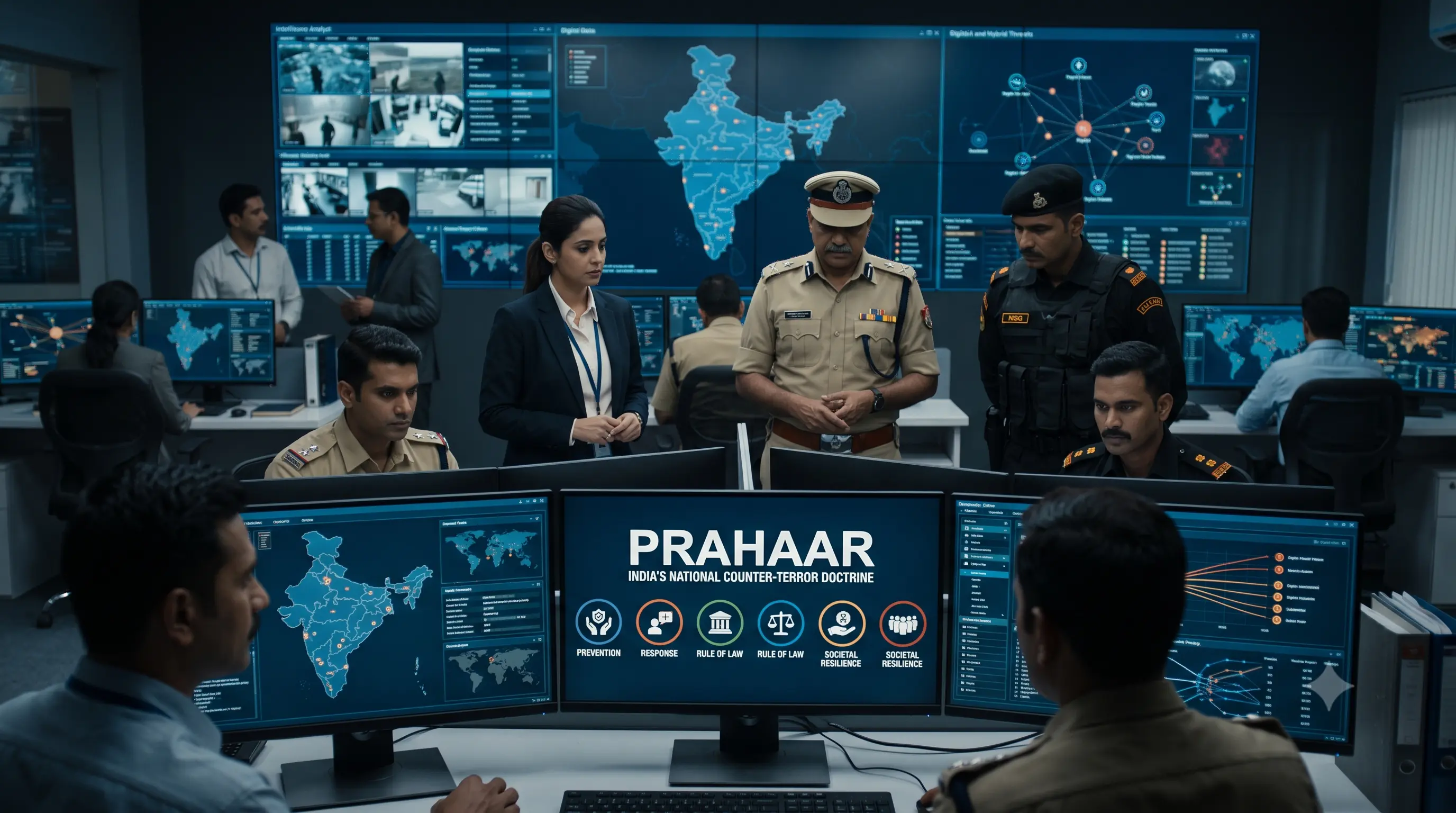
PRAHAAR marks a strategic shift in India's counter-terrorism architecture from dispersed, reactive measures to an integrated, systems-based national doctrine. Built on seven pillars and a whole-of-government model, it consolidates intelligence, addresses hybrid threats, embeds human rights, and enhances global counter-terror alignment.
Introduction
Context & Background
Key Points
- •Seven Pillars of PRAHAAR: The framework rests on seven key pillars: prevention, response, capacity aggregation, rule of law, counter-radicalisation, international cooperation, and societal resilience.
- •Whole-of-Government & Whole-of-Society Model: It moves beyond purely military/police responses by integrating de-radicalization, youth empowerment, civil society, NGOs, and socio-economic schemes.
- •Intelligence-Led Disruption: Strengthens the Multi-Agency Centre (MAC) and the Joint Task Force on Intelligence to shift focus from post-attack investigation to pre-emptive disruption of sleeper cells, arms flows, and funding networks.
- •Recognition of Hybrid & Non-Kinetic Threats: Explicitly addresses modern warfare tactics including drones, encrypted communications, dark web transactions, cryptocurrencies, cyberattacks, and CBRNED (Chemical, Biological, Radiological, Nuclear, Explosive, and Drone) risks.
- •Core Guiding Principles: Operates on a Zero-Tolerance Doctrine against civilian/State violence while firmly maintaining that terrorism is not linked to any specific religion or community.
- •Legal Anchoring & Human Rights: Grounded in the Unlawful Activities (Prevention) Act (UAPA), Prevention of Money Laundering Act (PMLA), and new criminal codes (Bharatiya Nyaya Sanhita, etc.), while explicitly embedding human rights and adherence to international treaties like the ICCPR.
PRAHAAR Doctrine: Strategic Strengths vs. Operational Gaps
| Dimension | Strategic Strengths | Key Operational Gaps | Bookmark |
|---|---|---|---|
| Threat Assessment | Recognizes modern hybrid, cyber, CBRNED, and digital financial threats. | Lacks specific mechanisms for algorithm-driven extremism and crypto/hawala analytics. | |
| Institutional Coordination | Strengthens MAC and inter-agency intelligence integration. | Absence of a specialized, integrated unit bridging narco-enforcement and counter-terror. | |
| Governance & Federalism | Establishes a unified whole-of-government response model. | Vague on Union-State statutory consultation under State List subjects. | |
| Rights & Accountability | Explicitly names 'Rule of Law' and international human rights covenants. | Omits statutory requirements for parliamentary intelligence oversight or independent reviews. |
Related Entities
Impact & Significance
- •Doctrinal Maturity: Provides institutional clarity and defined roles for state police forces, National Security Guard (NSG), National Investigation Agency (NIA), and Central Armed Police Forces (CAPFs).
- •Enhanced Global Alignment: Strengthens India’s diplomatic leverage in multilateral forums, extradition procedures, Mutual Legal Assistance Treaties (MLATs), and international counter-terror partnerships.
- •Credible Deterrence: Anchored by high conviction rates of agencies like the NIA (around 90%+), reinforcing legal and prosecutorial deterrence against terror networks.
Challenges & Criticism
- •Federal Balance Concerns: Expanding central agency powers without elaborating structured Union–State consultation mechanisms may provoke federalism disputes under the Constitutional State List (Public Order and Police).
- •Institutional Oversights: While affirming human rights, the doctrine currently lacks statutory requirements for independent review bodies, parliamentary oversight committees, or public annual reporting.
- •Operational Gaps in Cyber & Finance: Lacks detailed operational mechanics for blockchain analytics, dark web tracking, algorithm-driven online radicalization, and AI-based surveillance safeguards.
- •Unaddressed Narco-Terror Synergy: Lacks a dedicated integrated structure connecting anti-narcotics enforcement with counter-terror mechanisms along the Golden Crescent and Golden Triangle routes.
Future Outlook
- •Implementation SOPs: Translating the seven pillars into actionable, state-level Standard Operating Procedures (SOPs) with agency-specific targets.
- •Financial & Digital Intelligence Hubs: Setting up specialized units linking NIA, Financial Intelligence Unit (FIU), Enforcement Directorate (ED), and Narcotics Control Bureau (NCB) to combat narco-terror, crypto-funding, and hawala operations.
- •Oversight & Legislative Reforms: Establishing parliamentary review committees and independent civilian oversight mechanisms to uphold civil liberties and balance security imperatives.
- •Institutionalized Federal Dialogue: Building structured Union-State consultation forums to foster cooperative federalism in internal security management.
UPSC Relevance
- • GS-3 (Internal Security): Terrorism in hinterlands & border regions, linkage of organized crime with terrorism, money laundering and its prevention.
- • GS-2 (Governance & Federalism): Issues and challenges pertaining to the federal structure, Union-State coordination in public order.
- • Mains Focus: Analyzing the shift from reactive to proactive counter-terror architectures, balancing national security with fundamental rights and cooperative federalism.
Sample Questions
Prelims
Consider the following statements regarding the PRAHAAR Counter-Terrorism Framework:
1. It is a legally binding Act passed by Parliament replacing the UAPA.
2. It adopts a whole-of-government and whole-of-society approach to combat hybrid threats.
3. It explicitly attributes terrorist activities to specific religious demographics.
Answer: Option 2
Explanation: Statement 1 is incorrect as PRAHAAR is a policy doctrine/framework, not a new Act replacing UAPA. Statement 2 is correct. Statement 3 is incorrect because the doctrine explicitly rejects associating terrorism with any religion or ethnic community.
Mains
“PRAHAAR represents a doctrinal shift from reactive security measures to a proactive, integrated counter-terrorism strategy.” Critically evaluate the strengths and operational limitations of the PRAHAAR doctrine in tackling modern hybrid security threats.
Introduction: Define the PRAHAAR framework as India’s codified national counter-terror doctrine based on a whole-of-government approach and seven strategic pillars.
Body:
• Key Strengths: Shift towards intelligence-led prevention (MAC/Task Forces); Recognition of hybrid and non-kinetic warfare (drones, cyber, crypto); Embedding human rights and rule of law; Global diplomatic synergy.
• Operational Limitations: Lack of structured Union-State consultation mechanisms (federal friction); Absence of independent statutory/parliamentary oversight; Inadequate integration of narco-terror and crypto-analytics platforms.
• Way Forward: Translating intent into agency-wise SOPs; Establishing independent intelligence review committees; Institutionalizing narco-finance coordination cells.
Conclusion: Conclude that while PRAHAAR is a milestone in strategic articulation, its success lies in seamless operational execution and maintaining federal harmony without compromising civil liberties.