
Preserving India's Linguistic Heritage
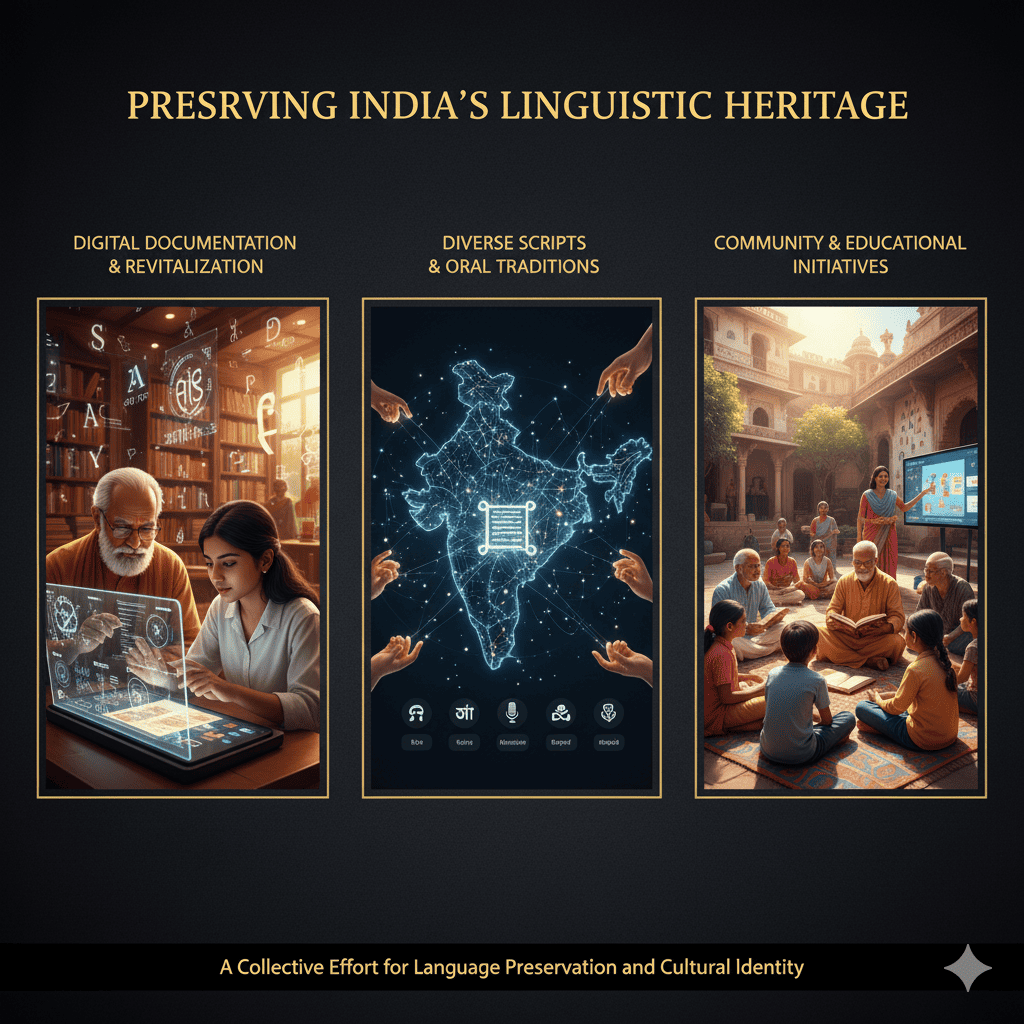
India’s linguistic heritage includes ancient classical languages, regional languages and thousands of tribal tongues. Rapid urbanisation, the dominance of English and some regional languages, and lack of digital tools are causing many of these languages to decline. The government and research bodies are using a mix of policy, community recording, and AI tools (like Bhashini and Adi-Vaani) to document, teach and revive languages so they stay alive for future generations. For beginners: think of languages as living traditions — if children stop speaking them, the languages slowly disappear; digitisation and community projects act like food and care that keep these traditions alive.
Introduction
Context & Background
Key Points
- •Language vs dialect (simple): A language is a full system of speech and writing used by a community. A dialect is a regional or social variety of a language. The difference is often social and political, not always purely linguistic.
- •Mother tongue explained: The first language a child learns at home — often different from the language used in school or work.
- •Why languages die: When families stop teaching a language to children (because they think another language will give better jobs or education), the language loses speakers and becomes endangered.
- •Classical language criteria (plain): Old written records, rich literature, and a separate tradition—this is why some languages get the 'Classical' label.
- •Why preserve languages? Languages carry local knowledge — for example, names of medicinal plants, farming practices, folk songs, and local laws — that may not exist in any other language.
- •AI & tech role (simple examples): OCR turns printed manuscripts into editable text; speech recognition turns oral stories into written ones; machine translation helps people read texts in another language.
- •Bhashini & BharatGen: National AI platforms that help translate between Indian languages and generate speech/text so people can access information in their own language.
- •Adi-Vaani: AI tools specially built for tribal languages so oral traditions can be recorded and reused in education.
- •SPPEL: A scheme to find and document languages with very few speakers — a rescue mission of sorts.
- •Role of schools: Teaching local languages in primary schools helps children keep their mother tongue while learning other languages.
- •Community participation: Elders, storytellers and families must be involved — technology alone cannot save a language without living speakers.
- •Simple successes elsewhere: Maori in New Zealand and Irish Gaelic in Ireland have been partly revived through schools, media and legal support — India can learn from these models.
Common Terms — Quick Guide (Beginner-friendly)
| Term | Simple Meaning | Example | Bookmark |
|---|---|---|---|
| Mother tongue | Language learned at home first | A child in a Kodava family learning Kodava as the mother tongue | |
| Classical language | Has very old literature and records | Tamil and Sanskrit | |
| Endangered language | Few speakers remain; risk of extinction | A tribal tongue spoken by a few hundred elders | |
| OCR (Optical Character Recognition) | Converts printed or handwritten pages into editable text | Turning a scanned palm-leaf manuscript into searchable text | |
| NLP (Natural Language Processing) | Computers understanding and processing human language | Auto-translating a Hindi news piece into Tamil |
How AI Helps — Simple Use Cases
| Problem | AI Solution (plain) | What it achieves for beginners | Bookmark |
|---|---|---|---|
| Old manuscripts unreadable | OCR + NLP to convert and translate | Makes ancient texts searchable and readable by students | |
| Elders only speak, don't write | Speech-to-text recording & archiving | Oral stories are preserved and can be played to children | |
| No schools teach local tongue | Language apps & digital courses | Kids can learn basics on phones or in classrooms | |
| No corpus (data) for AI models | Community recordings build datasets | Once enough recordings exist, AI can translate and teach that language |
What Everyday People Can Do
| Who | Action (simple) | Why it helps | Bookmark |
|---|---|---|---|
| Families | Speak the mother tongue at home | Keeps language alive for the next generation | |
| Teachers | Include local stories & words in lessons | Makes learning relatable and preserves culture | |
| Students | Record grandparents’ stories | Creates material for archives and school projects | |
| Local bodies | Support community recordings and festivals | Gives visibility and pride to local language users |
Related Entities
Impact & Significance
- •Cultural Memory (easy): Languages store songs, poems, rituals and local science — losing a language means losing knowledge about plants, local weather signs, folk medicine and history.
- •Education & access: When public information (health, agriculture, legal) is available in local languages, more people benefit. For beginners: a farmer is more likely to follow advice if it’s in the language he understands best.
- •Social dignity: Preserving tribal languages gives recognition and dignity to communities that might otherwise feel invisible.
- •Digital inclusion: Translating government services, websites and education into many languages helps more citizens participate in the digital economy.
- •Research & global scholarship: Digitised texts and translations make ancient Indian knowledge available globally for study and collaboration.
Challenges & Criticism
- •Why youth stop using languages (simple): Parents often encourage children to learn English or a dominant regional language for jobs; the mother tongue is seen as less 'useful'.
- •Shortage of teachers and materials: Many small languages have no textbooks, trained teachers or standard spelling — teaching becomes hard.
- •Oral languages are fragile: If a language is never written down, it can be lost when the oldest speakers die.
- •Technology cannot fix everything: AI models need lots of recorded speech and written material. For tiny languages, building that dataset is slow and requires community trust.
- •Risk of incorrect representation: Poorly trained AI or non-sensitive translations can change meanings or disrespect cultural idioms; human oversight is essential.
- •Fragmented policy efforts: Multiple ministries and universities may work separately; coordination and sustained funding are needed for long-term impact.
Future Outlook
- •Create open, public digital repositories where recordings, dictionaries and teaching materials are stored and shared freely.
- •Fund language fellowships for young researchers to work with elders and communities to document oral literature.
- •Build simple mobile apps (audio + visuals) for children to learn basic vocabulary and songs in the mother tongue.
- •Make local languages part of early education — bilingual classrooms help children learn both their mother tongue and a national/global language.
- •Establish community recording centres (at schools or panchayats) where elders can come and record stories, songs and knowledge.
- •Partner with international bodies (like UNESCO) and global universities to share best practices and technical help.
- •Use AI carefully — combine tech tools with human review (linguists, community elders) so translations and transcriptions are accurate and culturally sensitive.
- •Promote local media (radio, TV, podcasts) in regional and tribal languages to increase usage and prestige.
UPSC Relevance
- • GS-1: Cultural diversity, languages, tribal heritage and society.
- • GS-2: Policy measures for education, minority and tribal welfare, digital inclusion.
- • GS-3: Role of AI and digitisation in governance and public services.
- • Essay: Language, culture and development — balancing modernisation with cultural continuity.
Sample Questions
Prelims
With reference to linguistic preservation in India, consider the following statements:
- (a)The SPPEL scheme aims to document languages spoken by fewer than 10,000 people.
- (b)Bhashini is part of the National Language Translation Mission.
- (c)Sanskrit and Tamil are the only classical languages in India.
- (d)Adi-Vaani is focused on digitising tribal languages using AI.
Mains
India’s linguistic heritage is under threat due to declining intergenerational transmission and digital neglect. Discuss how AI-based tools and community-led documentation can revive classical and endangered languages.
Introduction: Context: India’s multilingual nature is an asset, but many languages are endangered as speakers shift to dominant languages for economic reasons.
Body:
• Problems: Loss of speakers, lack of written materials, shortage of teachers and funding, fragmented policy efforts.
• AI role: OCR, speech-to-text, machine translation and searchable digital archives speed up documentation and increase accessibility.
• Community role: Elders, storytellers and local groups must lead documentation. Technology supports but does not replace living transmission.
• Policy steps: Fund long-term documentation projects, integrate mother tongue teaching in early grades, build open repositories and coordinate across ministries.
• Challenges & safeguards: AI models must be trained with ethical safeguards and human oversight; community consent and benefit-sharing must be central.
Conclusion: A combined strategy — technology + community action + supportive policy — can ensure India’s linguistic diversity remains a living, usable asset rather than a museum piece.