
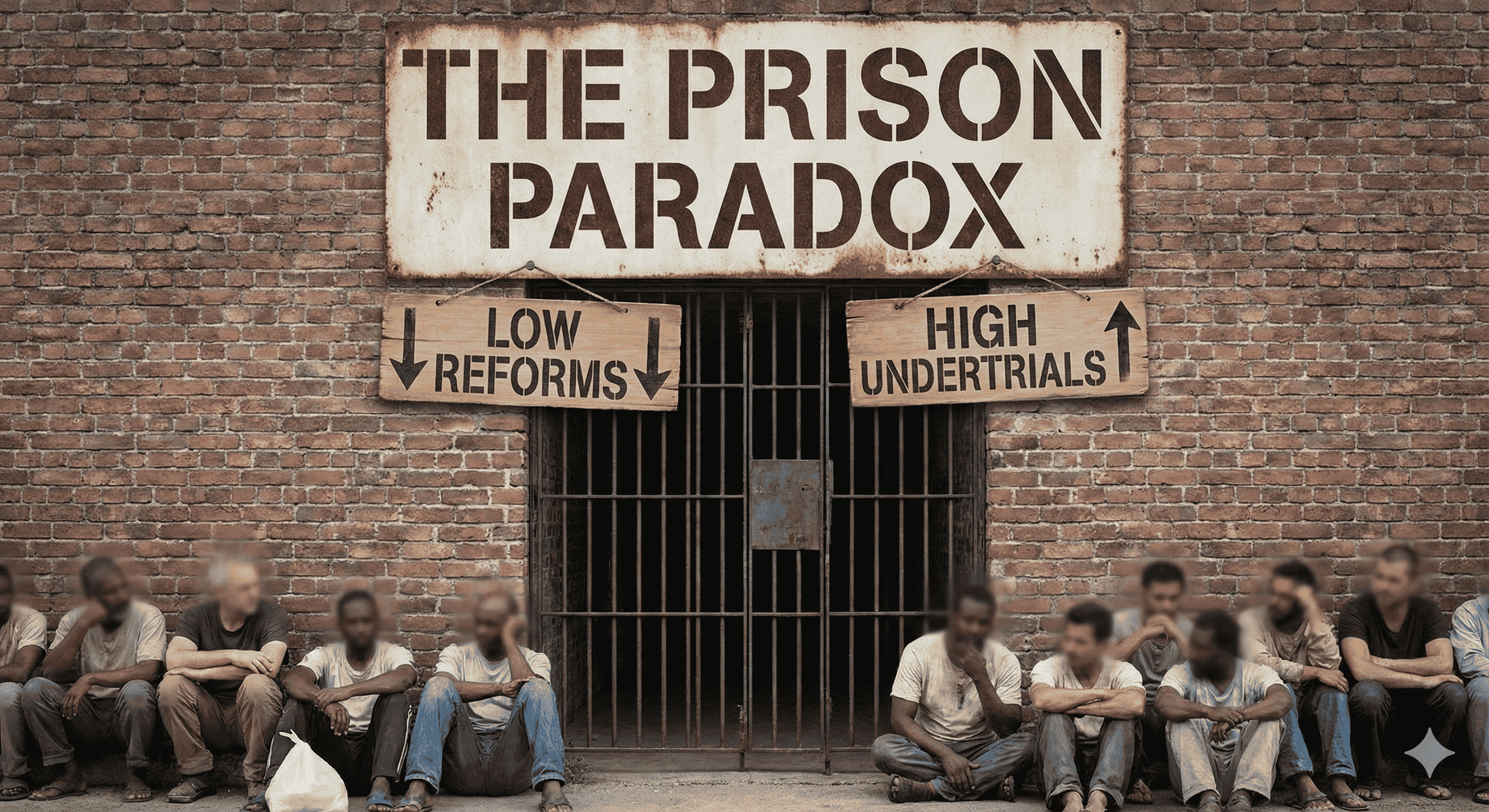
The Prison Paradox: Low Reforms, High Undertrials
The 'Prisons in India 2025 Report' by the Supreme Court’s Centre for Research & Planning highlights a critical crisis: Indian prisons are severely overcrowded with 75% of inmates being undertrials (people awaiting trial). Despite new laws like the Model Prisons Act 2023 and the BNSS 2023, deep-rooted issues such as caste-based labour, wage disparities, lack of legal aid, weak implementation of court directives, and poor focus on mental health and rehabilitation continue to undermine prison reforms.
Introduction
Context & Background
Key Points
- •Overcrowding Crisis: Indian prisons are bursting at the seams, operating at 131.4% capacity. This means for every 100 available spaces, there are nearly 132 inmates. Alarmingly, 75% of these inmates are undertrials, meaning 3 out of 4 people in jail have not yet been proven guilty. Overcrowding leads to poor sanitation, violence, disease spread, and makes any meaningful rehabilitation nearly impossible.
- •Undertrial Dilemma: An 'undertrial' is a prisoner whose trial is pending in court. Many remain in jail for years—sometimes longer than the sentence they would receive if convicted—due to a slow judicial system, repeated adjournments, lack of legal representation, and inability to afford bail. The Bharatiya Nagarik Suraksha Sanhita (BNSS), 2023 tries to address this by allowing bail for first-time offenders who have served one-third of their maximum possible sentence, but effective implementation and awareness remain weak.
- •Socio-Economic & Caste Vulnerability: A disproportionate share of undertrials belong to SCs, STs, OBCs and religious minorities, reflecting structural discrimination and poverty. Many are first-generation litigants who do not understand legal processes, sign documents without awareness, and are unable to arrange sureties for bail.
- •Caste-Based Discrimination: The report reveals a shocking reality: some state prison manuals still assign work based on caste (e.g., lower castes assigned cleaning or 'sweeping' duties, upper castes given clerical or kitchen roles). The Supreme Court, in the Sukanya Shantha case, declared such practices unconstitutional as they violate Articles 14, 15 and human dignity.
- •Wage Inequality: Prisoners working in jails are paid drastically different wages depending on the state. For example, inmates in Mizoram earn as little as ₹20 per day, while those in Karnataka earn ₹524. This violates the principle of equal pay for equal work and also affects their ability to support families, pay fines, or save some money for post-release resettlement.
- •Women Prisoners: The system is largely designed for men. Women inmates often face neglect regarding reproductive and menstrual health, lack of privacy, and inadequate facilities for pregnant women and mothers with children. They are stereotypically assigned domestic chores like cooking and cleaning, limiting their exposure to diverse vocational training. Issues of sexual harassment and lack of female staff at all levels further compound their vulnerability.
- •Mental Health & Counselling: Overcrowding, long trials, stigma, and isolation cause high levels of stress, depression, and even suicidal tendencies. Many inmates also enter prison with existing substance-abuse or mental health conditions. However, trained counsellors, psychiatrists and social workers are extremely few, and mental healthcare is often treated as a low priority.
- •Open Prisons: These are facilities with minimal security where inmates can live with families and work outside, promoting trust and rehabilitation. Despite their success in states like Rajasthan, where open prisons have shown lower recidivism and better reintegration, they are underutilized, functioning at only 74% occupancy nationally. Many states are reluctant to adopt this model due to security concerns and conservative attitudes.
- •Model Prisons Act, 2023: This new central law aims to replace the 1894 Act. It focuses on reformation and rehabilitation, categorizes prisoners based on risk, mandates separate facilities for women and transgender inmates, provides for high-security jails for dangerous offenders, and encourages the use of technology (video courts, CCTV, digital record-keeping). However, being a model law, it still requires individual states to adopt and adapt it.
- •Technology in Prisons: The e-Prisons system digitizes inmate records to ensure no one stays in jail beyond their release date and to track case status, parole, and remission. The 2025 report highlights the need for better integration with the Inter-operable Criminal Justice System (ICJS) so that police, courts, prisons and forensic labs can share real-time data. Without this, undertrials continue to suffer due to missing paperwork and coordination failures.
- •Reintegration & Stigma: Even after release, former prisoners face social stigma, difficulty in finding jobs, and lack of access to housing or bank accounts. The absence of structured halfway homes, community support programmes, and employer sensitisation means many fall back into crime or poverty, perpetuating the cycle of incarceration.
Major Challenges vs. Proposed Reforms (2025 Report)
| Challenge Area | Current Status | Recommendation/Reform | Bookmark |
|---|---|---|---|
| Overcrowding | 131.4% occupancy; 75% are undertrials. | Use 'Open Prisons' (as highlighted in Suhas Chakma advocacy), implement periodic undertrial review committees, and fast-track bail for petty offences. | |
| Discrimination | Manuals use caste to assign 'menial' work; derogatory language used; vulnerable groups like SC/ST, minorities over-represented. | Eliminate caste-based duties (Sukanya Shantha case), remove offensive terms, and sensitise staff through mandatory human rights training. | |
| Legal Aid | Weak infrastructure; many inmates unaware of rights; legal aid lawyers overburdened. | Strengthen Legal Aid Clinics inside prisons, ensure regular visits by NALSA/State Legal Services Authorities, classify undertrial cases as 'Urgent', and use video conferencing for frequent hearings. | |
| Wages | Huge disparity (₹20 to ₹524); no linkage with local minimum wages. | Mandatory wage review every 3 years; move towards parity with minimum wages for unskilled work; ensure a portion of wages goes to inmate savings and victim compensation where applicable. | |
| Women & Vulnerable Groups | Inadequate facilities for women, transgender persons, elderly and disabled inmates; lack of gender-sensitive infrastructure. | Create gender-segregated and disability-friendly facilities, recruit more women staff, ensure access to menstrual hygiene, maternity care, and protection from sexual harassment. | |
| Rehabilitation & Skill Building | Focus still on menial labour; limited vocational training and education. | Introduce market-relevant skills (IT, digital literacy, modern trades), link with Skill India programmes and NGOs, and certify courses through recognised boards/universities. |
Legal Framework for Prisoners
| Law/Article | Purpose/Right | Bookmark |
|---|---|---|
| Article 21 | Right to Life & Personal Liberty, interpreted to include the Right to Speedy Trial (Hussainara Khatoon case) and dignified prison conditions. | |
| Article 39A | Directive to the State to provide free legal aid to ensure that justice is not denied due to economic or other disabilities. | |
| Model Prisons Act, 2023 | Modern law focusing on correctional approach, classification of prisoners, high-security and open prisons, use of technology, and protection of vulnerable inmates. | |
| BNSS 2023 (Replacing CrPC) | Contains provisions for bail, timelines, and procedures that can help reduce undertrial population if implemented effectively. | |
| Nelson Mandela Rules | UN standard minimum rules for treating prisoners humanely, covering accommodation, healthcare, discipline, contact with family, and preparation for release. |
Related Entities
Impact & Significance
- •Human Rights: Improving prison conditions aligns India with global standards like the Nelson Mandela Rules. Poor conditions currently damage India's reputation and often lead foreign courts to question or deny the extradition of fugitives to India on grounds of potential human rights violations.
- •Recidivism (Reoffending): A purely punitive system breeds hardened criminals by exposing first-time offenders to hardened criminals in a violent environment. A rehabilitative system that focuses on education, vocational training, mental health, and family contact reduces the chance of inmates returning to crime after release.
- •Judicial Efficiency: Reducing the number of undertrials through better bail practices and faster trials clears the backlog in courts and saves state resources spent on housing inmates who either deserve bail or minor sentences.
- •Social Justice: Since a majority of undertrials are from marginalized, poor backgrounds, reforming the bail, legal aid and prison system is a direct act of social justice and is essential for achieving the constitutional promise of equality and dignity.
- •Economic & Fiscal Impact: Overcrowded prisons are expensive to maintain—food, security, healthcare and infrastructure costs escalate. Rationalizing undertrial numbers and investing in community-based alternatives (probation, community service, open prisons) can significantly reduce the fiscal burden on states while improving outcomes.
Challenges & Criticism
- •State Subject Issue: Since prisons are a State subject, the Center (MHA) can only issue advisories and model laws. States often lack the political will, administrative capacity or funds to prioritize prison reforms over other visible sectors like roads or power.
- •Colonial Mindset: Changing laws is easier than changing attitudes. Many prison officials still see inmates as 'dangerous elements' to be controlled, not as rights-bearing individuals capable of reform. This mindset leads to resistance to open prisons, liberal parole, and community engagement.
- •Digital Divide: While e-courts, e-Prisons and ICJS are proposed, the physical infrastructure for video conferencing, reliable internet, and trained staff in remote jails is often weak. Technology remains underused or breaks down frequently, limiting its impact.
- •Public Perception: Society often stigmatizes prisoners, seeing any improvement in their conditions as a 'waste of taxpayer money'. Without public awareness and political support, programmes like halfway homes, employer partnerships, or rehabilitation schemes struggle to gain traction.
- •Monitoring & Accountability: Though there are mechanisms like Board of Visitors, NHRC inspections, and judicial monitoring, these are irregular and often lack follow-up. Under-reporting of custodial violence, deaths, and rights violations remains a serious concern.
Future Outlook
- •Implementation of Model Act: The next decade will depend on how many States adopt and faithfully implement the Model Prisons Act 2023, including updating prison manuals, training staff, and budgeting for reforms.
- •Focus on Open Prisons: Expanding the open prison model and community-based alternatives (parole, probation, community service) can drastically reduce overcrowding and costs while improving reform rates and family contact.
- •Tech-Driven Management: Use of real-time digital dashboards, AI-based alerts for prisoners eligible for bail/remission, and seamless ICJS integration can prevent people from languishing in jails due to paperwork delays.
- •Vocational Training & Education: Shifting from 'menial labor' to skill-building that matches current market needs (e.g., computer skills, digital services, modern crafts) and linking inmates to employment cells can ensure financial independence upon release.
- •Community & Civil Society Participation: Greater involvement of NGOs, religious and community organisations, universities, and corporate CSR in counselling, education, legal aid and post-release support can make prisons part of a broader social reform ecosystem instead of isolated punitive spaces.
UPSC Relevance
- • GS-2: Governance, Constitution (Article 21, 39A), Social Justice, Government Policies, Role of Judiciary and NHRC.
- • GS-4 (Ethics): Ethical treatment of prisoners, human dignity, rehabilitation vs. retribution, empathy and compassion in governance.
- • Essay: Topics related to Criminal Justice System, Human Rights, Social Justice, and Reform vs. Punishment.
- • Important for questions on State List subjects, police and prison administration reforms.
- • Case-law based questions on undertrials, custodial deaths, and rights of prisoners.
- • Applicable in answer writing on implementation challenges at State level.
Sample Questions
Prelims
With reference to Prison Administration in India, consider the following statements:
- (a)Prisons are a subject under the Concurrent List of the Constitution.
- (b)The Model Prisons Act, 2023 aims to replace the colonial Prisons Act of 1894.
- (c)The Nelson Mandela Rules relate to the minimum standards for the treatment of prisoners.
- (d)NALSA is mandated to provide free legal aid, including to eligible prisoners.
Mains
The high number of undertrials in Indian prisons indicates a systemic failure in the criminal justice system. Discuss the challenges faced by undertrials and suggest measures, including the provisions of the Model Prisons Act 2023 and BNSS 2023, to address this issue.
Introduction: Highlight statistics (75% undertrials, overcrowding above 130%) from the Prisons in India 2025 Report to show the scale of the problem.
Body:
• Challenges: Slow judicial process, frequent adjournments, poverty (inability to pay bail or hire lawyers), lack of awareness of rights, caste and class-based discrimination, language barriers, and mental health issues.
• Consequences: Violation of Article 21 (life, liberty, speedy trial), overcrowding, criminalisation of first-time offenders, burden on the exchequer, and inter-generational impact on families.
• Reforms & Model Prisons Act 2023: Focus on classification of prisoners, separate facilities for women and vulnerable groups, promotion of open prisons, better record-keeping, legal aid clinics, use of video trials, and grievance redressal mechanisms.
• BNSS 2023 & Systemic Measures: Provisions for liberal bail for first-time offenders after serving part of maximum sentence, time-bound investigations and trials, use of technology, strengthening of Legal Services Authorities, periodic undertrial review committees, and better coordination through ICJS.
Conclusion: Conclude with the need to shift from a purely punitive to a rehabilitative and rights-based justice system, where prisons become spaces of correction and reintegration rather than overcrowded warehouses of the poor and marginalised.