
Procedural Irregularities in Lok Sabha: The Motion of Thanks and Presidential Address
Congress MP K.C. Venugopal flagged serious procedural irregularities in the Lok Sabha, questioning the validity of passing the Motion of Thanks without the Prime Minister’s customary reply. This article examines the constitutional provisions under Articles 86 and 87, parliamentary rules, and the significance of the President's Address.
Introduction
Context & Background
Key Points
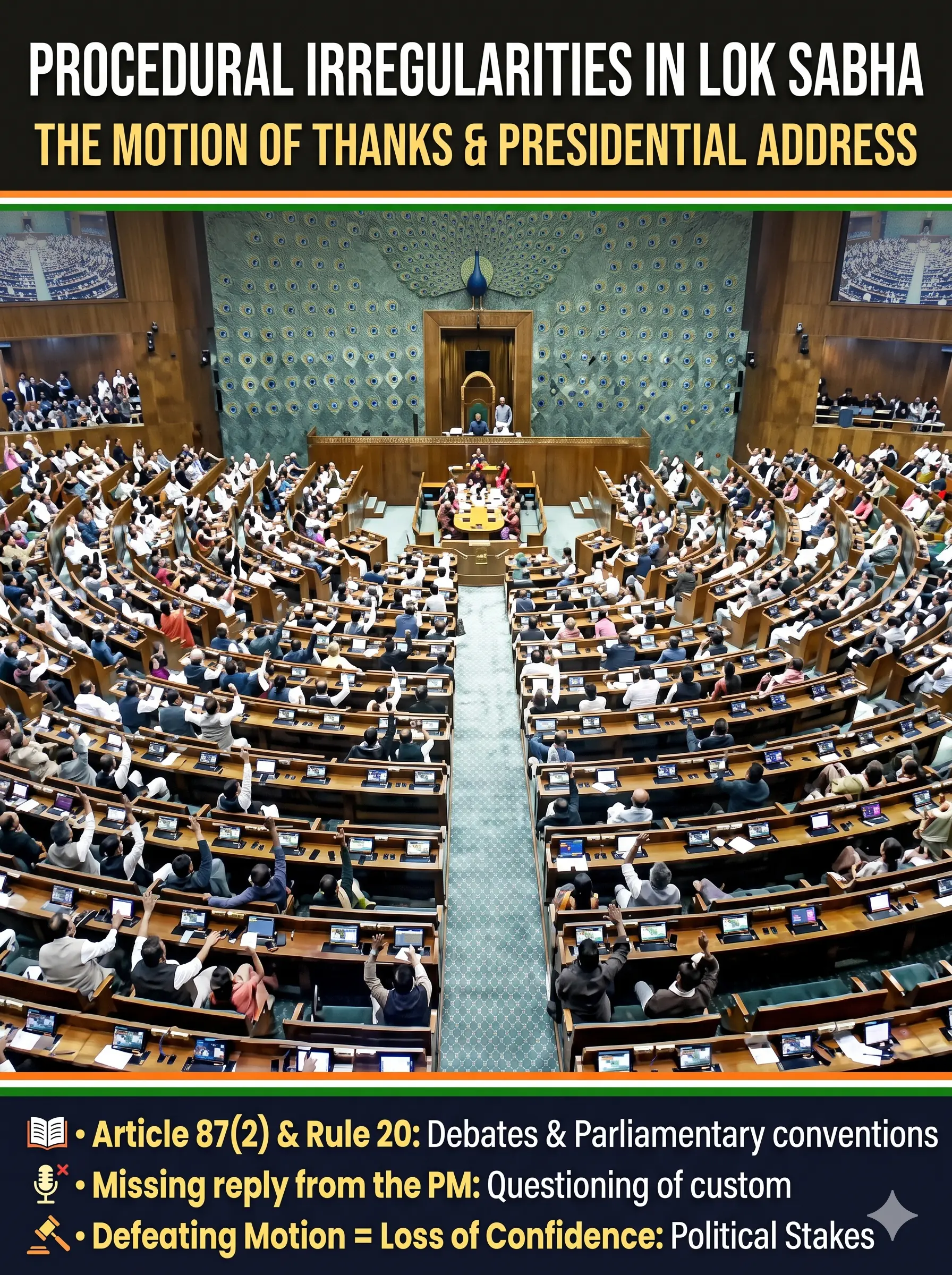
- •Motion of Thanks: Similar to Britain’s ‘Speech from the Throne’, the President's Address is debated through a Motion of Thanks under Article 87(2).
- •Role of the Prime Minister: Under Rule 20, the Motion is moved and seconded by members nominated by the Prime Minister. The PM or a senior minister usually replies to the discussion.
- •First Amendment Act, 1951: Originally, Article 87 required the President to address Parliament every session. This amendment limited the address to once a year.
- •Political Accountability: The Address is drafted by the Council of Ministers. Members cannot invoke the President's name during debates, as accountability rests with the government.
- •Test of Confidence: Passing the Motion of Thanks by a simple majority is mandatory. Failure to pass it is treated as a loss of confidence in the ruling government.
Key Constitutional and Parliamentary Rules
| Provision | Function/Scope | Nature/Limitation | Bookmark |
|---|---|---|---|
| Article 86 | Empowers President to address either/both Houses. | Discretionary; never invoked since 1950. | |
| Article 87 | Mandates a 'special address' to both Houses together. | Compulsory after general elections and first session annually. | |
| Rule 20 (Lok Sabha) | Governs discussion on the President's Address. | Conducted via a Motion of Thanks nominated by the PM. |
Related Entities
Impact & Significance
- •Litmus Test for the Executive: The voting on the Motion of Thanks is effectively a trust vote. If the motion is defeated, the Council of Ministers must resign.
- •Platform for Opposition: It provides a structured three-day window for the opposition to debate national issues, propose amendments, and hold the government accountable.
Challenges & Criticism
- •Bypassing Conventions: Skipping customary procedures, such as the Prime Minister’s reply, undermines the deliberative nature of Parliament.
- •Time Constraints: Often, the time allotted based on party strength limits the ability of smaller parties or independent MPs to thoroughly debate government policies.
- •Rubber-Stamp Debates: Due to the anti-defection law and party whips, passing the motion is usually a foregone conclusion for majority governments, sometimes reducing the debate to a mere formality.
Future Outlook
- •Preserving Parliamentary Conventions: Ensuring the Prime Minister's customary reply is maintained upholds the tradition of executive accountability to the legislature.
- •Strict Adherence to Rule 20: Future sessions must strictly observe Lok Sabha rules to prevent allegations of procedural irregularities and maintain decorum.
UPSC Relevance
- • GS-2 (Polity & Constitution): Parliament and State legislatures—structure, functioning, conduct of business, powers & privileges and issues arising out of these.
- • Prelims Focus: Articles 86 and 87, Rule 20, Constitutional Amendment regarding Presidential Address, and implications of defeating the Motion of Thanks.
Sample Questions
Prelims
With reference to the President's Address and the Motion of Thanks, consider the following statements:
1. Article 86 mandates the President to address both Houses of Parliament at the commencement of the first session every year.
2. Failure to pass the Motion of Thanks in the Lok Sabha amounts to the defeat of the government.
3. The President's Address is drafted by the President's Secretariat.
Answer: Option 2
Explanation: Statement 1 is incorrect (Article 87 mandates the annual address, not 86). Statement 3 is incorrect (drafted by the Council of Ministers). Statement 2 is correct.
Mains
The 'Motion of Thanks' on the President's Address is not merely a procedural formality but a crucial mechanism to ensure executive accountability. Discuss in the light of constitutional provisions and parliamentary rules.
Introduction: Define the Motion of Thanks and mention its origin (Speech from the Throne). Cite Articles 86 and 87.
Body:
• Constitutional Basis: Explain Articles 86 and 87, noting how the Address outlines government policies.
• Parliamentary Mechanism: Detail Rule 20 and the requirement of passing the Motion of Thanks. Mention the scope of debate and amendment provisions.
• Executive Accountability: Discuss how defeating the motion implies a loss of confidence, and why the PM's reply is a vital convention for answering the opposition.
Conclusion: Conclude that upholding procedural regularities during the Motion of Thanks is vital for the health of a parliamentary democracy.