
Project Vault: U.S. Strategic Critical Minerals Reserve Initiative
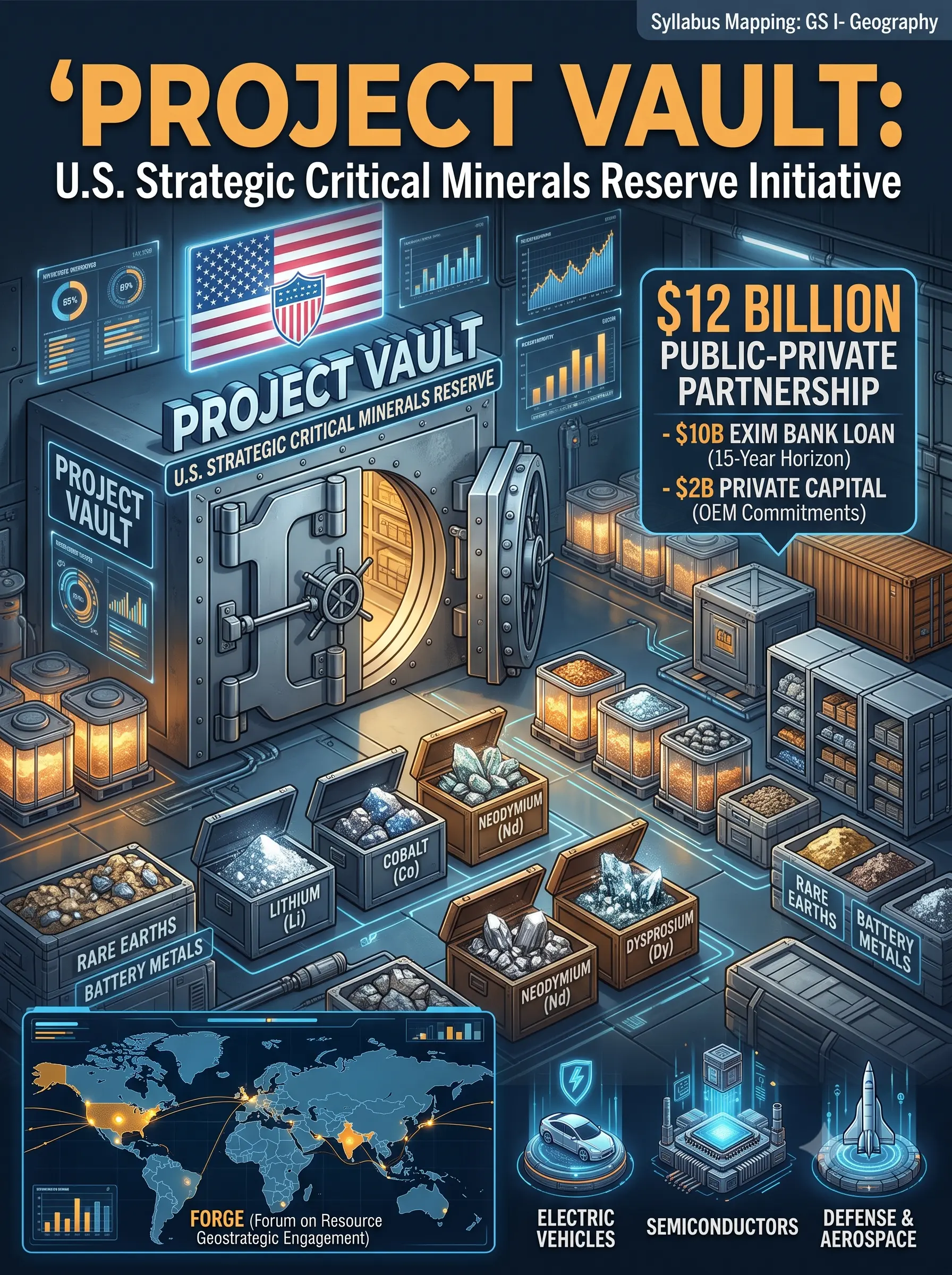
The Donald Trump administration launched “Project Vault” in February 2026, a $12 billion public-private initiative to establish a U.S. Strategic Critical Minerals Reserve. Backed by a historic $10 billion EXIM Bank loan, the program aims to stockpile essential minerals like lithium, cobalt, and rare earths to shield civilian and defense industries from supply chain disruptions and geopolitical leverage.
Introduction
Context & Background
Key Points
- •Strategic Purpose Beyond Simple Stockpiling: Project Vault functions similarly to the Strategic Petroleum Reserve, institutionalizing mineral security as a core pillar of national security. It aims to shield U.S. manufacturers from geopolitical coercion, particularly China's dominance in rare earth processing.
- •Hybrid Mission (Commercial + Strategic): Unlike traditional defense-only stockpiles, this reserve supports civilian industries (EVs, smartphones, semiconductors). Firms can draw minerals during shortages but are subject to a mandatory replenishment rule.
- •Innovative Financing Model: Structured as a Public-Private Partnership (PPP), the project is seeded by a $10 billion loan from the U.S. Export-Import (EXIM) Bank and nearly $2 billion in private capital from major Original Equipment Manufacturers (OEMs).
- •Mechanism of the Vault: Participating OEMs commit to forward purchase agreements at fixed prices. An independent board manages the reserve to insulate daily operations from direct political interference.
- •Strategic Significance for India: India is a vital partner in FORGE (Forum on Resource Geostrategic Engagement, formerly MSP). As the U.S. pursues "friend-shoring," Indian mining and processing sectors could secure new export opportunities, while stabilized global prices could lower input costs for "Make in India" initiatives.
- •Mineral Diplomacy: The initiative is complemented by the "Washington Accords"—bilateral agreements with nations like Australia, Japan, and Rwanda to diversify sourcing away from Chinese-controlled mines.
Key Minerals Targeted by Project Vault
| Mineral Category | Primary Application | Bookmark |
|---|---|---|
| Rare Earths (Neodymium, Dysprosium) | Magnets in EVs and wind turbines | |
| Battery Metals (Lithium, Cobalt, Nickel) | Electric Vehicle (EV) batteries | |
| Tech Essentials (Gallium, Germanium, Silicon) | Semiconductors and AI infrastructure | |
| Industrial Inputs (Copper, Zinc) | Core industrial manufacturing |
Funding and Operational Structure
| Entity/Source | Contribution/Role | Details | Bookmark |
|---|---|---|---|
| U.S. EXIM Bank | $10 Billion Loan | Largest loan in the agency's 92-year history; set for a 15-year horizon. | |
| Private Capital (OEMs) | $1.67 - $2 Billion | Contributed by participating corporations like General Motors, Boeing, and Google. | |
| Trading Firms | Logistics & Storage | Firms like Hartree Partners and Traxys North America manage physical acquisition. |
Related Entities
Impact & Significance
- •Economic Shock Absorption: The reserve ensures that U.S. manufacturers have uninterrupted access to raw materials, preventing factory shutdowns and production delays during global crises.
- •Geopolitical Realignment: It actively diminishes the ability of adversarial states to use mineral exports as diplomatic leverage, accelerating the decoupling of critical tech supply chains from China.
- •Market Confidence: By providing long-term (15-year) government-backed financial certainty and fixed-price commitments, it encourages the private sector to invest heavily in domestic and allied mining projects.
- •Catalyst for Allied Ecosystems: It accelerates the restructuring of global trade, allowing partner nations to integrate deeply into secure, U.S.-backed supply networks.
Challenges & Criticism
- •Short-Term Price Spikes: Industry groups, such as the Aerospace Industries Association (AIA), have warned that massive government procurement could create immediate competition for private-sector buyers, potentially driving up prices in already tight markets.
- •Market Distortion: Fixed-price purchasing by the state may inadvertently distort global market mechanisms, potentially impacting non-participating smaller manufacturers who must navigate volatile spot prices.
- •Operational Complexity: Safely storing, managing, and maintaining the quality of up to 60 different processed minerals via trading firms involves massive logistical challenges compared to storing crude oil.
- •Environmental Concerns: Rapidly expanding domestic and allied mining to fill the vault will inevitably face pushback from environmental groups concerned about ecological degradation and water pollution.
Future Outlook
- •Integration with AI Ecosystems: Initiatives like Pax Silica will aim to combine capital, energy, and mineral reserves across allied jurisdictions to strengthen global AI infrastructure.
- •Global Price Stabilization: Through forward purchase agreements, the Vault intends to reduce speculative volatility, encouraging long-term investments in mining and refining worldwide.
- •Stricter Supply Chain Standards: Future procurement will likely enforce high technical and environmental standards, reshaping global mining practices and favoring compliant "friend-shored" partners.
- •Expansion of Resource Alliances: The U.S. will likely deepen its mineral diplomacy, embedding supply chain resilience into broader foreign policy through multilateral platforms like FORGE.
UPSC Relevance
- • GS-1 (Geography): Distribution of key natural resources across the world; factors responsible for the location of primary, secondary, and tertiary sector industries.
- • GS-2 (International Relations): Bilateral, regional, and global groupings and agreements involving India and/or affecting India's interests (e.g., FORGE, friend-shoring).
- • GS-3 (Economy/Security): Supply chain resilience, indigenization of technology, and national security challenges related to critical tech.
- • Mains Focus: Analyzing the weaponization of supply chains and strategies for India to secure critical minerals for its clean energy transition.
Sample Questions
Prelims
Consider the following statements regarding 'Project Vault', recently seen in the news:
1. It is a public-private partnership primarily aimed at protecting civilian industries rather than just the military.
2. It features a mandatory 'Replenishment Rule' for companies drawing from the reserve.
3. India is not permitted to participate in the associated FORGE (Forum on Resource Geostrategic Engagement) alliance.
Answer: Option 1, Option 2
Explanation: Statements 1 and 2 are correct. The initiative is a PPP designed as a buffer for civilian tech and features a replenishment mandate. Statement 3 is incorrect; India is a key partner in FORGE, which is the revamped Minerals Security Partnership (MSP).
Mains
The launch of 'Project Vault' by the United States highlights the growing weaponization of critical mineral supply chains. Discuss the strategic implications of this initiative and suggest measures India should adopt to ensure its own mineral security.
Introduction: Introduce Project Vault as a $12 billion U.S. strategic reserve initiative launched in 2026. Define critical minerals and briefly mention China's current dominance in the sector.
Body:
• Strategic Implications of Project Vault: Reduces reliance on China's near-monopoly in rare earth processing (~90%); shifts global mining investments toward allied nations (friend-shoring); acts as an economic buffer for civilian tech industries (EVs, AI) against geopolitical shocks.
• Impact on Global Markets: Potential stabilization of mineral prices through fixed-price agreements, though initial aggressive stockpiling might cause short-term price spikes.
• Measures for India: Leverage partnerships like FORGE (formerly MSP) to secure overseas assets; scale up domestic exploration (e.g., lithium in J&K, graphite in Odisha); strengthen KABIL (Khanij Bidesh India Ltd) for international acquisitions; invest in domestic mid-stream processing and recycling technologies.
Conclusion: Conclude by emphasizing that critical minerals are the 'new oil' of the 21st century. India must transition from import dependence to becoming a node in diversified, resilient global supply chains through proactive resource diplomacy and domestic capacity building.