
Proposal to Lower the Juvenile Age Threshold
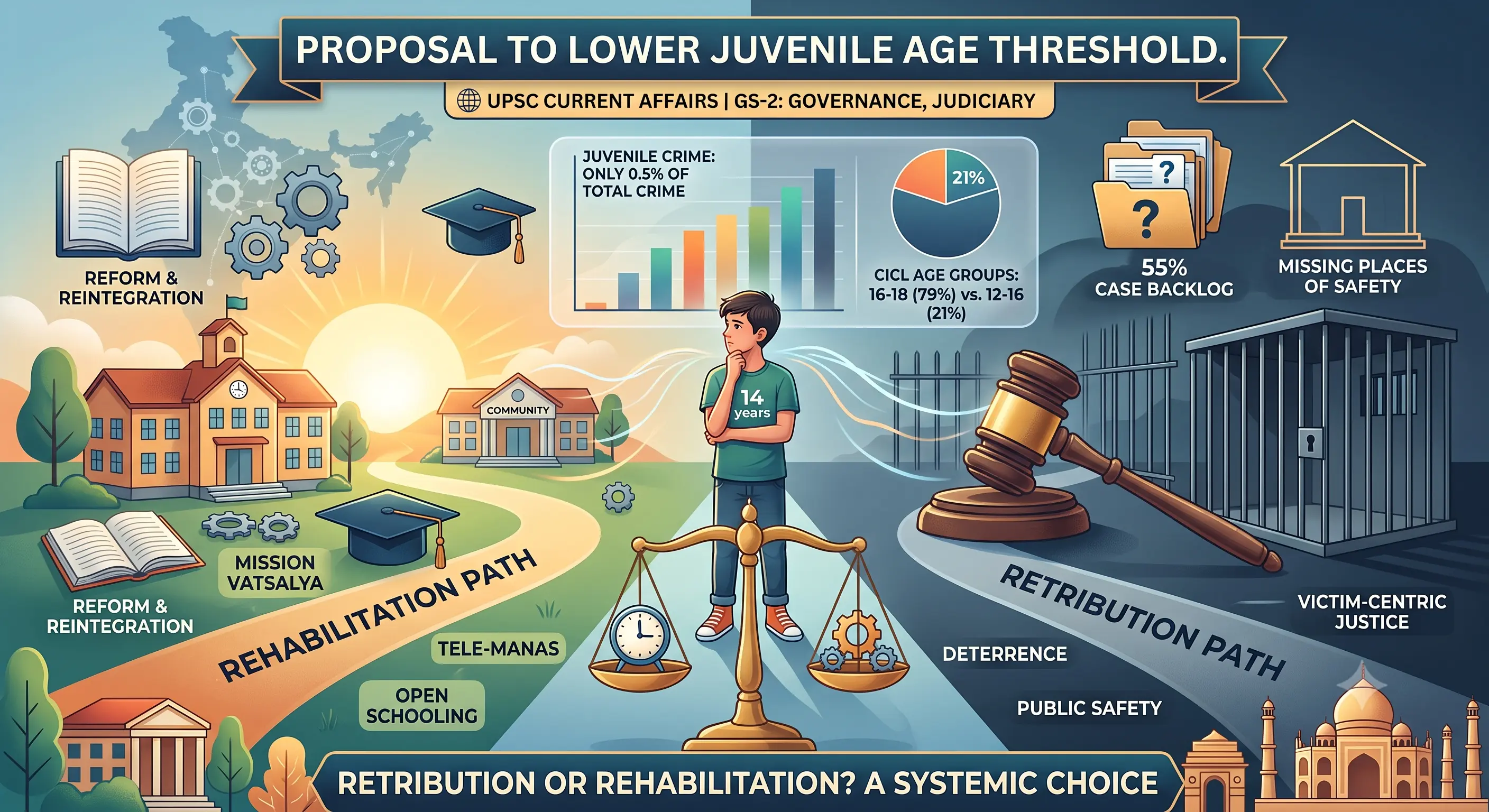
A proposed Bill aims to modify the Juvenile Justice (Care and Protection of Children) Act, 2015 by lowering the minimum age for trying children as adults in cases involving heinous offences from 16 to 14 years. This proposal has sparked debates around deterrence, public safety, and the reformative ethos of the juvenile justice system.
Introduction
Context & Background
Key Points
- •Case Backlog: As of October 2023, nearly 55% of the 100,904 cases before Juvenile Justice Boards (JJBs) were pending, with an average caseload of 154 cases per Board.
- •Institutional Gaps: About 25% of JJBs are operating without the mandated three-member composition, and 30% lack attached legal services clinics.
- •Infrastructure Deficits: Fourteen States have yet to establish the compulsory Places of Safety for 16–18-year-olds accused of heinous offences.
- •Compliance Shortfalls: Only 11 out of 292 districts met all seven prescribed minimum standards, and there are just 40 child-care homes exclusively for girls nationwide.
Understanding the Juvenile Transfer System
| Mechanism | Current Provision | Remarks / Proposed Change | Bookmark |
|---|---|---|---|
| Legal Provision | Children aged 16–18 years accused of heinous offences (7+ years punishment) may be tried as adults. | Proposed Bill seeks to lower this threshold to 14 years. | |
| Preliminary Assessment | Juvenile Justice Board (JJB) evaluates the child's mental/physical capacity and circumstances of the offence. | Determines if an adult trial is warranted. | |
| Children's Court Role | Retains discretion to conduct the trial as an adult court or continue under the juvenile framework. | Acts upon the transfer assessment made by the JJB. |
NCRB 2023 Data Insights on Juvenile Crime
| Category | Data Statistic | Insight | Bookmark |
|---|---|---|---|
| Overall Juvenile Crime Share | 31,365 cases | Only 0.5% of total recorded crimes. | |
| 16–18 Age Group | 31,610 children (79%) | The largest cohort among Children in Conflict with Law (CICL). | |
| 12–16 Age Group | 8,426 children (21%) | Contradicts claims that the younger group is driving serious crime trends. |
Related Entities
Impact & Significance
- •Deterrence Rationale: Proponents argue that stricter legal consequences could discourage violent conduct among adolescents aged 14–16 by reinforcing the seriousness of punishment.
- •Public Safety Concerns: High-profile and brutal crimes involving minors have intensified demands for stronger accountability mechanisms to safeguard society and deter repeat offences.
- •Victim-Centric Justice: Supporters emphasise proportionality in punishment, arguing that grave harm requires responses closer to adult criminal liability.
- •Institutional Credibility: There is a perception that existing juvenile protections are being misused, weakening deterrence and public confidence in the justice system.
Challenges & Criticism
- •Limited Share of Juvenile Crime: NCRB data for 2023 indicates that cases involving Children in Conflict with Law (CICL) numbered 31,365, constituting only 0.5% of total recorded crimes, undermining claims of a widespread juvenile crime surge.
- •Concentration among Older Adolescents: Of the 40,036 CICL apprehended in 2023, nearly 79% (31,610) belonged to the 16–18 age group, suggesting that younger adolescents are not the principal contributors.
- •Marginal Role of Younger Cohort: Only 21% (8,426) of CICL fell in the 12–16 age bracket, contradicting assertions that the 14–16 group is driving serious crime trends.
- •Greater Scope for Arbitrariness: Extending the transfer system to younger children widens the ambit of subjective assessments, increasing the risk of inconsistent and unequal outcomes.
- •Erosion of Reformative Ethos: The juvenile justice framework is anchored in rehabilitation and reintegration; early exposure to adult trials may compromise long-term corrective outcomes.
Future Outlook
- •Preventive and Early Interventions: Enhance early risk detection through schools, anganwadis, and local institutions, leveraging frameworks such as Mission Vatsalya.
- •Mental Health and De-Addiction Support: Mainstream counselling and substance abuse interventions for adolescents in conflict situations, including services like Tele-MANAS.
- •Capacity Building of JJBs: Standardise preliminary assessment procedures and strengthen training to minimise discretion-based inconsistencies.
- •Rehabilitation-Centric Approach: Prioritise education, skill development, and restorative justice pathways, for instance through open schooling and PMKVY-linked skill programmes.
UPSC Relevance
- • GS-2 (Judiciary): Structure, organization and functioning of the Judiciary; Mechanisms, laws, institutions and Bodies constituted for the protection and betterment of vulnerable sections.
- • GS-2 (Social Justice): Issues relating to development and management of Social Sector/Services relating to Children.
- • Essay Topics: 'Rehabilitation vs. Retribution in the Juvenile Justice System', 'The impact of institutional deficits on justice delivery'.
Sample Questions
Prelims
Consider the following statements regarding the Juvenile Justice framework in India:
1. The Children's Court is bound to try a juvenile as an adult once the case is transferred by the Juvenile Justice Board (JJB).
2. Under the Juvenile Justice Act, 2015, the JJB is responsible for the preliminary assessment of the child's mental and physical capacity.
3. According to NCRB 2023 data, juvenile crime constitutes more than 10% of total recorded crimes in India.
Answer: Option 2
Explanation: Statement 1 is incorrect; the Children's Court retains discretion to conduct the trial as an adult court or continue under the juvenile framework. Statement 2 is correct. Statement 3 is incorrect; NCRB 2023 data indicates juvenile crime accounts for only 0.5% of total recorded crimes.
Mains
Evaluate the rationale behind the proposal to lower the age threshold for trying juveniles as adults from 16 to 14 years. How do systemic infrastructural deficits in the current Juvenile Justice administration impact its reformative objectives?
Introduction: Introduce the proposed amendment to the Juvenile Justice Act, 2015. Define the current legal provision allowing 16-18 year olds to be tried as adults for heinous crimes.
Body:
• Rationale for Lowering Age: Deterrence against violent conduct (14-16 bracket), public safety concerns stemming from high-profile crimes, demand for victim-centric justice, and maintaining institutional credibility against perceived misuse of juvenile protections.
• Arguments Against/Data Reality: NCRB 2023 data shows juvenile crime is only 0.5% of total crimes; the 12-16 age group constitutes a marginal 21% of these. Risk of arbitrary subjective assessments and the erosion of the reformative ethos.
• Infrastructural Deficits: 55% case backlog, 25% of JJBs lacking full composition, lack of Places of Safety in 14 states, and severe compliance shortfalls hinder the primary goal of rehabilitation.
Conclusion: Conclude by advocating for a balanced approach. Emphasize that while grave offences require serious responses, the focus must shift towards strengthening preventive interventions, mental health support (Tele-MANAS), and the capacity of JJBs rather than solely relying on punitive legal amendments.