
Protecting the Freedom of Speech of MPs
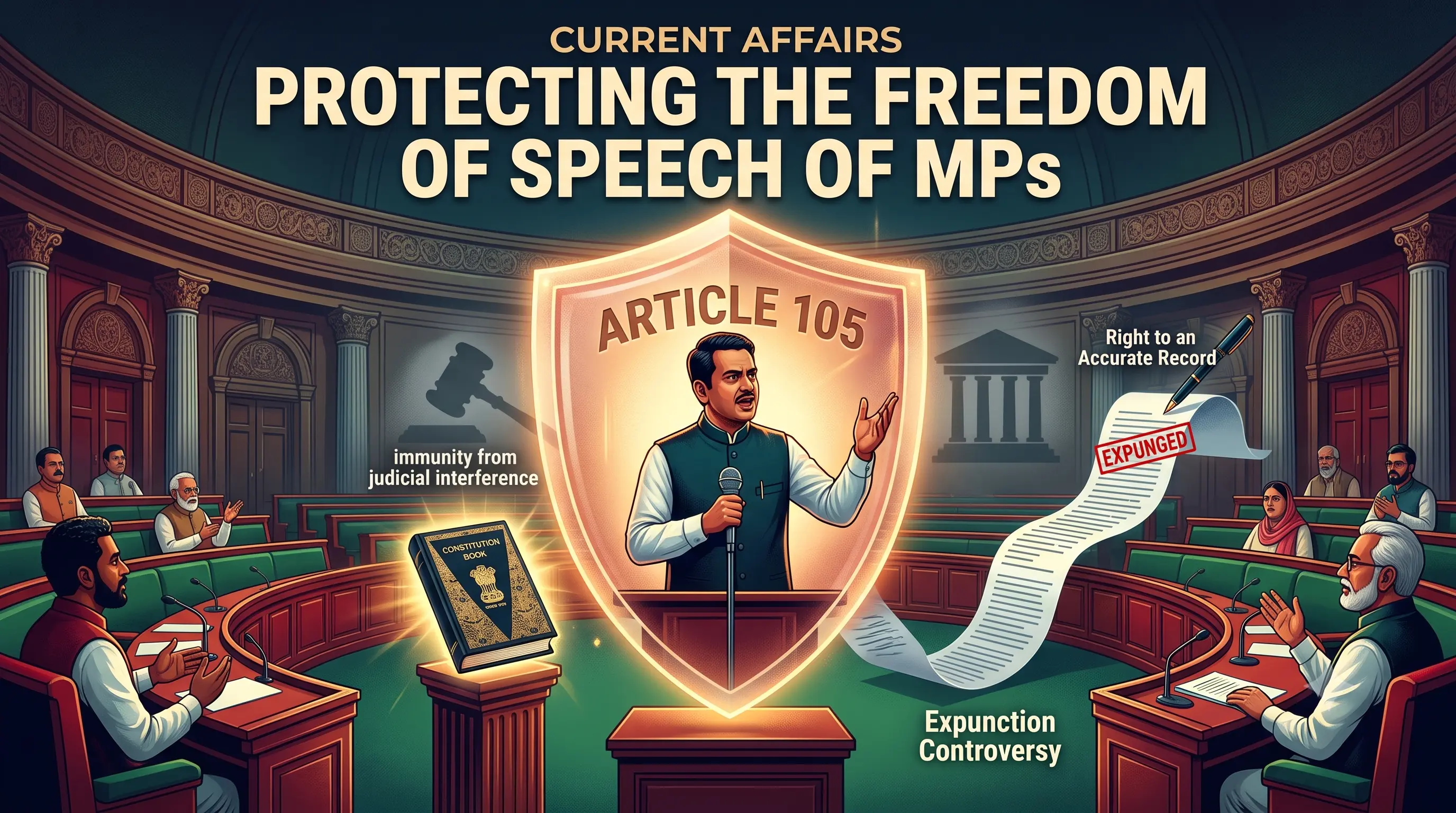
Recent events in Parliament have highlighted the necessity of safeguarding the freedom of speech of Members of Parliament, a privilege secured under Article 105. This article examines the constitutional framework, the controversy surrounding the expunction of speeches, and the vital role of free speech and the Opposition in a parliamentary democracy.
Introduction
Context & Background
Key Points
- •Dual Structure of Free Speech: While Article 19 guarantees freedom of speech to citizens generally, Articles 105 and 194 confer special, stronger legislative privileges upon MPs and MLAs to ensure fearless debate.
- •Immunity from Judicial Interference: Courts are constitutionally restricted from examining parliamentary proceedings, preserving the absolute autonomy of legislative debate.
- •The Expunction Controversy (Rule 380): Presiding officers have the power to remove specific unparliamentary words. However, extensive deletions distort the meaning of speeches, fragment arguments, and weaken accountability.
- •Indispensable Role of the Opposition: A healthy legislature requires sustained scrutiny of government actions. Criticism and dissent by Opposition members are structural necessities, not mere disruptions.
- •Rules as Enablers, Not Substitutes: Procedural rules are intended to uphold order and dignity in the House. They must operate in support of, and never in substitution for, constitutional speech rights.
Key Constitutional & Procedural Provisions Governing Parliamentary Speech
| Provision | Applicability | Purpose / Scope | Bookmark |
|---|---|---|---|
| Article 19 | General Citizens | Guarantees freedom of speech and expression to all citizens, subject to reasonable restrictions. | |
| Articles 105 & 194 | MPs and MLAs | Confers distinct legislative privileges, providing immunity for anything said or any vote cast within the House. | |
| Article 121 | Parliament | Prohibits discussion on the conduct of judges in the discharge of their duties except during formal removal proceedings. | |
| Rule 380 | Presiding Officers | Authorises the deletion of expressions that are unparliamentary, defamatory, indecent, or undignified from the record. |
Related Entities
Impact & Significance
- •Shield Against Executive Overreach: Unfettered debate allows legislators to function without fear, preventing undue executive influence over parliamentary discourse.
- •Effective Oversight: Meaningful scrutiny of the executive is only possible when members are able to question policies, actions, and failures freely.
- •Strengthening Deliberative Lawmaking: Sound legislation depends on uninterrupted and substantive debate; curbing speech weakens Parliament’s evaluative capacity.
- •Enhancing Transparency and Trust: Visible and intelligible debate promotes public confidence in the fairness and accountability of democratic institutions.
Challenges & Criticism
- •The Expunction Controversy: Frequent invocation of Rule 380 to delete "unparliamentary" expressions often results in fragmented records, distorting the original intent of speeches and reducing transparency.
- •Procedural Misuse: There are growing concerns that procedural rules meant to maintain order are being weaponised to suppress dissent and silence critical voices.
- •Signs of Institutional Strain: Extreme punitive measures and difficulties faced by Opposition leaders in presenting their views indicate a breakdown in the cooperative foundations of parliamentary functioning.
- •Mechanical Application of Discipline: When presiding officers apply deletions routinely without careful judgment, it diminishes the long-term institutional value of parliamentary debates.
Future Outlook
- •Proportionate Application of Rules: Presiding officers must ensure disciplinary powers are used judiciously so they do not curtail the essential speech freedoms of members or distort the historical record.
- •Rebuilding Institutional Respect: Restoring mutual restraint and cooperation between the government and the Opposition is essential for the smooth functioning of parliamentary democracy.
- •Strengthening Democratic Conventions: Beyond written rules, shared norms of respect, accountability, and openness must be actively cultivated to deepen deliberative lawmaking.
UPSC Relevance
- • GS-2 (Polity & Governance): Parliament and State legislatures—structure, functioning, conduct of business, powers & privileges and issues arising out of these.
- • GS-2 (Constitutional Framework): Fundamental Rights (Article 19) vs Parliamentary Privileges (Article 105).
- • Essay/Interview: The role of the Opposition in a democracy, executive overreach, and the declining standards of parliamentary debates.
Sample Questions
Prelims
With reference to the freedom of speech in Parliament, consider the following statements:
1. The freedom of speech of an MP in Parliament is identical to the freedom of speech guaranteed to citizens under Article 19.
2. Courts possess the absolute power to inquire into the proceedings of Parliament to ensure constitutional validity.
3. Parliament is constitutionally barred from discussing the conduct of judges except upon a motion for their removal.
Answer: Option 3
Explanation: Statement 1 is incorrect: MPs enjoy a higher constitutional footing for speech within the House (Article 105) compared to Art 19. Statement 2 is incorrect: Courts are restricted from examining parliamentary proceedings. Statement 3 is correct: Article 121 explicitly prohibits discussions on the conduct of judges except during removal proceedings.
Mains
“Parliamentary privileges are designed to facilitate fearless debate, not to stifle legitimate dissent.” Analyze the significance of freedom of speech for MPs under Article 105, highlighting the concerns surrounding the frequent expunction of parliamentary records.
Introduction: Define parliamentary privileges under Article 105. Briefly mention recent instances where the expunction of MPs' remarks sparked debates about the balance between parliamentary decorum and free speech.
Body:
• Constitutional Basis & Significance: Mention Art 105/194; distinct from Art 19. Enables MPs to hold the executive accountable, pass sound legislation, and represent citizens fearlessly without judicial interference.
• Concerns Regarding Expunction (Rule 380): Highlight the mechanical application of rules leading to distortion of speeches; fragments the historical record; limits the Opposition's structural role in democracy.
• Institutional Strain & Way Forward: Overuse of punitive measures indicates a breakdown of mutual restraint. Need for proportionate use of rules, reliance on democratic conventions, and preserving the equilibrium between majority governance and minority critique.
Conclusion: Conclude that safeguarding free speech in Parliament is fundamental to democratic equilibrium. Procedural rules must organize debate without diluting constitutional guarantees.