
Railway Safety in India: Modernization, Challenges, and the Way Forward
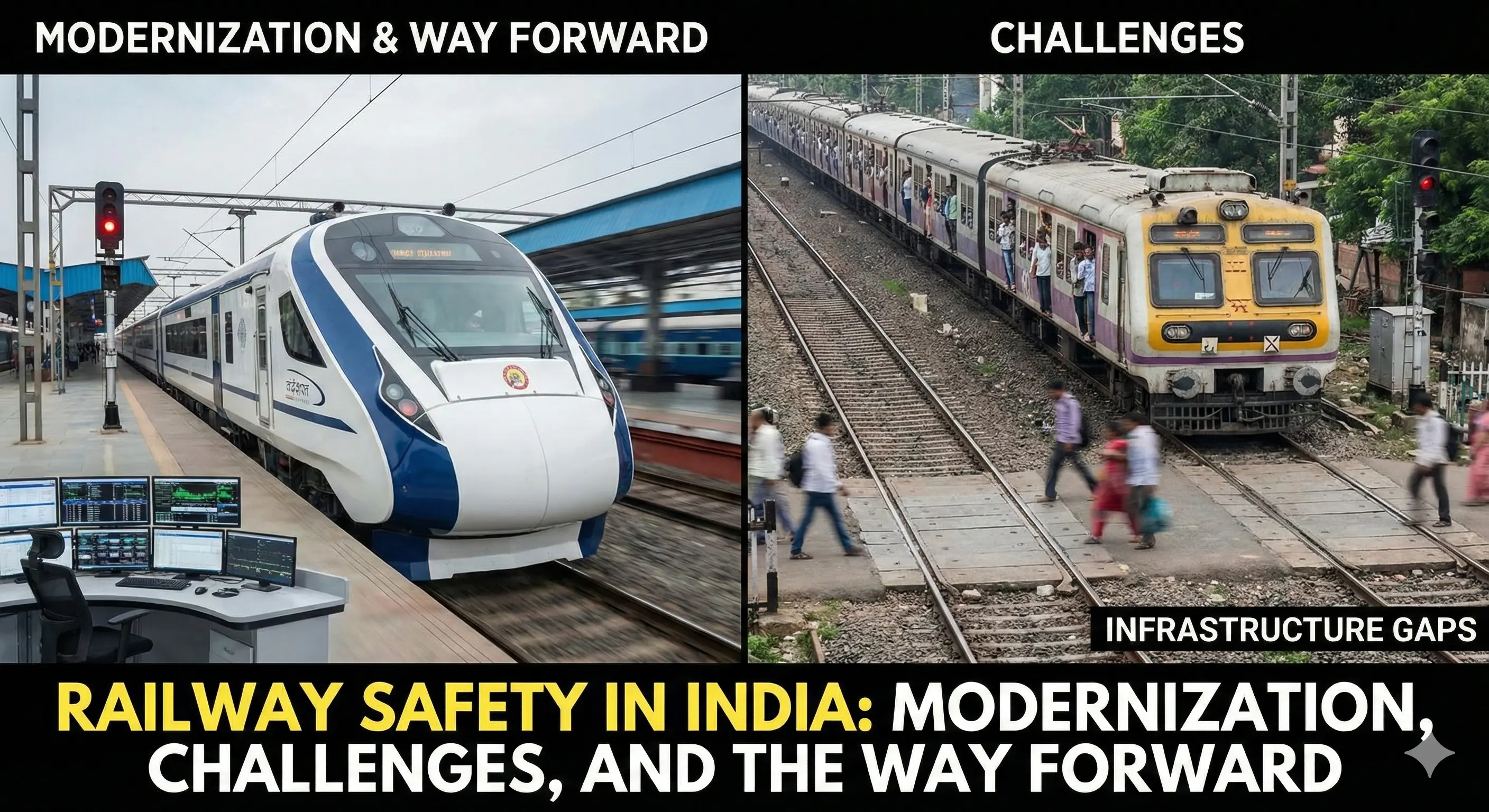
Despite significant modernization efforts like KAVACH and LHB coaches, Indian Railways continues to face safety challenges, highlighted by recent accidents like the one in Bilaspur. The need for accelerated infrastructure upgrades, filling safety vacancies, and a shift towards a 'safety-first' culture is more critical than ever.
Introduction
Context & Background
Key Points
- •Human Factors: The railway workforce is overburdened. There are over 1.7 lakh vacancies in safety-critical roles (loco pilots, track maintainers). This leads to long duty hours, fatigue, and 'microsleeps', contributing to errors like SPAD (Signal Passed At Danger).
- •Infrastructure Deficit: About 25% of tracks are overaged and need renewal. The network is congested, operating at 120% capacity on key routes (like Delhi-Howrah), leaving little time for maintenance. It's like trying to repair a highway while cars are speeding on it.
- •Technological Lag: While we have developed KAVACH (an indigenous Automatic Train Protection system), its rollout is painfully slow. It covers only ~3,700 km out of 68,000 km. At this pace, full coverage will take decades. Meanwhile, 60% of signaling still relies on older mechanical systems.
- •Institutional Issues: The Rashtriya Rail Sanraksha Kosh (RRSK), a dedicated safety fund, faces chronic funding shortfalls. A CAG report (2022) shockingly revealed that safety funds were sometimes diverted for non-essential items like foot massagers and furniture.
- •Modernization vs. Safety: There is a criticism that the focus on launching high-speed trains (Vande Bharat) and redeveloping stations (Amrit Bharat) might be diverting attention and resources from basic track renewal and safety signaling.
- •External Threats: Sabotage (placing objects on tracks) and unmanned level crossings (though significantly reduced) still pose risks. Encroachments near tracks add to operational hazards.
Major Recent Railway Accidents (2023-2025)
| Incident | Cause | Key Lesson | Bookmark |
|---|---|---|---|
| Balasore Collision (2023) | Signaling interference & Human negligence | Need for fail-safe signaling logic and strict maintenance protocols. | |
| Vizianagaram Collision (2023) | Driver Error (SPAD) | Urgency for KAVACH (auto-braking) on all routes. | |
| Mathura Express Fire (2024) | Short-circuit | Need for fire-retardant materials and smoke sensors in all coaches. | |
| Bargarh Collision (2025) | Fog & Signal Misreading | Need for Fog-Safe devices and better loco-pilot training. |
Key Safety Committees & Recommendations
| Committee | Key Recommendation | Bookmark |
|---|---|---|
| Anil Kakodkar (2012) | Complete elimination of level crossings; ₹1 lakh crore safety fund. | |
| Bibek Debroy (2015) | Independent safety regulator; unbundling of operations. | |
| Sam Pitroda (2012) | Modernization of signaling and tracks; use of IoT and big data. |
Related Entities
Impact & Significance
- •Public Confidence: Recurring accidents erode trust in the railway system, pushing passengers towards road or air travel, which is more expensive and polluting.
- •Economic Cost: Accidents disrupt freight corridors, delaying coal and raw material supply to power plants and industries, hurting the GDP.
- •Global Image: For a country aspiring to be a $5 trillion economy, a safe and modern railway network is a prerequisite for attracting investment and logistics efficiency.
Challenges & Criticism
- •Slow KAVACH Rollout: Despite being a game-changer, the implementation speed is too slow due to limited manufacturing capacity and high costs.
- •Workforce Fatigue: The refusal to fill vacancies in safety categories creates a stressed workforce prone to errors. Automation cannot fully replace the need for alert human oversight.
- •Financial Priorities: The Operating Ratio (money spent to earn ₹100) is high (~98%), leaving little surplus for internal safety funding. Reliance on budget support (Gross Budgetary Support) is increasing.
Future Outlook
- •Accelerated KAVACH: The government aims to fast-track KAVACH installation by involving private players like L&T and Siemens.
- •Predictive Maintenance: Shifting from 'Find and Fix' to 'Predict and Prevent' using AI and IoT sensors. 'Smart Tracks' that can detect fractures before a train passes are being piloted.
- •Independent Regulator: There is a growing demand to separate the regulator from the operator (Indian Railways) to ensure unbiased safety audits.
- •Human Capital: Better training simulators for drivers and filling vacancies will be crucial to reducing human error.
UPSC Relevance
- • GS-3: Infrastructure: Railways; Investment models.
- • GS-3: Disaster Management (Rail accidents).
- • GS-2: Government policies and interventions (Safety reforms).
- • Essay: 'Speed vs Safety: The dilemma of development'.
Sample Questions
Prelims
With reference to railway safety in India, consider the following statements:
1. 'KAVACH' is an indigenously developed Automatic Train Protection (ATP) system.
2. The Rashtriya Rail Sanraksha Kosh (RRSK) was introduced to fund new high-speed bullet train projects.
3. The Commission of Railway Safety (CRS) works under the administrative control of the Ministry of Civil Aviation.
Answer: Option 1, Option 3
Explanation: Statement 2 is incorrect (RRSK is for safety works like track renewal, not bullet trains). Statement 3 is correct (CRS is under Civil Aviation to ensure independence).
Mains
“Modernization of Indian Railways must not be limited to speed and aesthetics but must fundamentally prioritize safety.” In light of recent accidents, identify the structural challenges in railway safety and suggest a roadmap for a 'Zero Accident' regime.
Introduction: Start with the 'Lifeline of the Nation' context and recent accidents (Balasore/Bilaspur).
Body:
• Structural Challenges: Human resource crunch (vacancies/fatigue), underfunding of safety (RRSK issues), slow KAVACH adoption, and aging infrastructure.
• Technological Solutions: AI-based predictive maintenance, IoT sensors for tracks/rolling stock, faster KAVACH rollout.
• Institutional Reforms: Independent safety regulator, empowering CRS, and a cultural shift from 'punctuality' to 'safety first'.
Conclusion: Conclude with the PM's mantra of 'Speed, Scale, and Sensitivity', emphasizing that sensitivity to safety is the foundation of a developed railway network.