
Rare Earth Magnet Scheme: Building India's Strategic Autonomy
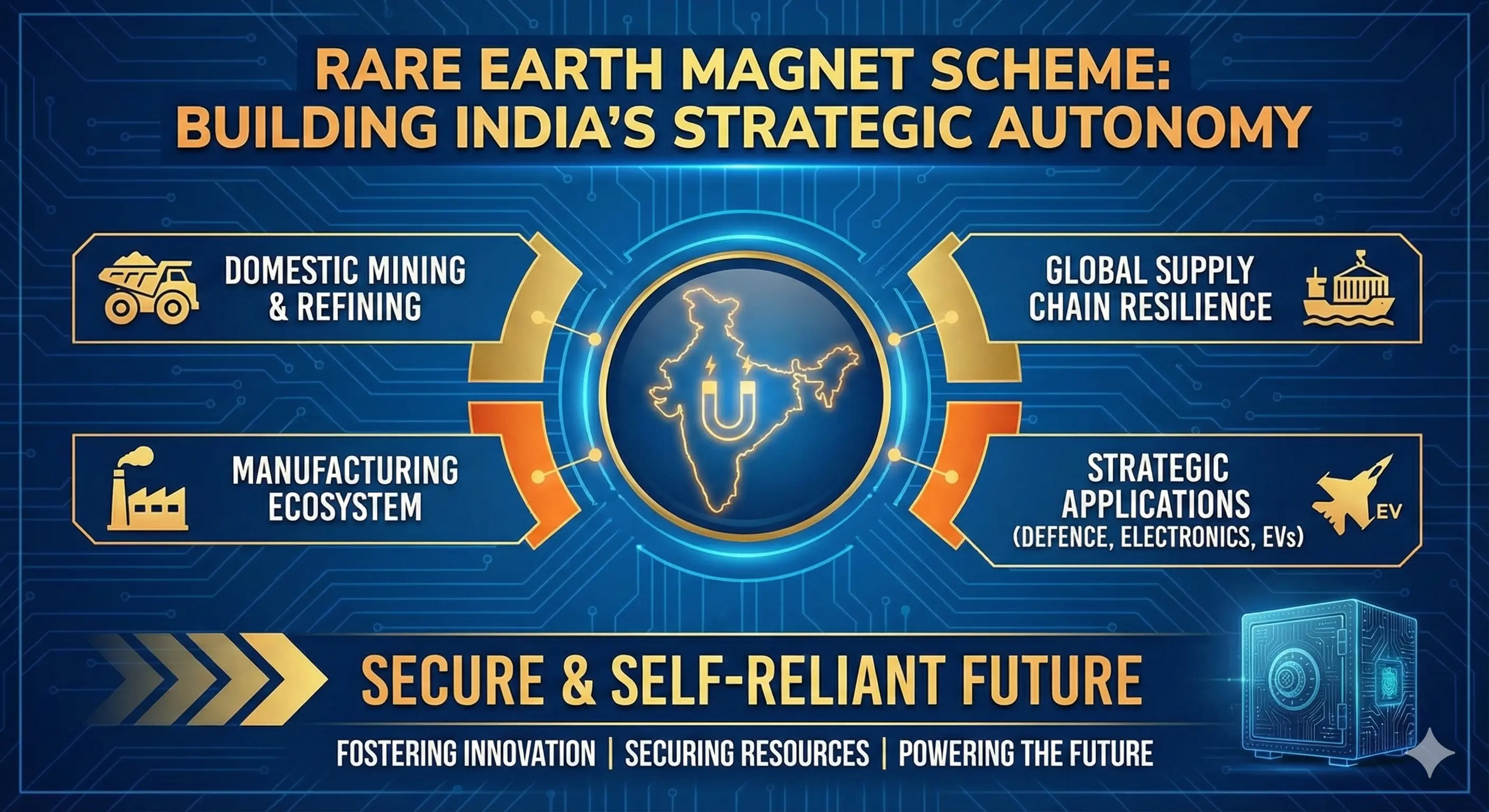
The Union Cabinet has approved a ₹7,280-crore scheme to create India's first integrated manufacturing ecosystem for Rare Earth Permanent Magnets (REPMs). This move aims to reduce import dependence on China and secure supply chains for critical sectors like EVs, Defense, and Clean Energy.
Introduction
Context & Background
1. Demand Explosion: India's push for EVs and Renewable Energy means magnet demand will double by 2030.
2. Geopolitical Risk: In 2024-25, China imposed export controls on rare earth technologies, causing panic and delays for Indian manufacturers. This highlighted that energy security is now tied to material security.
Key Points
- •Scheme Overview: The ₹7,280 crore outlay is split into ₹6,450 crore as sales-linked incentives (a bonus for every magnet sold) and ₹750 crore as a capital subsidy (help to build factories). It aims to set up a capacity of 6,000 MTPA (Metric Tonnes Per Annum), allocated to 5 competitively selected companies.
- •The Technology Gap: Manufacturing REPMs is chemically complex. It involves: Mining (Ore) -> Processing (Oxides) -> Reduction (Metal) -> Alloying -> Sintering (Magnet). India currently stops at the first step. The scheme incentivizes the entire value chain.
- •Strategic Importance:
1. Defense: Missiles, fighter jets, and submarines use these magnets. Relying on an adversary (China) for them is a national security risk.
2. Climate Goals: You cannot have 'Green Energy' without these 'Critical Minerals'. Wind turbines need tonnes of magnets to generate electricity. - •Environmental Challenge: Rare earth mining is notoriously dirty. It involves radioactive by-products (Thorium) and toxic chemicals. The scheme mandates strict ESG (Environmental, Social, and Governance) compliance to ensure we don't destroy the environment while saving the climate.
- •Domestic Resource: The scheme will likely operationalize Monazite sands found in Kerala, Tamil Nadu, and Odisha, which are currently under-utilized due to atomic mineral restrictions (as they contain Thorium).
Supply Chain Vulnerability: India vs. China
| Stage of Value Chain | China's Dominance | India's Status | Bookmark |
|---|---|---|---|
| Mining (Raw Material) | High (~60% global share) | High Potential (5th largest reserves), Low Extraction | |
| Processing (Refining) | Near Monopoly (~85%) | Negligible (Lack of technology) | |
| Magnet Manufacturing | Dominant (~90%) | Zero (100% Import Dependent) |
Key Sectors Dependent on REPMs
| Sector | Application of REPMs | Bookmark |
|---|---|---|
| Electric Vehicles (EVs) | Traction Motors (The engine of the EV) | |
| Renewable Energy | Generators in Wind Turbines | |
| Defense | Guidance systems for missiles, Aircraft actuators | |
| Electronics | Hard Disk Drives (HDDs), Speakers, MRI machines |
Related Entities
Impact & Significance
- •Strategic Autonomy: By making its own magnets, India insulates its defense and energy sectors from global supply shocks or trade wars.
- •Atmanirbhar Bharat: This is a classic example of moving from being a raw material exporter to a value-added manufacturer.
- •Technological Spillover: Mastering rare earth processing will help India in other high-tech fields like semiconductors and space exploration.
Challenges & Criticism
- •Technology Denial: Countries with this tech (China, Japan) guard it jealously. Getting technology transfer will be tough.
- •Environmental Cost: Extracting rare earths from Monazite produces radioactive waste. Managing this safely is a massive challenge in a densely populated country.
- •Cost Competitiveness: Chinese magnets are cheap due to scale and subsidies. Indian magnets might be costlier initially, requiring protectionist tariffs which can hurt EV makers.
Future Outlook
- •Global Partnerships: India is likely to partner with Japan, Australia, or the USA (Quad partners) who also want to break China's monopoly but lack India's processing capacity potential.
- •Recycling: A future focus will be 'Urban Mining'—extracting rare earths from old electronics and EV batteries, creating a circular economy.
- •New Materials: Research into ferrite magnets (which don't use rare earths) to reduce dependency in the long run.
UPSC Relevance
- • GS-1: Distribution of key natural resources across the world (Critical Minerals).
- • GS-3: Infrastructure: Energy, Ports, Roads, Airports, Railways etc. (EV ecosystem).
- • GS-3: Indigenization of technology and developing new technology.
- • Essay: Energy Security vs. Environmental Sustainability.
Sample Questions
Prelims
With reference to Rare Earth Permanent Magnets (REPMs), consider the following statements:
- (a)India possesses the world's largest reserves of rare earth elements.
- (b)REPMs are critical components in the traction motors of Electric Vehicles.
- (c)Monazite sand is a major source of rare earths but contains radioactive Thorium.
Mains
Despite having significant reserves, India is largely dependent on imports for Rare Earth Permanent Magnets (REPMs). Discuss the strategic necessity of the recently approved manufacturing scheme and the challenges in its implementation.
Introduction: Highlight India's 'Reserves vs. Production' paradox and the import dependence on China.
Body:
• Strategic Necessity: Supply chain resilience for EVs/Wind Energy, Defense autonomy, countering Chinese monopoly.
• Challenges: Technological gap (oxide-to-metal), Environmental concerns (radioactive waste), and high capital cost.
• Way Forward: Technology transfer from Quad partners, investing in R&D for recycling, and strict ESG norms.
Conclusion: Conclude that the scheme is a vital step towards 'Net Zero' and 'Atmanirbhar Bharat', bridging the gap between resource availability and utilization.