
RBI Proposes Compensation for Digital Fraud Victims
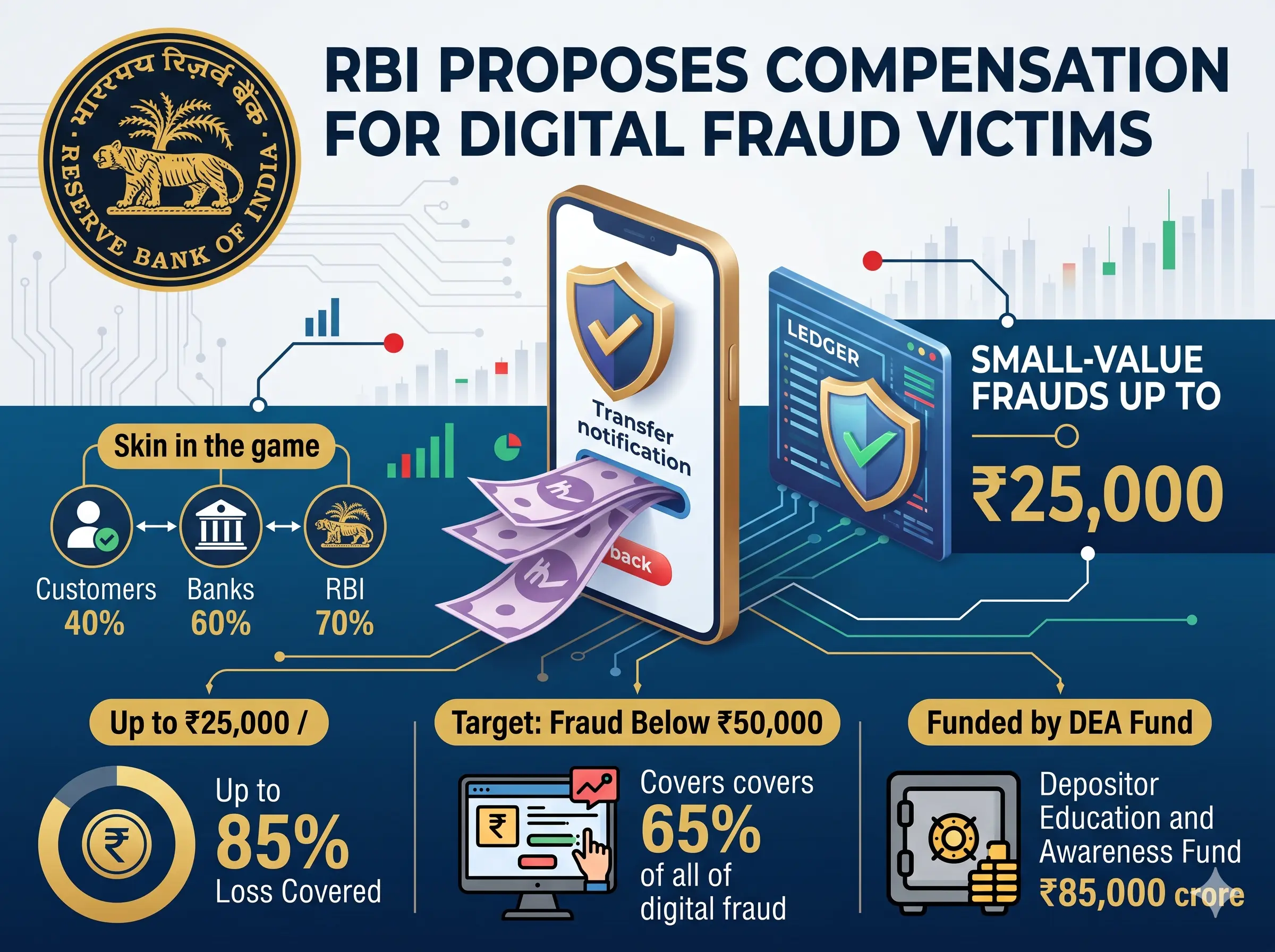
The Reserve Bank of India (RBI) has proposed a compensation framework for victims of small-value digital frauds up to ₹25,000. Leveraging the Depositor Education and Awareness (DEA) Fund, the scheme targets frauds below ₹50,000 and introduces a shared liability model among customers, banks, and the RBI.
Introduction
Context & Background
Key Points
- •Target Scope & Frequency: The framework specifically targets digital frauds below ₹50,000, which account for approximately 65% of all digital fraud cases. It offers a one-time relief per customer to discourage habitual negligence.
- •Compensation Quantum: Victims are eligible to receive compensation of up to ₹25,000 or 85% of the loss, whichever is lower.
- •Eligibility Constraints: Unlike previous strict rules, this framework covers inadvertent credential sharing (negligence), provided that the transaction was not mala fide (fraudulent intent by the user).
- •Funding Mechanism: The payouts will be sourced from the Depositor Education and Awareness (DEA) Fund, which currently boasts a surplus of approximately ₹85,000 crore.
- •DEA Fund Origins: Established in 2014 under Section 26A of the Banking Regulation Act, 1949. Banks must transfer credit balances of accounts remaining inoperative or unclaimed for 10 years or more to this fund.
- •Depositor Rights: Transferring money to the DEA Fund does not extinguish the original depositor’s right to reclaim their funds along with applicable interest paid by the RBI.
Liability Sharing: 'Skin in the Game' Model
| Stakeholder | Liability Share | Rationale | Bookmark |
|---|---|---|---|
| Customers | 15% of the loss (deductible) | Absorb a small portion to ensure continued vigilance and avoid habitual negligence. | |
| Banks | Proposed share (~15%) | Contribute to the compensation to incentivise the implementation of robust security protocols. | |
| RBI (via DEA Fund) | Residual balance (~70%) | Covers the majority of the loss, subject to the overall ₹25,000 compensation cap. |
Related Entities
Impact & Significance
- •Consumer Confidence: By providing a safety net for inadvertent errors, the policy bolsters trust among rural and first-time digital banking users.
- •Equitable Burden Sharing: The 'skin in the game' strategy prevents moral hazard by ensuring customers still face a 15% deductible, while banks are penalized for potential systemic vulnerabilities.
- •Productive Use of Idle Funds: Effectively deploys the massive ₹85,000 crore sitting in the DEA Fund towards an immediate public grievance without straining the exchequer.
Challenges & Criticism
- •Determining 'Mala Fide' Intent: Operationally, banks may find it difficult to differentiate between genuine inadvertent negligence and deliberate, orchestrated fraud by the customer.
- •One-Time Limitation: Because the relief is a one-time offer per customer, vulnerable populations (like the elderly) who might repeatedly fall victim to sophisticated scams remain at risk.
- •Cap Restraints: The ₹25,000 maximum payout cap provides limited relief for middle-class users who may lose significantly higher amounts in a single elaborate scam.
Future Outlook
- •Incentivizing Cybersecurity: By enforcing financial liability (~15%) on banks, financial institutions are expected to proactively upgrade their backend fraud detection systems and security protocols.
- •Enhanced Digital Literacy: The DEA Fund will continue to support depositor awareness programs, focusing heavily on educating the public against social engineering and credential-sharing scams.
- •Streamlined Claims Process: Future integration with digital banking systems may allow for automated flagging and faster disbursal of the one-time ₹25,000 relief to genuine victims.
UPSC Relevance
- • GS-3 (Indian Economy): Digital economy, banking sector regulations, consumer protection, and cybersecurity in financial transactions.
- • Prelims Focus: Provisions of the Banking Regulation Act, 1949; operational mechanics of the DEA Fund and the UDGAM portal.
- • Mains Focus: Analyzing the balance between consumer protection (compensation) and institutional accountability (bank liability) in the digital era.
Sample Questions
Prelims
Consider the following statements regarding the Depositor Education and Awareness (DEA) Fund:
1. The DEA Fund was established under the Banking Regulation Act, 1949.
2. Deposits unclaimed for 10 years or more are transferred to the DEA Fund.
3. Once funds are transferred to the DEA Fund, depositors lose the legal right to reclaim them.
Answer: Option 1, Option 2
Explanation: Statement 1 is correct (Section 26A of the BR Act, 1949). Statement 2 is correct. Statement 3 is incorrect; the transfer to the DEA Fund does not extinguish the depositor’s right to reclaim their funds with applicable interest.
Mains
The RBI's proposed compensation framework for digital fraud victims represents a shift from 'caveat emptor' to a 'shared responsibility' model. Discuss the significance of this move in the context of India's growing digital economy.
Introduction: Introduce the rapid rise of digital payments in India and the corresponding increase in cyber frauds. Mention the RBI's recent proposal to compensate small-value fraud victims up to ₹25,000.
Body:
• Need for the Framework: High volume of small-ticket frauds (<₹50,000 constitutes 65% of cases); vulnerability of new digital users; previous rigid rules penalized inadvertent negligence heavily.
• The Shared Responsibility Model: Explain the 'skin in the game' approach (Customer 15%, Banks 15%, RBI/DEA Fund 70%). Highlights how it keeps users vigilant while forcing banks to improve security.
• Role of DEA Fund: Utilizing the ₹85,000 crore corpus of unclaimed deposits for public welfare while retaining the original depositor's right to reclaim.
Conclusion: Conclude by stating that while this framework provides a crucial safety net for retail digital users, long-term security relies on robust digital literacy and proactive AI-driven fraud detection by banks.