
RBI Report on State Budgets and Fiscal Performances
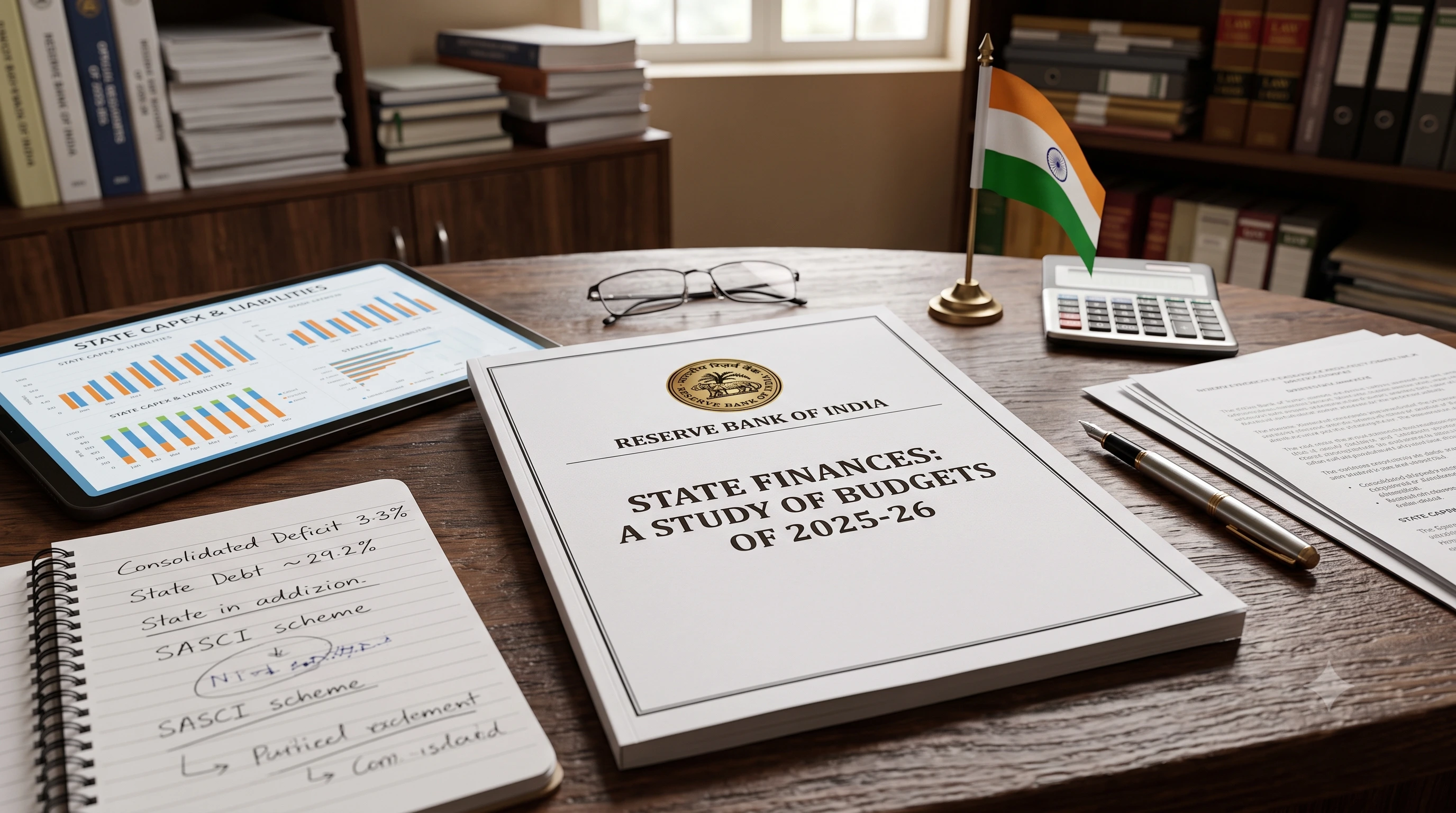
The Reserve Bank of India's annual report, 'State Finances' for FY 2025-26, assesses the fiscal health and budgetary priorities of Indian states. It highlights a budgeted Gross Fiscal Deficit of 3.3% of GDP, rising state debt levels, and the differing fiscal pressures states face due to demographic transitions. The report also flags major concerns like expenditure rigidity, off-budget borrowings, and the proliferation of non-merit subsidies.
Introduction
Context & Background
Key Points
- •Fiscal Deficit Trends: The consolidated Gross Fiscal Deficit of states is budgeted at 3.3% of GDP for FY25, which is an increase from the 3% maintained over the previous three fiscals.
- •Capital Spending Push: State capital expenditure is projected at 3.2% of GDP, focusing on long-term public asset creation. This growth is heavily supported by the Centre through 50-year interest-free loans under the SASCI scheme.
- •Breaching Debt Targets: Total outstanding state liabilities stand at 29.2% of GDP. This significantly exceeds the fiscal prudence target of 20% recommended by the FRBM Review Committee (2017).
- •Tax Structure Shifts: State Goods and Services Tax (SGST) is the primary tax source, but its growth has slowed, and its share in SGDP remains below pre-GST levels. Furthermore, non-tax revenue sources have declined steadily over the past decade.
- •The Demographic Divide: States are facing distinct fiscal challenges based on their population age structures. 'Young States' need investments in human capital (education/skills), 'Ageing States' are burdened by pensions and healthcare, and 'Transition States' require structural adjustments for long-term sustainability.
Key Fiscal Indicators for States (FY 2025-26)
| Indicator | Budgeted Level | Remarks/Comparison | Bookmark |
|---|---|---|---|
| Gross Fiscal Deficit | 3.3% of GDP | Up from 3% over the previous three fiscals | |
| Capital Expenditure | 3.2% of GDP | Supported by 50-year interest-free loans (SASCI) | |
| Outstanding State Liabilities | 29.2% of GDP | Exceeds the FRBM Review Committee target of 20% |
Demographic Transition & Fiscal Priorities
| Category | Examples | Primary Fiscal Focus | Bookmark |
|---|---|---|---|
| Young States | Bihar, Uttar Pradesh | Must increase spending on education and skills to utilize the working-age population. | |
| Ageing States | Kerala, Tamil Nadu | Facing rising fiscal pressures from pension and geriatric healthcare demands. | |
| Transition States | West Bengal, Maharashtra | Need to adjust fiscal strategies for long-term revenue sustainability. |
Related Entities
Impact & Significance
- •Macroeconomic Stability: High state debt levels (29.2% of GDP) combined with central debt pose systemic risks to India's overall sovereign credit ratings and macroeconomic resilience.
- •Infrastructure vs. Welfare: While capital spending is high (3.2%), the over-reliance on central loans implies that states' own revenues are being consumed by committed expenditures, limiting independent infrastructure growth.
- •Inter-generational Equity: Expanding non-merit subsidies (freebies) financed by market borrowings places an unfair fiscal burden on future generations.
- •Regional Disparities: The differing demographic profiles mean states will have vastly different developmental trajectories. The fiscal capacity to handle these demographic shifts will determine regional inequality in the coming decades.
Challenges & Criticism
- •Expenditure Rigidity: States are trapped by high committed expenditures—money that legally must be spent on salaries, pensions, and interest payments—leaving little fiscal space for discretionary developmental projects.
- •Subsidy Quality and 'Freebies': The aggressive expansion of non-merit subsidies (often driven by electoral cycles) risks crowding out much-needed productive investments in health, education, and physical infrastructure.
- •Discom Stress: Power distribution companies (Discoms) continue to incur persistent financial losses. These losses act as a hidden drain on state coffers, creating massive contingent liabilities.
- •Transparency Gaps: States frequently resort to off-budget borrowings (borrowing through state-owned entities) to bypass borrowing limits, which obscures the true extent of state indebtedness and systemic fiscal risk.
Future Outlook
- •Time-Bound Fiscal Consolidation: States must adopt a strict roadmap to reduce their debt-to-GDP ratios to sustainable levels, moving closer to the FRBM targets.
- •Expanding the Revenue Base: To reduce dependency on central transfers and continuous borrowing, states urgently need to strengthen their non-tax revenue sources (e.g., monetizing assets, rationalizing user charges).
- •Climate-Sensitive Budgeting: With the rising frequency of natural disasters, states should integrate climate budgeting to mitigate unforeseen fiscal shocks.
- •Digital Public Financial Management: Implementing stronger digital systems can drastically improve the efficiency of tax collection and ensure better targeting of subsidies.
UPSC Relevance
- • GS-3 (Indian Economy): Government Budgeting, Fiscal Policy, Public Debt, and mobilization of resources.
- • GS-2 (Governance & Polity): Issues and challenges pertaining to the federal structure, devolution of powers and finances up to local levels and challenges therein.
- • Mains Focus: Analyzing the quality of expenditure by states (Capex vs. Revenue/Freebies), understanding the implications of demographic dividends/ageing on state budgets, and measures for fiscal consolidation.
Sample Questions
Prelims
With reference to the state finances in India, consider the following statements and identify the correct one:
1. The FRBM Review Committee (2017) recommended a target of 30% for outstanding state liabilities as a percentage of GDP.
2. State Goods and Services Tax (SGST) has emerged as the primary source of tax revenue for Indian states.
3. The SASCI scheme provides states with short-term, high-interest loans to manage their revenue deficits.
Answer: Option 2
Explanation: Option 2 is correct. SGST is the primary tax source for states. Option 1 is incorrect; the FRBM Review Committee (2017) recommended a target of 20% for state debt. Option 3 is incorrect; SASCI provides 50-year interest-free loans specifically for capital investment, not short-term high-interest loans for revenue deficits.
Mains
Highlighting the key findings of the recent RBI report on State Finances, discuss the major structural and fiscal challenges faced by Indian states. How does demographic transition influence state budgetary priorities?
Introduction: Introduce the context by mentioning the RBI's annual report 'State Finances: A Study of Budgets' for 2025-26. Briefly define the current fiscal stance of states (increasing Capex supported by Centre, but widening deficits).
Body:
• Key Findings & Fiscal Challenges: Rising Fiscal Deficit (3.3% of GDP); High debt liabilities (29.2% of GDP vs FRBM target of 20%); Expenditure rigidity due to salaries/pensions; Slower growth in SGST and decline in non-tax revenues; Threat of non-merit subsidies (freebies); Contingent liabilities from stressed power Discoms; Gaps in transparency due to off-budget borrowings.
• Impact of Demographic Transition: Explain the diverging needs. Young states (Bihar, UP) require heavy capital outlay in education, skilling, and job creation. Ageing states (Kerala, TN) face soaring revenue expenditure on pensions and geriatric healthcare. Transition states need to balance both while sustaining revenues.
Conclusion: Conclude by emphasizing the RBI's recommendations: states need a credible, time-bound fiscal consolidation path, integration of climate budgeting, and enhanced digital financial management to ensure sustainable economic growth.