
The Right to be Forgotten (RTBF): Balancing Privacy and Public Interest
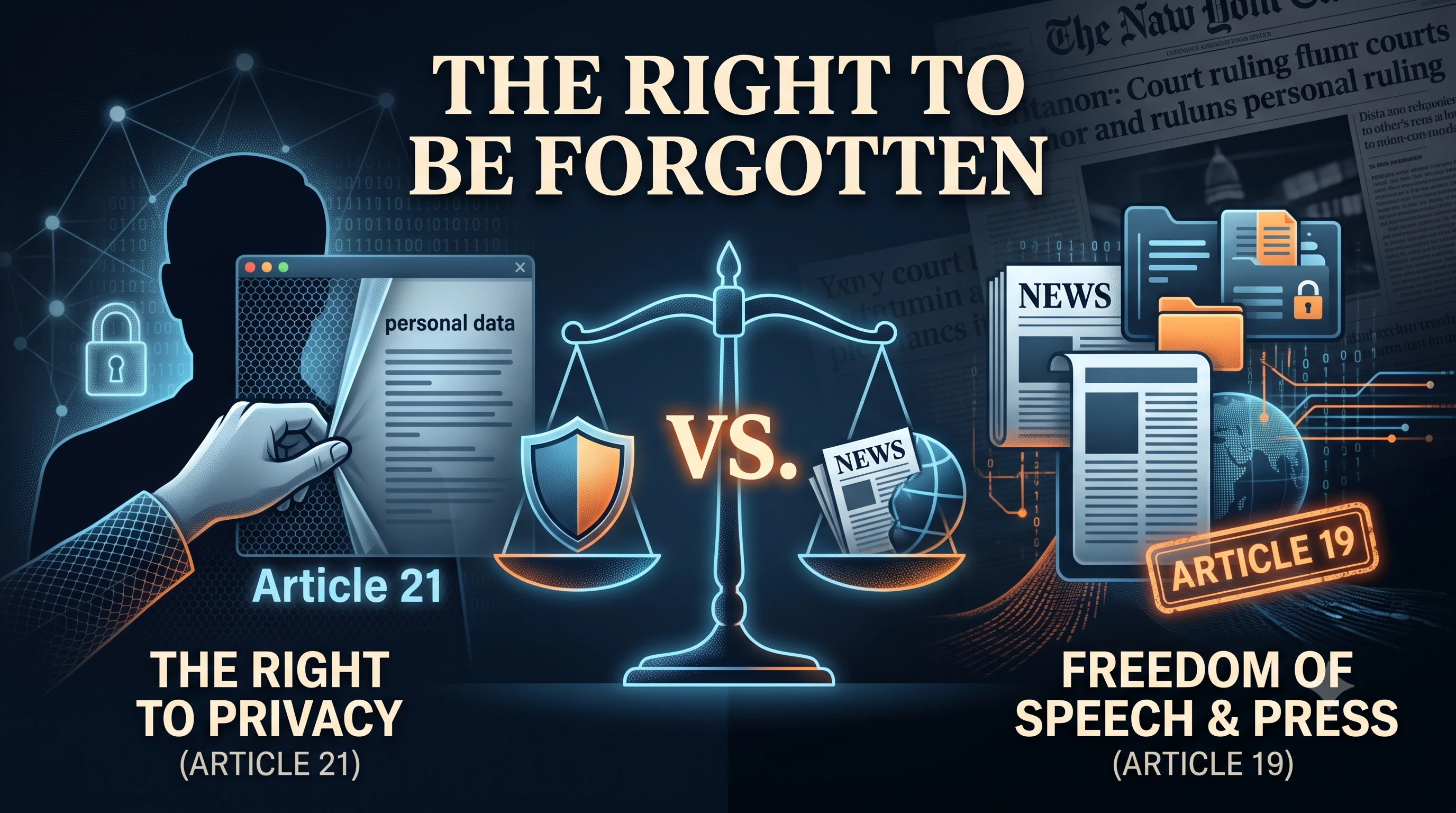
The Supreme Court of India is set to determine the scope of the 'Right to be Forgotten' (RTBF) after staying a Delhi High Court order that directed the removal of factual news reports. This article examines the constitutional friction between the Right to Privacy (Article 21) and the Freedom of Speech and Press (Article 19), analyzing judicial precedents and the need for a statutory framework in India.
Introduction
Context & Background
Key Points
- •Constitutional Basis: In the landmark K.S. Puttaswamy v. Union of India (2017) judgment, the Supreme Court recognized RTBF as an intrinsic part of the Right to Life and Dignity under Article 21.
- •Current Legal Position: India currently lacks a dedicated statutory provision formally establishing the right to be forgotten. Its application relies entirely on judicial interpretations and policy drafts.
- •Personal Data Protection (PDP) Bill, 2019: This bill envisaged a limited RTBF, allowing individuals to restrict data disclosure if the data has fulfilled its original purpose, consent is withdrawn, or if the disclosure violates prevailing laws.
- •Rationale for RTBF: The right provides individuals with autonomy over personal data, protects against non-consensual disclosure (e.g., intimate images), and reduces long-term digital harm to social standing and employment prospects.
Core Legal Conflict: Privacy vs. Free Speech
| Aspect | Right to Privacy (Article 21) | Freedom of Speech & Press (Article 19) | Bookmark |
|---|---|---|---|
| Primary Focus | Focuses on individual dignity and reputation. | Focuses on the public’s right to know and transparency. | |
| Core Argument | Argues that digital permanence causes enduring stigma even after legal exoneration. | Argues that erasing accurate reports distorts history and creates a “chilling effect.” | |
| Status of Information | Information becomes irrelevant after a person is cleared of charges. | Subsequent discharge does not retroactively make factual reporting defamatory. |
Key Judicial Precedents on RTBF in India
| Case / Court | Year | Key Ruling / Observation | Bookmark |
|---|---|---|---|
| R. Rajagopal vs. State of Tamil Nadu (SC) | 1994 | Articulated the “right to be let alone” but limited erasure for public/judicial records. | |
| Dharamraj Bhanushankar Dave (Gujarat HC) | 2017 | Declined removal of acquittal details to preserve justice system transparency. | |
| Delhi High Court | 2021 | Permitted removal of personal details in a criminal matter to protect dignity/career. | |
| Supreme Court Order | 2022 | Directed masking of personal details in a sensitive matrimonial dispute from search engines. | |
| Kerala High Court | 2023 | Ruled RTBF cannot extend to sub judice matters, citing principles of open justice. | |
| Himachal Pradesh High Court | 2024 | Directed the anonymisation of both the accused and the victim after acquittal in a rape case. |
Related Entities
Impact & Significance
- •Digital Rehabilitation: RTBF empowers individuals who have been legally exonerated to rebuild their personal and professional lives without the perpetual shadow of past allegations.
- •Threat to Journalistic Freedom: If applied too broadly, RTBF could force media houses to alter historical archives, creating a chilling effect on factual reporting.
- •Platform Liability: It places a massive compliance burden on tech intermediaries and search engines, who must navigate complex cross-border jurisdictions to implement erasure requests.
- •Integrity of Public Records: Wiping out past records challenges the core democratic principles of open justice and institutional transparency.
Challenges & Criticism
- •Legislative Vacuum: The absence of a clear statutory framework has led to fragmented and contradictory judgments by different High Courts across India.
- •Status of Public Records: There is an ongoing tension regarding whether court orders and public records can ever truly be 'forgotten' without undermining the transparency of the justice system.
- •Technical Impossibility: Enforcing total erasure on the internet is practically impossible due to data duplication across multiple global servers and the 'Streisand Effect'.
- •Risk of Abuse: Critics fear that powerful individuals, politicians, or corporations might exploit RTBF to scrub legitimate criticism or evidence of past misdeeds from the public eye.
Future Outlook
- •Comprehensive Legislation: India urgently needs a robust data protection law that explicitly recognizes the RTBF, outlines clear criteria for erasure, and establishes an independent data protection authority.
- •Safeguards Against Misuse: Clear definitions, limitations, and oversight mechanisms must be established to ensure the right is not weaponized to suppress legitimate, public-interest information.
- •Judicial Guidelines: Until a law is passed, courts should develop consistent principles to balance privacy and public interest, factoring in the nature of data and the time elapsed since publication.
- •Industry Self-Regulation: Digital platforms and intermediaries should adopt responsible data management practices, including data minimisation, anonymisation, and secure deletion protocols.
UPSC Relevance
- • GS-2 (Polity & Constitution): Fundamental Rights, specifically the interpretation of Article 21 (Privacy) vs Article 19 (Freedom of Speech/Press).
- • GS-2 (Governance): Government policies and interventions (Data Protection Laws), role of the judiciary in filling legislative vacuums.
- • Essay Topics: 'Privacy in the Digital Age: A Myth or Reality?', 'Balancing Individual Rights with Public Interest'.
Sample Questions
Prelims
Consider the following statements regarding the 'Right to be Forgotten' in India: 1. It is explicitly mentioned as a fundamental right under Article 21 of the Indian Constitution. 2. The Supreme Court recognized it as a facet of the Right to Privacy in the K.S. Puttaswamy judgment. 3. It allows for the unrestricted removal of any personal data from the public domain upon request.
1. 1 and 2 only
2. 2 only
3. 2 and 3 only
4. 1, 2, and 3
Answer: Option 2
Explanation: Statement 1 is incorrect; RTBF is an inferred right from Article 21, not explicitly mentioned in the Constitution. Statement 2 is correct. Statement 3 is incorrect; RTBF is not absolute and must be balanced against public interest and freedom of speech.
Mains
The 'Right to be Forgotten' presents a complex constitutional dilemma between individual privacy and public transparency. Examine this statement in the context of recent judicial pronouncements in India.
Introduction: Define RTBF as a facet of the Right to Privacy recognized in the Puttaswamy judgment (2017). Mention the current context of the Supreme Court examining its applicability against factual journalism.
Body:
• The Constitutional Dilemma: Discuss the conflict between Article 21 (right to dignity, escaping past stigma) and Article 19 (freedom of press, public's right to know, historical accuracy).
• Judicial Pronouncements: Highlight divergent High Court views—e.g., Gujarat HC prioritizing open court records, while Delhi HC and HP HC leaned towards protecting individual dignity after acquittal.
• Challenges: Emphasize the legislative vacuum, technical constraints of digital erasure, and the risk of judicial overreach.
Conclusion: Conclude that while individuals deserve digital rehabilitation, a comprehensive statutory framework is necessary to provide clear guidelines, ensuring RTBF does not degenerate into a tool for rewriting history.