
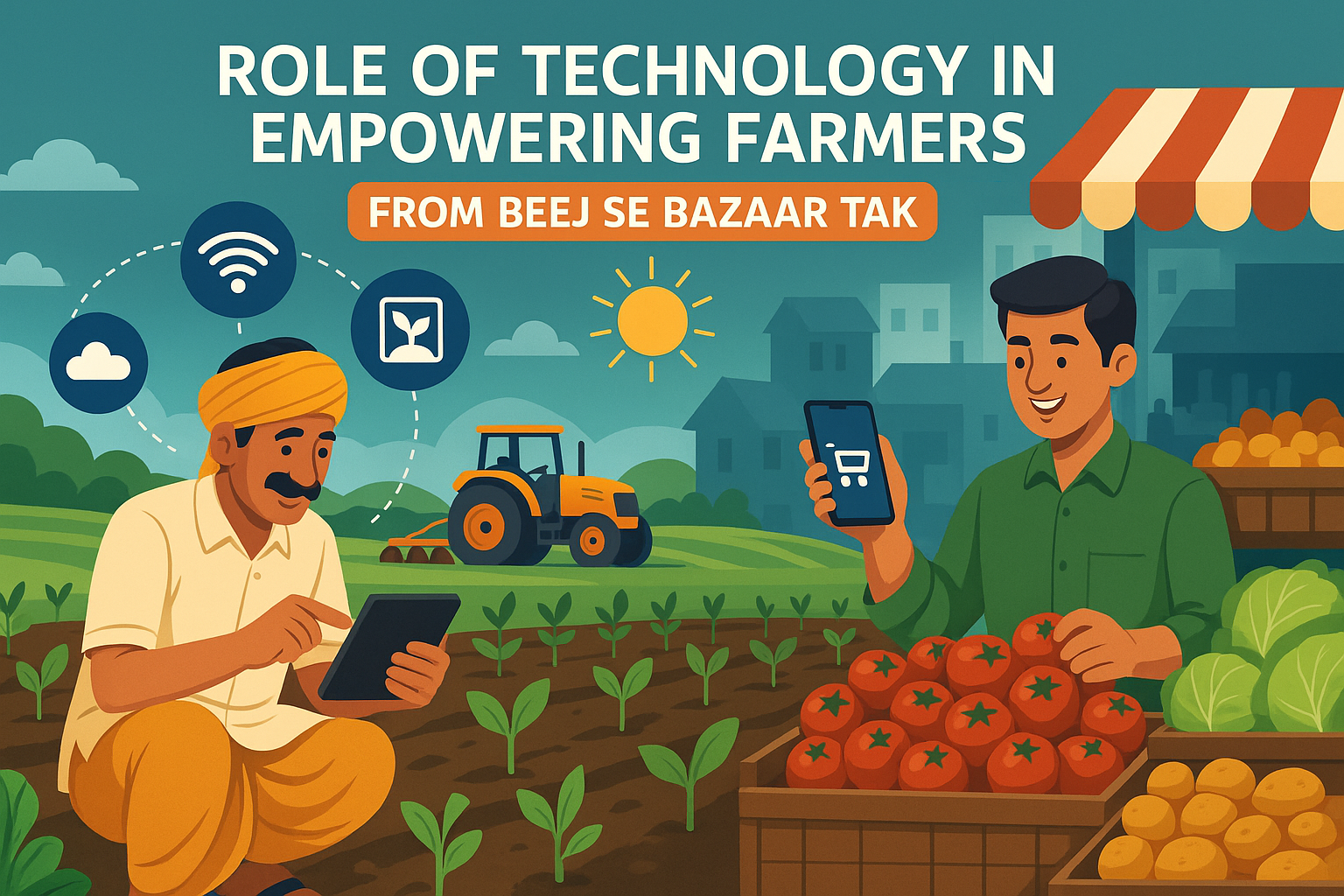
Role of Technology in Empowering Farmers: From Beej se Bazaar tak
AI, IoT, drones, space tech, and the JAM trinity are reshaping Indian agriculture—raising productivity, lowering risk, improving market access, and deepening financial inclusion for smallholders.
Introduction
Technology is the new plough in Indian agriculture. From AI crop advisories and IoT soil sensors to drones, satellite mapping, and DBT via JAM, digital tools are powering a seed-to-market (Beej se Bazaar) transformation—making farming productive, resilient, and inclusive.
Context & Background
Half of India’s workforce depends on agriculture. Yet, fragmented landholdings, climate shocks, soil degradation, and market inefficiencies suppress incomes. A whole-of-government and ecosystem approach—integrating AI/ML, IoT, space applications, drones, and fintech—is addressing these structural constraints while centering the farmer as Annadata.
Key Points
- •Precision Farming with AI/IoT: Variable rate irrigation and fertilisation using soil moisture sensors, NDVI maps, and AI models cuts input overuse and raises yield; smart greenhouses automate microclimate control.
- •Early Warning & Pest Management: AI vision models flag disease/pest symptoms from images; rule-engine + ML advisories recommend time-of-day spray, molecule rotation, and biological controls.
- •Climate Intelligence: Hyperlocal weather + crop phenology models guide sowing windows, heat/flood stress avoidance, and harvesting decisions; losses fall, stability rises.
- •Space Tech for Planning & Insurance: Satellite indices (vegetation, moisture) feed acreage, yield and damage estimation for planning and PMFBY claims; geoportals like Krishi-DSS unify layers for district/block advisories.
- •Drones at Scale: Swarm-planning for uniform droplet size spray reduces chemical drift; Namo Drone Didi enables SHG-led drone services with 80% subsidy; SVAMITVA drone surveys secure property titles for credit.
- •Market Access & Price Discovery: e-NAM onboarding, assaying, and interoperable warehousing (e-NWR) let farmers sell beyond mandis and time sales using scientific storage.
- •Fintech & JAM for Inclusion: Jan Dhan + Aadhaar + Mobile enable DBT (PM-Kisan), KCC digitisation, e-KYC, and alt-data credit scoring for input loans and post-harvest finance.
- •Post-Harvest & Traceability: IoT in cold chains, GS1/barcode tagging and blockchain trails certify origin and quality—earning premiums for residue-free/organic produce.
- •Institutional Rails: KVK/FPO networks act as last-mile integrators for device sharing, agronomy skilling, and service monetisation to smallholders.
- •Gender & Youth Lens: Women-led drone services and AgriTech entrepreneurship engage rural youth, boosting adoption and local jobs.
Related Entities
Impact & Significance
- •Higher Incomes: Input optimisation + better timing lift net margins for small/marginal farmers.
- •Risk Reduction: Weather/pest early-warnings and satellite-aided insurance quicken payouts.
- •Financial Deepening: JAM/Fintech expand low-cost credit and cut leakages.
- •Quality & Export Readiness: Traceability and assaying enable premium markets.
- •Sustainability: Water, fertiliser, and pesticide footprints shrink; soil health improves.
Challenges & Criticism
- •Digital Divide: Connectivity gaps, device affordability, and low digital literacy slow uptake.
- •Affordability & Scale: Capex for drones/sensors is high for smallholders without custom hiring centres.
- •Ops Reliability: Sensor drift, weather limits for drones, and device maintenance in harsh field conditions.
- •Data Governance: Farmer data ownership, consent, and platform lock-in concerns.
- •Institutional Fragmentation: Scheme silos across ministries impede convergence at the village level.
Future Outlook
- •Universal 4G/5G via BharatNet and edge AI for low-bandwidth advisories.
- •FPO-run equipment banks (drones, planters, harvesters) with pay-per-use pricing.
- •Geo-tagged MSP procurement and e-NWR adoption for pledge finance.
- •Carbon farming MRV stacks to monetise low-till, cover crops, reduced nitrogen.
- •Regional-language voice bots and multimodal advisory (voice + image + text).
UPSC Relevance
- • GS-3 (Agriculture): Technology missions, e-NAM, PMFBY, precision farming, climate-smart agriculture.
- • GS-2: DBT/JAM for welfare delivery; institutional convergence (KVK/FPOs).
- • Essay: Tech for inclusion; AI & farmers’ data rights; sustainability vs productivity.
Sample Questions
Prelims
Consider the following statements about technology in Indian agriculture: 1) NPSS provides AI/ML-based pest advisories using farmer-uploaded images. 2) SVAMITVA uses drones primarily to estimate crop yields for PMFBY claims. 3) Namo Drone Didi subsidises drones for SHGs to offer agri-services. Which of the statements given above are correct?
- (a)1 and 2 only
- (b)1 and 3 only
- (c)2 and 3 only
- (d)1, 2 and 3
Mains
Technology is no longer a luxury add-on but the new plough in farmers’ hands. Critically examine how AI, IoT, drones, space tech, and fintech can transform Indian agriculture, and discuss the constraints and safeguards required for equitable adoption.
Introduction:
Digital innovations—AI/IoT, drones, satellites, and JAM—are shifting Indian agriculture from input-heavy, risk-prone practices to data-driven, precise, and resilient farming.
Body:
• Transformational Channels: (a) Productivity: precision input use, hyperlocal advisories; (b) Risk: early warnings, index-aided insurance; (c) Markets: e-NAM, e-NWR, traceability; (d) Finance: DBT/KCC digitisation and alt-data credit; (e) Inclusion: women/SHG-led drone services; (f) Sustainability: water and chemical footprint reduction, MRV for carbon.
• Constraints: Connectivity and device gaps; affordability for smallholders; maintenance/reliability in field conditions; data privacy/ownership; scheme fragmentation and capacity deficits.
• Safeguards & Enablers: BharatNet + edge AI; FPO-run custom hiring centres; regional-language voice UIs; interoperable open standards; farmer-centric data governance (consent, portability); convergence of MoA&FW-MeitY-NABARD with KVK/FPO channels.
Conclusion:
With affordable access, robust data rights, last-mile capacities, and open ecosystems, technology can raise smallholder incomes, cut risk, and green India’s agriculture—truly empowering the farmer from Beej se Bazaar.