
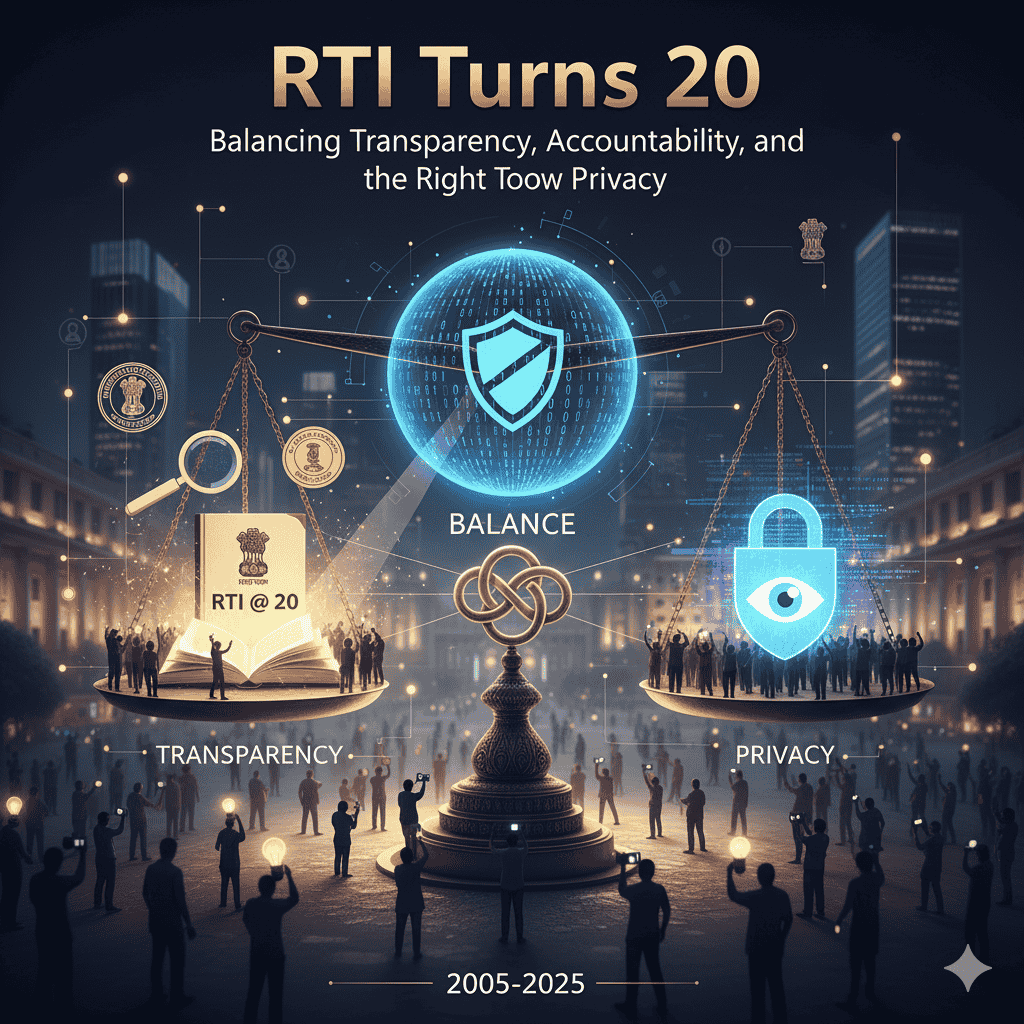
RTI Turns 20: Balancing Transparency, Accountability, and the Right to Privacy
As the Right to Information (RTI) Act completes 20 years, India faces a critical debate: how to protect citizens’ right to know while respecting the right to privacy. Court rulings, bureaucratic resistance, and the DPDP Act, 2023 have created new challenges for transparency.
Introduction
Context & Background
Key Points
- •Technology-Driven Warfare: Modern battles increasingly rely on AI, drones, sensors, satellite networks and cyber tools. Even simple drones fitted with cameras or explosives can cause huge damage at very low cost. For beginners: this means wars are shifting from heavy tanks and soldiers to technology and automation.
- •Multi-Domain Operations: Future conflicts will not stay limited to land, air or sea. Countries will fight simultaneously in cyber space (hacking), space (satellite disruption), information space (fake news) and traditional military domains. Victory depends on controlling ALL domains at once.
- •Speed & Information Dominance: Commanders now need data instantly. Whoever processes battlefield information faster gains an advantage. AI-enabled systems, sensors and real-time analytics help armies respond immediately rather than waiting hours or days like earlier.
- •Hybrid Warriors: Soldiers of the future must be skilled not only in physical combat but also in coding, data analysis, cyber defence, electronic warfare and operating drones. War is no longer only about strength but also about technological literacy.
- •Cheaper Lethality: Small countries or non-state groups can now buy or build cheap loitering munitions (suicide drones) and hit high-value targets. This makes even small adversaries dangerous.
- •Fluid and Modular Frontlines: Rigid divisions are being replaced by small, flexible, fast-moving units like Integrated Battle Groups (IBGs). These combine infantry, artillery, engineers, surveillance and armour into a single mobile force ready to fight instantly.
- •Information Warfare: Controlling narratives, social media, and psychological influence is now as important as winning physical battles. Countries use deepfakes, propaganda, and disinformation to shape public opinion during conflict.
- •Space as a Battlefield: Satellites used for communication and GPS are vulnerable. Disabling an enemy’s satellites can paralyse its military operations.
Key Judicial Rulings That Shaped RTI
| Case | Year | Key Ruling | Impact | Bookmark |
|---|---|---|---|---|
| Union of India vs ADR | 2002 | Candidates must disclose assets & criminal records | Boosted electoral transparency | |
| CBSE vs Aditya Bandopadhyay | 2011 | RTI should not obstruct administration | Used to justify restricting disclosures | |
| Girish Deshpande Case | 2012 | Service records are personal information | Basis for denying information on officials | |
| RBI vs Jayantilal Mistry | 2015 | RBI must reveal wilful defaulter info | Strengthened financial transparency | |
| SC vs Subhash Agarwal | 2019 | CJI’s office under RTI | Promoted judicial transparency |
RTI vs DPDP Act (2023): What Changed?
| Provision | Earlier Position under RTI | After DPDP Amendment | Bookmark |
|---|---|---|---|
| Disclosure of personal information | Allowed if larger public interest justified it | Completely exempt, irrespective of public interest | |
| Access to service records | Allowed in corruption/disciplinary cases | Likely denied as personal data | |
| MPs/MLAs attendance & fund use | Disclosed citing public interest | Could now be fully denied | |
| Beneficiary lists of schemes | Disclosed for social audits | Classified as personal data—may be withheld |
Related Entities
Impact & Significance
- •Stronger National Security: Modernisation helps India respond quickly to threats from China or Pakistan. Faster decision-making, better surveillance, and integrated commands reduce delays in wartime.
- •Better Maritime Control: With new drones, satellites and naval platforms, India can monitor the Indian Ocean Region (IOR) more effectively, helping prevent Chinese naval expansion.
- •Higher Combat Readiness: Joint doctrines, IBGs, and integrated commands allow the Army, Navy and Air Force to fight as one force. This improves the ability to respond during high-speed modern conflicts.
- •Boost to Indigenous Industry: Demand for AI-systems, drones, sensors, missiles and defence electronics supports Make in India and strengthens domestic manufacturing.
- •Better Use of Technology: Networks like IACCS (air defence network) and Akashteer (Army air defence control system) create a common picture of threats, reducing friendly-fire and improving accuracy.
- •Enhanced Disaster Response: Technological improvements in logistics and surveillance help armed forces respond better to floods, earthquakes, and humanitarian emergencies.
- •Professional Military Education: Training future commanders in AI, cyber operations, information warfare, and networked combat prepares India’s military leadership for the next 30 years.
Challenges & Criticism
- •Slow Jointness: India’s armed forces still work in separate ‘silos’. Theatre commands are not operational yet, which delays integration and prevents smooth coordination during emergencies.
- •Gap with China: China is far ahead in AI warfare, drone swarms, electronic warfare, and civil-military integration. India must catch up quickly to avoid technological disadvantage.
- •Unproven Doctrines: New structures like IBGs look good on paper but need large-scale field testing in real environments. Their effectiveness in high-intensity conflict remains uncertain.
- •Civil–Military Fusion Weakness: Countries like China integrate universities, private industry and the military. India lacks such deep collaboration, slowing innovation.
- •Cyber Vulnerability: India faces major challenges in cyber defence. Critical systems may be exposed to hacking, information theft, and disruption during war.
- •Logistics and Infrastructure Gaps: Rapid mobilisation requires modern roads, tunnels, storage and integrated supply chains. Many border areas still have weak infrastructure.
- •Data Interoperability Issues: Different services use different digital systems, making real-time data sharing difficult. A common joint communications framework is missing.
- •Procurement Delays: Long bureaucratic processes slow down acquisition of new technologies like drones, sensors, and UAVs, which adversaries adopt at much faster speeds.
Future Outlook
- •Accelerate the shift to Integrated Theatre Commands so that the Army, Navy, and Air Force can plan and fight together instead of separately.
- •Strengthen civil–military fusion by bringing DRDO, private industry, startups, and universities into joint R&D for drones, AI, EW (electronic warfare) and robotics.
- •Train officers to become tech-leaders with skills in cyber defence, AI tools, coding, algorithmic warfare, and applied data science.
- •Create unified digital communication standards so all services share real-time battlefield data seamlessly.
- •Invest heavily in drone swarms, hypersonic weapons, space-based surveillance, directed energy weapons (laser systems), and anti-drone technologies.
- •Adopt a culture of rapid prototyping—testing new systems quickly, fixing issues, and discarding outdated technologies without delays.
- •Build a strong domestic defence industrial base by encouraging joint ventures, Make in India, and private-sector innovation in missiles, sensors, and AI systems.
- •Strengthen border infrastructure: more all-weather roads, tunnels, advanced logistics hubs, and airfields for rapid deployment.
- •Set up national-level joint cyber commands and space command to prepare for futuristic warfare.
- •Integrate military training with wargaming simulations, AI-based scenario prediction, and realistic joint exercises across domains.
UPSC Relevance
- • GS-2: Transparency, accountability, statutory bodies, role of judiciary.
- • GS-3: Governance, cyber security, data protection.
- • Essay: Ethics, privacy vs transparency, democratic accountability.
- • Ethics: Accountability, integrity, whistleblower protection.
Sample Questions
Prelims
Which of the following best describes the impact of the DPDP Act, 2023 on the RTI Act?
- (a)It expanded access to personal data under RTI.
- (b)It removed the 'larger public interest' exception from Section 8(1)(j).
- (c)It made Information Commissions constitutionally independent bodies.
- (d)It mandated proactive disclosure of beneficiary lists under all schemes.
Mains
RTI at 20 has helped India deepen democracy but now faces challenges from privacy laws and executive control. Discuss the tension between transparency and privacy in the context of recent amendments and judicial rulings.
Introduction: RTI is one of India's most powerful democratic tools, but recent legal and administrative trends have reduced its effectiveness. Balancing the citizen’s right to know with privacy and data protection has become an urgent challenge.
Body:
• Achievements: Empowered citizens, exposed corruption, strengthened service delivery.
• Challenges: DPDP amendments, bureaucratic resistance, judicial dilution, delays.
• Privacy Concerns: Genuine need to protect personal data, but excessive secrecy risks corruption.
• Reforms Needed: Restore public interest clause, strengthen commissions, digitise governance, safeguard activists.
Conclusion: Transparency and privacy need not be conflicting values. A balanced framework can strengthen both democracy and data protection.