
Review of the 2018 Sabarimala Verdict
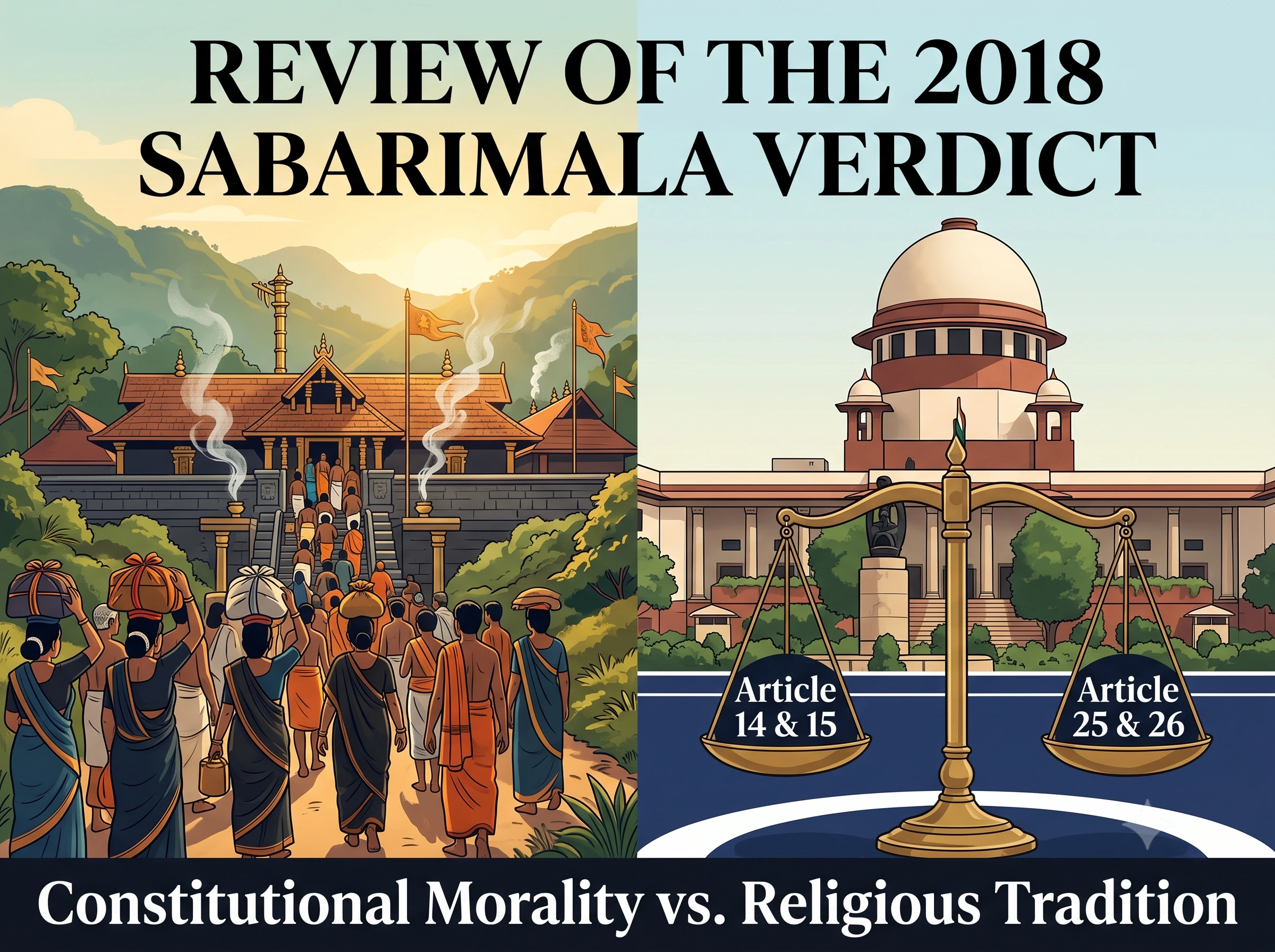
The Supreme Court of India is set to hear review petitions concerning its landmark 2018 judgment on women’s entry into the Sabarimala Temple. Scheduled for April 2026 before a nine-judge Constitution Bench, this issue highlights the complex intersection of religious freedom, gender equality, and constitutional morality.
Introduction
Context & Background
Key Points
- •The 2018 Majority Opinion (4:1): The Supreme Court ruled that prohibiting women between the ages of 10 and 50 infringed on their fundamental rights. Devotees of Lord Ayyappa do not constitute a separate religious denomination entitled to exclusive protections.
- •Violation of Equality and Dignity: The Court found the practice discriminatory under Article 15. Justice D.Y. Chandrachud noted that constitutional prohibition of untouchability extends to social exclusion based on ritual purity.
- •Rule Struck Down: Rule 3(b) of the Kerala Hindu Places of Public Worship (Authorisation of Entry) Rules, which enabled the restriction, was declared unconstitutional.
- •The Dissenting Opinion: Justice Indu Malhotra dissented, emphasizing judicial restraint in matters of faith. She argued courts shouldn't adjudicate religious practices unless they are manifestly oppressive (like Sati) and that rationality cannot be strictly applied to belief systems.
Timeline of the Sabarimala Legal Case
| Year | Event / Case | Outcome / Development | Bookmark |
|---|---|---|---|
| 1991 | S. Mahendran v. The Secretary | Kerala High Court upheld the exclusion of women, reasoning it constituted an established religious custom and did not infringe on Articles 14 or 25. | |
| 2006 | Indian Young Lawyers Association Petition | Challenged the restriction in the Supreme Court. The State of Kerala revised its stance to support women's access. | |
| 2018 | Supreme Court Landmark Verdict | A 4:1 majority held the practice barring women of menstruating age unconstitutional, citing violations of Articles 14 and 15. | |
| 2019-2026 | Review Petitions | Referred to a larger bench in 2019 (Kantaru Rajeevaru v. IYLA). A nine-judge bench will begin hearings in April 2026. |
Key Perspectives: Arguments For and Against Women's Entry
| Theme | Arguments Against Women's Entry | Arguments Supporting Women's Entry | Bookmark |
|---|---|---|---|
| Constitutional Guarantee | Protection under Article 26 (religious denomination autonomy). | Equality and non-discrimination under Articles 14 and 15; Freedom of religion for all. | |
| Tradition & Custom | Integral to the shrine's religious character and the celibate nature of the deity. | Religious practices must evolve with constitutional morality and gender justice. | |
| Statutory Context | Supported by Rule 3(b) of the Kerala Hindu Places of Public Worship Rules, 1965. | Supported by Section 4 of the 1965 Act prohibiting sectional discrimination. | |
| Social Implications | 41-day preparatory observance is physically difficult for menstruating women. | Exclusion is a form of untouchability (Article 17) and enforces menstrual stigma. |
Related Entities
Impact & Significance
- •Transformative Constitutionalism: The 2018 verdict was hailed as a major victory for gender justice, challenging patriarchal traditions and the stigma surrounding menstruation in religious spaces.
- •Public Response: The ruling triggered massive protests by sections of devotees who viewed it as judicial overreach into deeply held faith, causing severe implementation hurdles for the Kerala government.
- •Precedential Value: The ultimate resolution by the nine-judge bench will have ripple effects on other religious practices across India that face similar constitutional challenges regarding gender discrimination.
Challenges & Criticism
- •Implementation Difficulties: Enforcing the 2018 verdict on the ground proved highly volatile, requiring heavy security and resulting in widespread civil unrest in Kerala.
- •Judicial Overreach Accusations: Critics argue that applying secular constitutional principles of rationality to matters of faith undermines religious pluralism and autonomy.
- •Socio-Political Polarization: The issue rapidly escalated from a legal dispute to a highly polarized political controversy, complicating the separation of law, politics, and religion.
Future Outlook
- •Defining Essential Religious Practices: The 2026 hearings will likely shape future jurisprudence on the 'Essential Religious Practices' test and clarify doctrinal inconsistencies.
- •Balancing Equality and Autonomy: The nine-judge bench has the opportunity to articulate a principled framework for balancing the right to equality (Article 14) with religious autonomy (Article 26).
- •Judicial Intervention Limits: The verdict will define the broader doctrinal implications for how much courts can or should intervene in religious customs and democratic processes.
UPSC Relevance
- • GS-2 (Polity & Governance): Structure, organization, and functioning of the Judiciary; Significant Supreme Court Judgments.
- • GS-2 (Fundamental Rights): Conflict between Right to Equality (Art. 14, 15) and Right to Freedom of Religion (Art. 25, 26).
- • Essay Topics: Constitutional Morality vs. Religious Traditions; Gender Justice in India.
Sample Questions
Prelims
With reference to the Sabarimala Temple entry case, consider the following statements. Which of the statements given above are correct?
1. Article 26 of the Constitution guarantees religious denominations the right to manage their own affairs in matters of religion.
2. In the 2018 Sabarimala verdict, the Supreme Court struck down Rule 3(b) of the Kerala Hindu Places of Public Worship (Authorisation of Entry) Rules, 1965.
3. The dissenting judgment in the 2018 verdict was delivered by Justice D.Y. Chandrachud.
4. The 1991 Kerala High Court judgment declared the exclusion of women from Sabarimala as unconstitutional.
Answer: Option 1, Option 2
Explanation: Statements 1 and 2 are correct. Statement 3 is incorrect because the dissent was delivered by Justice Indu Malhotra, while Justice D.Y. Chandrachud was part of the majority. Statement 4 is incorrect because the 1991 Kerala High Court judgment upheld the restriction on women's entry.
Mains
The Sabarimala verdict brings to the forefront the tension between constitutional morality and freedom of religion. Analyze the Supreme Court's 2018 judgment in this context and discuss the significance of the upcoming review proceedings.
Introduction: Introduce the Sabarimala case as a landmark dispute over women's entry into the shrine. Briefly mention the 2018 Supreme Court verdict (4:1) and the referral to a nine-judge Constitution Bench for review in 2026.
Body:
• The Conflict of Rights: Discuss the tension between Article 14/15 (equality and non-discrimination) and Article 25/26 (freedom to manage religious affairs). Explain how the temple claimed denominational status.
• 2018 Majority vs. Dissent: Outline the majority's view that the practice was unconstitutional and violated dignity, contrasted with Justice Indu Malhotra's dissent advocating for judicial restraint in matters of faith unless inherently pernicious.
• Significance of the Review: The 2026 nine-judge bench will establish clearer doctrinal boundaries regarding the 'essential religious practices' test and how state institutions approach transformative constitutionalism.
Conclusion: Conclude by noting that the final outcome will create a lasting precedent on how a pluralistic democracy reconciles the dynamic nature of constitutional gender justice with the preservation of diverse religious traditions.