
Satellite Phones: A New Security Challenge in Indian Waters
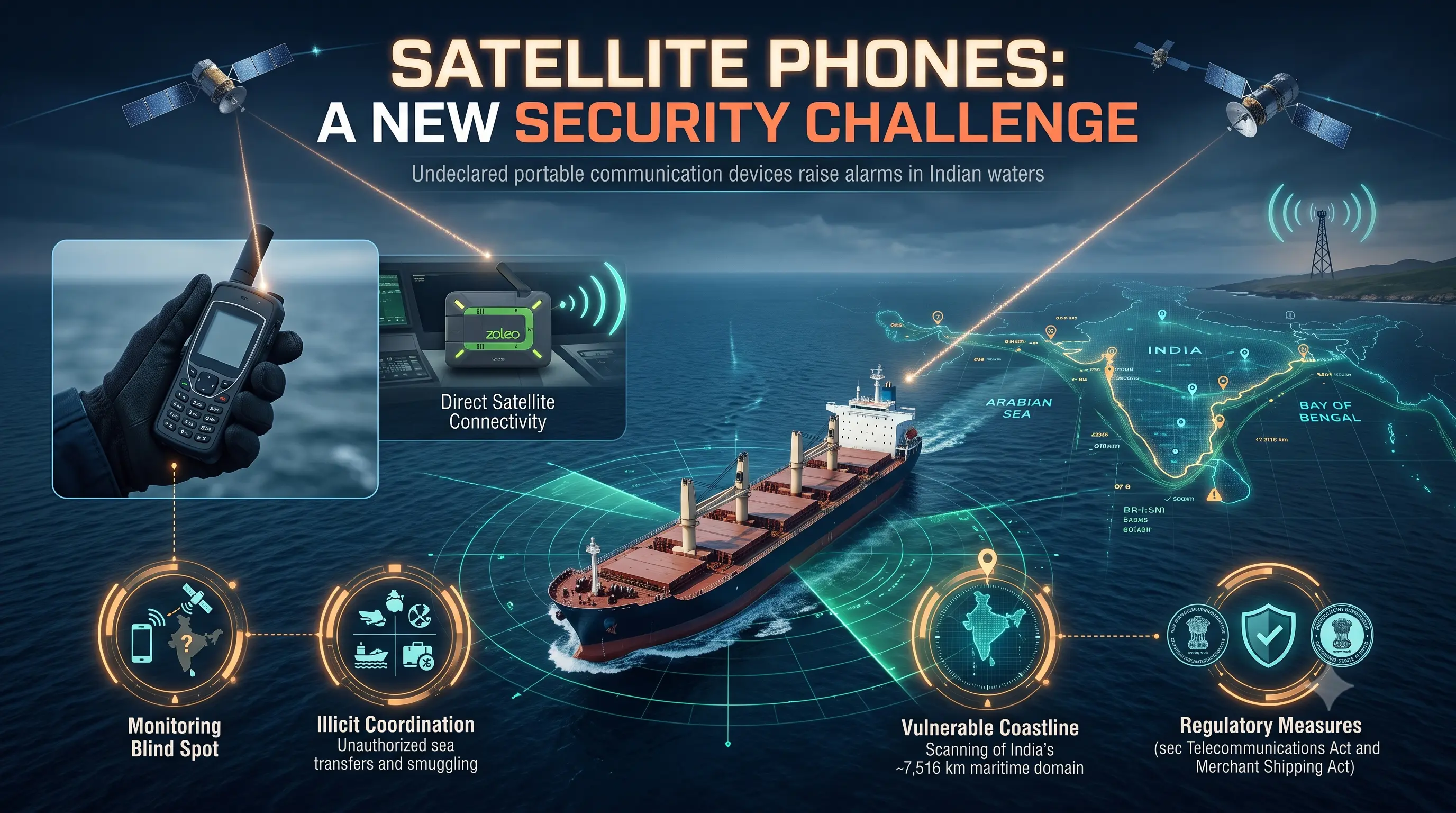
Security agencies and the Directorate General of Shipping (DGS) have raised alarms over the undeclared use of portable satellite communication devices on ships in Indian waters. This article explores the dual-use nature of these devices, the significant security risks they pose to India's coastal defense, and the regulatory measures being deployed to monitor them.
Introduction
Context & Background
Key Points
- •The Core Issue: Security agencies and the Directorate General of Shipping (DGS) have raised alarms over undeclared portable satellite communication devices (like satellite phones and Zoleo messaging units) being carried and used on ships in Indian waters.
- •How They Work: Satellite phones communicate directly with orbiting satellites (e.g., Low Earth Orbit constellations like Iridium) rather than terrestrial towers. The signals are routed through ground gateways, which, if located outside India, make domestic monitoring highly complex.
- •The Security Threat: The lack of local gateways creates monitoring blind spots. Undeclared devices can be used for illicit coordination, such as smuggling or illegal fishing, and parallel communication channels can confuse Search and Rescue (SAR) operations.
- •India's Vulnerability: With a massive coastline of over 7,516 km, 13 major ports, and heavy traffic sea-lanes in the Arabian Sea and Bay of Bengal, maritime surveillance is extremely challenging.
- •Legal Enforcement: The Telecommunications Act, 2023 empowers regulators to control equipment and impose penalties for unauthorized use, while the newly passed Merchant Shipping Act, 2025 provides robust maritime enforcement powers, including port state control and vessel detention.
Benefits of Satellite Communication Devices
| Use Case | Description | Advantage | Bookmark |
|---|---|---|---|
| Remote Connectivity | Functions beyond mobile network coverage. | Enables communication in isolated areas like oceans and deserts. | |
| Emergency SOS | Reliable alerts during maritime accidents. | Crucial for safety when terrestrial networks fail. | |
| Disaster Resilience | Operational during cyclones or earthquakes. | Ensures continuity of vital communications. | |
| Aviation & Maritime Safety | Provides navigation support and weather updates. | Coordinates safety through systems like GMDSS. |
Security Risks of Undeclared Satellite Devices
| Risk Factor | Issue Description | Impact | Bookmark |
|---|---|---|---|
| Monitoring Blind Spots | Lack of domestic gateways prevents local interception. | Hinders investigations of smuggling and illicit communications. | |
| Illicit Coordination | Undeclared links used for illegal transfers at sea. | Facilitates crew collusion and unauthorized operations. | |
| SAR Confusion | Parallel channels generate unauthenticated distress signals. | Complicates and delays Search & Rescue (SAR) operations. | |
| National Security | Bypassing of domestic monitoring networks. | Potential for exploitation by anti-national elements. |
Related Entities
Impact & Significance
- •National Security Vulnerability: The inability to intercept messages locally hampers intelligence gathering and anti-smuggling operations along vulnerable coastal borders.
- •Maritime Crime Proliferation: Unmonitored communications facilitate illicit activities such as human trafficking, illegal fishing, and unauthorized cargo transfers at sea.
- •Operational Safety Hazards: Uncoordinated distress signals from personal satellite devices can mislead official Search and Rescue (SAR) operations, wasting critical resources.
- •Regulatory Burden: Enforcing compliance on thousands of international vessels entering Indian ports strains the administrative resources of maritime and security authorities.
Challenges & Criticism
- •Technological Limitations: India currently lacks sufficient domestic gateways for prominent global satellite networks, making real-time local interception technically unfeasible.
- •Jurisdictional Complexities: Regulating foreign-flagged vessels and their crews carrying personal communication devices in international versus territorial waters involves navigating complex maritime laws.
- •Compliance Friction: Overly stringent bans could inadvertently penalize unwitting international seafarers who rely on these devices for personal safety and family contact.
- •Infrastructure Delays: While there are plans to develop dedicated national space capacities for monitoring, these infrastructure projects require significant time and capital to become fully operational.
Future Outlook
- •Tighten Declarations: Implementing mandatory e-declarations for all satellite devices before port entry, coupled with automated cross-checks against vessel manifests.
- •Domestic Gateways & Monitoring: Accelerating the development of domestic maritime satellite infrastructure (ground stations and regional gateways) to enable lawful traceability, leveraging initiatives by IN-SPACe.
- •Graduated Enforcement: Adopting a balanced approach that issues warnings for first offences while reserving fines and detention for repeat violations, ensuring unwitting seafarers are not unfairly penalized.
- •Shore-side Crew Welfare: Establishing regulated communication facilities, such as satellite kiosks at ports, allowing crews to maintain personal contacts safely without relying on illicit devices.
UPSC Relevance
- • GS-3 (Internal Security): Challenges to internal security through communication networks, role of media and social networking sites, and border/coastal security management.
- • GS-3 (Science & Technology): Awareness in the fields of Space, IT, and computers (working of LEO satellites and satellite phones).
- • GS-2 (Governance): Government policies and interventions (Telecommunications Act 2023, Merchant Shipping Act 2025).
Sample Questions
Prelims
Consider the following statements regarding the regulation of satellite communication devices in India: 1. Satellite phones primarily communicate via terrestrial mobile towers to provide connectivity in remote areas. 2. The Telecommunications Act, 2023 empowers the government to impose penalties for the unauthorized use of telecommunication equipment. 3. Ships operating in Indian waters are strictly prohibited from using the Global Maritime Distress and Safety System (GMDSS) due to security concerns. Which of the statements given above is/are correct?
1. 1 and 2 only
2. 2 only
3. 2 and 3 only
4. 1, 2 and 3
Answer: Option 2
Explanation: Statement 1 is incorrect; satellite phones communicate directly with orbiting satellites, not terrestrial towers. Statement 2 is correct. Statement 3 is incorrect; GMDSS terminals are internationally mandated and encouraged for maritime safety, whereas uncertified personal satellite units face restrictions.
Mains
"The proliferation of portable satellite communication devices presents a double-edged sword for maritime operations." Analyze the security challenges posed by undeclared satellite phones in Indian waters and discuss the regulatory measures needed to address them.
Introduction: Define portable satellite communication devices (e.g., satellite phones, Zoleo) and state the recent context of the Directorate General of Shipping (DGS) raising alarms over their undeclared use in Indian territorial waters.
Body:
• The Security Challenges: Explain monitoring blind spots due to the absence of domestic gateways, the potential for illicit coordination (smuggling, illegal fishing), and the generation of false distress signals complicating Search & Rescue (SAR) operations.
• India's Vulnerability: Highlight the geographical challenges of monitoring a 7,516 km coastline and heavily trafficked sea lanes in the Arabian Sea and Bay of Bengal.
• Regulatory Measures: Discuss the DGS draft guidelines for mandatory declarations, enforcement powers under the Telecommunications Act, 2023 and the Merchant Shipping Act, 2025, and the need for domestic monitoring infrastructure.
Conclusion: Conclude that while satellite communications are vital for seafarer welfare and maritime safety, establishing a robust regulatory framework and domestic technological capabilities is essential to mitigate security risks without isolating the maritime community.