
SC Flags States' Preference for 'Ad-hoc' DGP Appointments
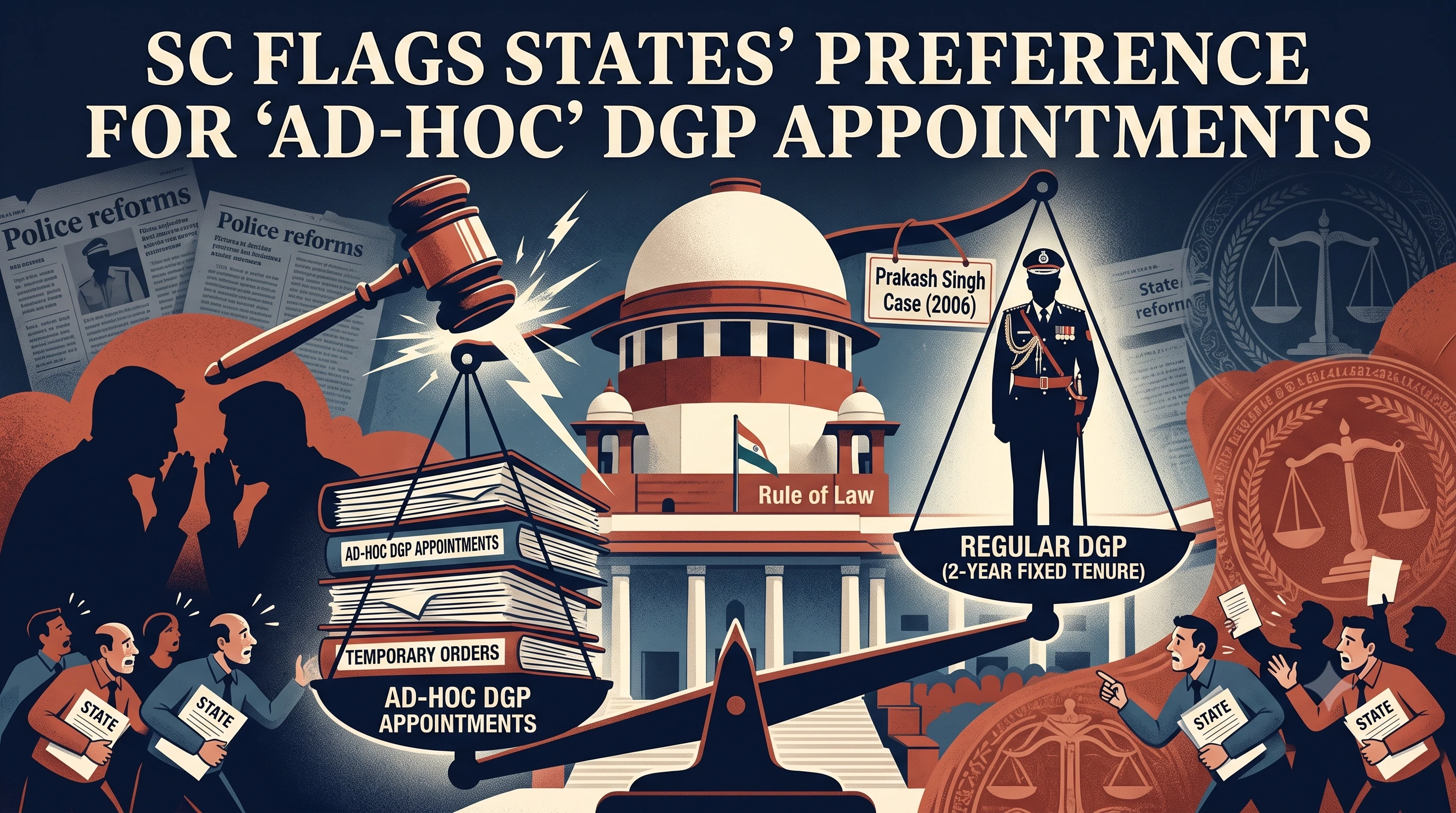
The Supreme Court has expressed deep concern over the continued practice by State governments of appointing 'Acting' Directors-General of Police (DGPs) instead of regular DGPs. This practice violates the 2006 Prakash Singh judgment directives, which aim to insulate police leadership from political interference through fixed tenures and UPSC-led merit-based selection.
Introduction
Context & Background
Key Points
- •Prakash Singh Case (2006) Directives: The Supreme Court laid down comprehensive police reforms, mandating the depoliticisation of police leadership, merit-based selection through UPSC, a minimum two-year fixed tenure, and explicitly rejecting the 'Acting DGP' concept.
- •Article 142 Invocation: These sweeping reform directions were originally issued using the Supreme Court’s extraordinary powers under Article 142 of the Constitution to ensure complete justice.
- •Appointment Mechanism (2018–2019): SC orders clarified that States must send proposals to the UPSC at least three months prior to the retirement of the incumbent DGP. The UPSC then prepares a panel based on seniority, merit, and service record, from which the State must immediately appoint one officer.
- •Judicial Concern over Violations: The UPSC informed the Supreme Court that many States willfully ignore this process. States delay sending proposals and install 'Acting DGPs' of their own choice to bypass independent scrutiny.
- •The Telangana Example: The Court highlighted Telangana, noting that the state has not had a regular DGP since November 2017. The State has continued with successive 'Acting' DGPs without sending proper proposals to the UPSC.
- •Accountability and Warnings: The Court directed the UPSC to formally demand timely proposals from States and warned that strict accountability measures would follow against officials responsible for intentional delays.
Prakash Singh Directives (2006) vs. Current State Practices
| Directive | Purpose | Current Violation/Practice | Bookmark |
|---|---|---|---|
| Depoliticisation of Police Leadership | Insulate the DGP office from political/external pressures. | States appoint 'Acting DGPs' to maintain political leverage. | |
| Merit-based Selection via UPSC | Appoint DGP from 3 senior-most empanelled officers. | States delay sending proposals or send them selectively. | |
| Fixed Tenure | Minimum 2-year tenure for stability and functional autonomy. | Successive short-term 'Acting' appointments bypass this rule. | |
| Rejection of 'Acting DGP' Concept | Eliminate ad-hoc leadership arrangements at the top level. | States consistently use the ad-hoc route (e.g., Telangana since 2017). |
Related Entities
Impact & Significance
- •Erosion of Institutional Integrity: By constantly navigating around SC orders, state executives weaken the constitutional rule of law and judicial supremacy.
- •Demoralization of the Force: When merit-based empanelment is ignored, senior, meritorious officers are unfairly denied top leadership roles, severely impacting professional morale.
- •Compromised Law Enforcement: Ad-hoc DGPs lack the security of a fixed tenure. This makes them highly vulnerable to political demands, compromising impartial law enforcement and internal security.
- •Subversion of Reforms: The continued circumvention halts the broader depoliticization of the police force that the 2006 reforms intended to trigger at all levels.
Challenges & Criticism
- •State Reluctance & Political Will: State governments view control over the police chief as essential for political survival and are unwilling to cede this power to a UPSC-driven independent process.
- •Procedural Loopholes: States exploit administrative mechanisms by simply sitting on files and delaying the submission of eligible officer lists to the UPSC.
- •Federalism Arguments: Some states argue that because 'Police' and 'Public Order' are State Subjects under the 7th Schedule, mandatory UPSC involvement infringes upon their constitutional autonomy.
Future Outlook
- •Proactive UPSC Role: The UPSC has been directed to formally write to States seeking timely proposals for regular DGP appointments and has been granted the liberty to approach the SC if States ignore these communications.
- •Strict Accountability: The Supreme Court warned that accountability measures will be initiated against specific officials responsible for delays, moving towards penalizing non-compliance.
- •Immediate Rectification in Flagged States: Taking the lapse in Telangana seriously, the Court granted the UPSC four weeks to convene meetings and make recommendations to install a regular DGP in the state, setting a precedent for other non-compliant regions.
UPSC Relevance
- • GS-2 (Executive & Judiciary): Role of the Supreme Court in enforcing governance reforms (Article 142), and the functioning of the Executive at the State level.
- • GS-2 (Centre-State Relations): Friction between State autonomy over 'Police' (State List) and Central/Judicial mandates via UPSC empanelment.
- • GS-3 (Internal Security): Importance of an independent, depoliticized, and professional police leadership for democratic governance and maintaining internal security.
Sample Questions
Prelims
With reference to the appointment of the Director-General of Police (DGP) in Indian States, consider the following statements and identify the correct one:
1. The Supreme Court mandated that 'Acting DGPs' can be appointed for a maximum of one year in extraordinary circumstances.
2. State governments must send proposals to the UPSC at least three months prior to the retirement of the incumbent DGP.
3. Police falls under the Concurrent List, giving both the Centre and State equal power in DGP appointments.
4. The Prakash Singh judgment was delivered primarily to reform the Central Armed Police Forces (CAPFs).
Answer: Option 2
Explanation: Option 2 is correct as per the Supreme Court's 2018-2019 clarifications. Option 1 is incorrect; the SC explicitly rejected the 'Acting DGP' concept entirely. Option 3 is incorrect; Police is a State Subject. Option 4 is incorrect; the Prakash Singh judgment focused on reforming State police forces.
Mains
The persistent reliance on 'Acting DGPs' by state governments undermines the core objectives of the Prakash Singh judgment. Examine the implications of this practice on police administration and suggest measures to ensure state compliance with judicial directives.
Introduction: Introduce the context of the recent Supreme Court observations regarding states like Telangana running on 'Acting DGPs' for years. Mention the foundational Prakash Singh case (2006) and its primary objective to depoliticize police leadership.
Body:
• The Core Issue: Despite the Prakash Singh (2006) directives mandating UPSC empanelment and fixed tenures, states intentionally delay sending proposals to appoint compliant officers as ad-hoc DGPs.
• Implications on Administration: It leads to the erosion of institutional integrity, denies meritorious officers their rightful opportunities, subverts police reforms, and ensures continued political subservience of law enforcement.
• Measures for Compliance: Empowering the UPSC to actively monitor and report delays; imposing strict contempt-of-court penalties on Chief Secretaries for non-compliance; and establishing a statutory backing for the model police act.
Conclusion: Conclude by emphasizing that an independent, professional police leadership is a non-negotiable pillar of democratic governance and internal security, which cannot be compromised by political maneuvering.