
Self-Sufficiency in Pulses Production: India’s Roadmap to Atmanirbharta
NITI Aayog's new report outlines a roadmap for India to achieve self-sufficiency in pulses through productivity enhancement, diversification, climate resilience, and improved procurement systems.
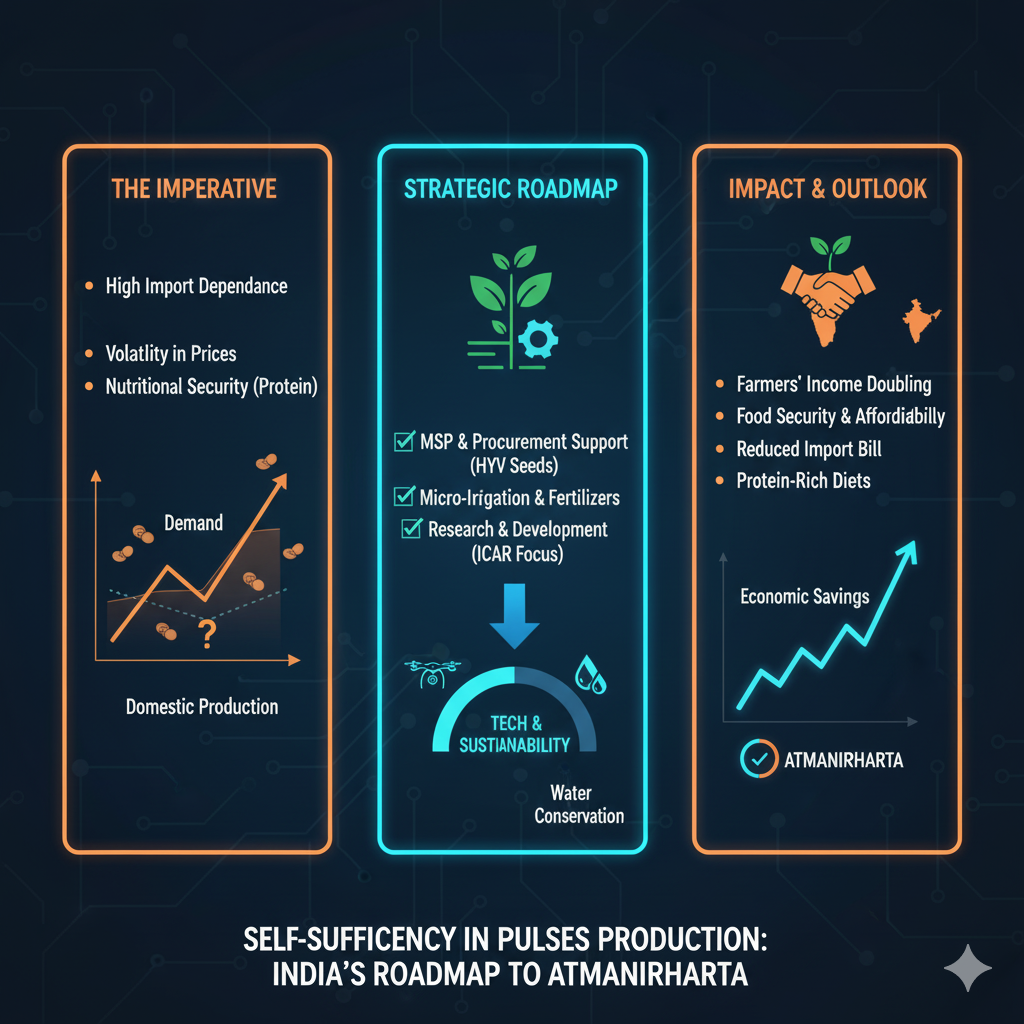
Introduction
India is the world’s largest producer, consumer, and importer of pulses, making these crops vital for nutrition, farmers' incomes, soil health, and food sovereignty. To achieve Atmanirbharta, NITI Aayog has released a strategic blueprint focused on boosting production, reducing import dependence, and closing yield gaps.
Context & Background
Pulses are a critical source of protein in Indian diets and essential for sustainable agriculture due to nitrogen-fixing properties. Despite policy interventions, India still imports 4–5 million tonnes annually, exposing farmers and consumers to global price volatility. The new strategy aims at strengthening domestic production, seed systems, procurement mechanisms, and climate resilience to ensure food and nutrition security.
Key Points
- •Production Snapshot: India contributes 38% of global area and 28% of global production of pulses, but productivity (0.74 t/ha) is below the global average (0.99 t/ha).
- •Regional Trends: MP, Maharashtra, and Rajasthan contribute ~55% of output; Gujarat has highest productivity (1.33 t/ha), Karnataka lowest (0.62 t/ha).
- •Rabi vs Kharif: Rabi pulses account for 67% of production but Kharif areas lag due to rainfed vulnerability and pest issues.
- •Need for Atmanirbharta: Protein security, reduced import bills, price stability, climate resilience, and soil fertility.
- •Key Bottlenecks: Rainfed dependence, low mechanisation, seed quality gaps, pest/disease vulnerability, limited MSP procurement, and post-harvest losses.
- •Government Push: NFSM-Pulses, TRFA programme, Mission for Atmanirbharta in Pulses (Budget 2025-26), 150+ ICAR-KVK seed hubs.
- •Strategic Pillars: Area expansion (rice fallows), seed reform, climate-smart farming, FPO-driven value chains, MSP + procurement enhancement, mechanisation support, and R&D innovation.
- •Tech & Innovation: Focus on CRISPR breeding, biofortification, stress-tolerant seeds, AI-based advisories, and digital input traceability.
- •4-Quadrant Strategy: District segmentation into High/Low area & High/Low yield zones for targeted interventions.
- •Nutrition Integration: Mandatory pulses in PDS, Mid-Day Meal, ICDS, Poshan Abhiyaan to boost protein intake and farmer demand.
Related Entities
Impact & Significance
- •Nutritional Security: Improves protein intake for low-income households.
- •Farmer Income Stability: MSP + procurement + FPO linkages boost rural income.
- •Climate Resilience: Expansion of drought-tolerant and short-duration varieties.
- •Soil Health Benefits: Nitrogen fixation reduces chemical fertilizer dependence.
- •Reduced Import Dependency: Helps manage CAD and ensures price stability.
Challenges & Criticism
- •Yield gaps persist due to limited adoption of improved varieties.
- •Market volatility continues due to weak procurement & storage systems.
- •Rainfed vulnerability makes crops climate-sensitive.
- •Limited mechanisation in small landholdings increases labour costs.
- •Import reliance continues for pulses like tur & urad.
Future Outlook
- •Target to add 2.85 MT from rice fallow expansion.
- •Rapid scaling of summer pulses and micro-irrigation systems.
- •Biofortified and climate-resilient pulse varieties mainstreamed.
- •Digital procurement, soil health monitoring, and AI-based crop advisories.
- •Pulse processing clusters & D2C farmer value chains via FPOs.
UPSC Relevance
- • GS-3: Food security, agricultural productivity, cropping patterns, MSP procurement system, climate-smart agriculture
- • Essay: Food sovereignty, nutrition security, sustainable agriculture
- • Agriculture Optional: Pulses agronomy, pulses economics, cropping diversification
Sample Questions
Prelims
With reference to pulses production in India, consider the following statements: 1) India is both the largest producer and importer of pulses. 2) Rabi pulses contribute a greater share in total pulses production than Kharif pulses. 3) Gujarat has the highest productivity of pulses in India. Which of the statements given above are correct?
- (a)1 and 2 only
- (b)1, 2 and 3
- (c)2 and 3 only
- (d)1 and 3 only
Mains
Discuss the significance of self-sufficiency in pulses for India's food and nutritional security. Examine measures required to improve productivity and market efficiency in the pulses sector.
Introduction:
Pulses are essential for India’s nutrition security, soil health, rural livelihoods, and import reduction. Despite being the largest producer, India remains dependent on imports due to yield gaps and production volatility. Achieving Atmanirbharta requires systemic reforms.
Body:
• Importance: Protein security, climate resilience, nitrogen fixation, reduced import bill, farmer income support.
• Challenges: Rainfed cultivation, pest/disease risks, limited mechanisation, poor procurement, price volatility, post-harvest losses.
• Measures Needed: Seed improvement, area expansion in rice fallows, FPO-value chains, MSP strengthening, digital advisory services, climate-smart irrigation, biofortified varieties, enhanced R&D.
• Institutional Support: NFSM-Pulses, TRFA, ICAR-KVK digitisation, PM-AASHA procurement reforms, storage expansion.
Conclusion:
India’s path to pulses self-sufficiency lies in productivity-led growth, climate-smart innovation, market reforms, and strong farmer institutions. The strategy aligns with SDGs and Atmanirbhar Bharat, ensuring nutrition and rural prosperity.