
Shikshapatri Dwishatabdi: 200 Years of Bhagwan Swaminarayan's Legacy
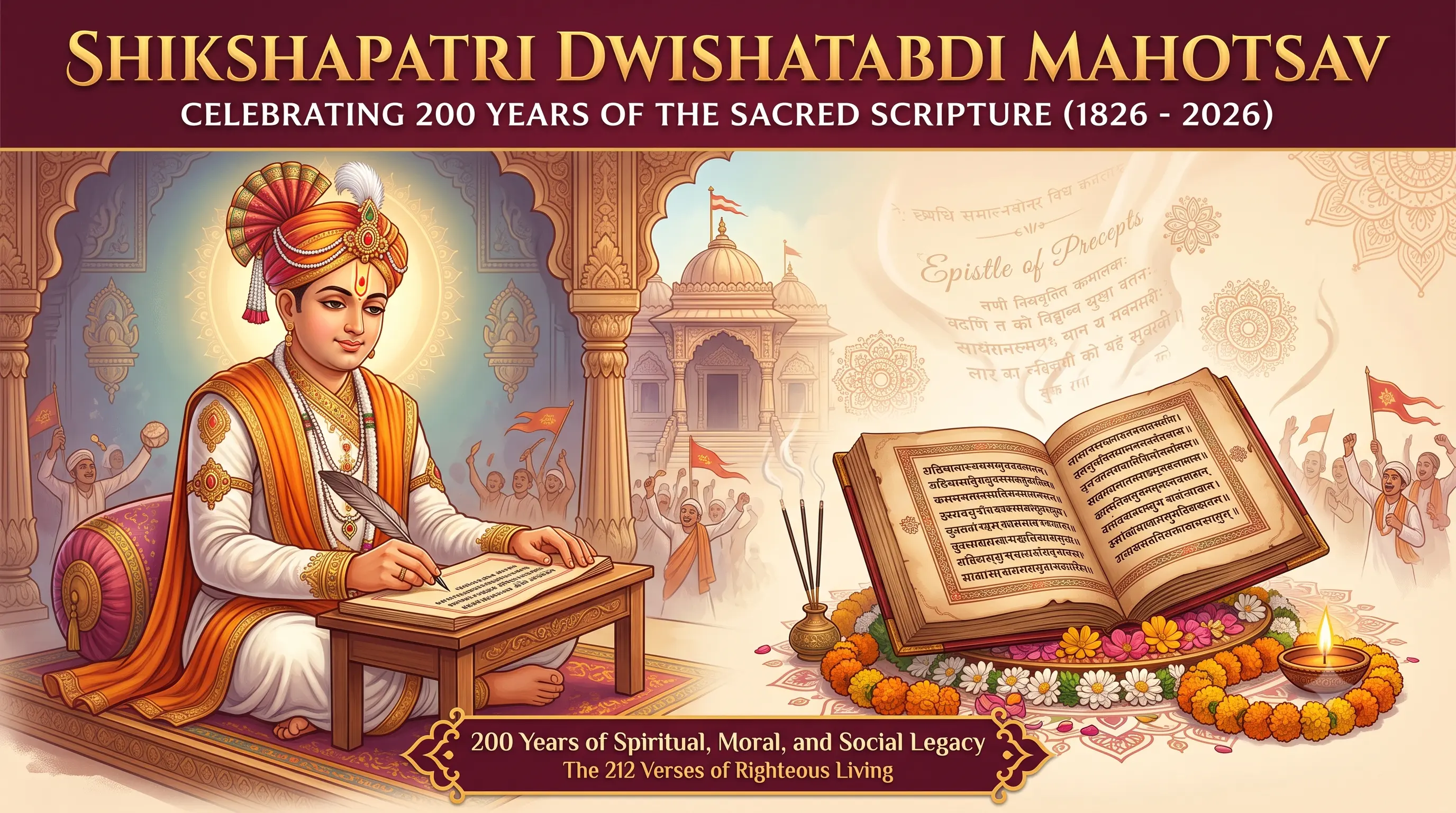
The Prime Minister recently addressed the Shikshapatri Dwishatabdi Mahotsav via video message, marking the 200th anniversary of Bhagwan Swaminarayan's Shikshapatri. This milestone highlights the profound spiritual, moral, and social impact of the historical text and the Navya-Vishishtadvaita philosophy.
Introduction
Context & Background
Key Points
- •Early Life and Renunciation: Born as Ghanshyam Pande on April 3, 1781, in Chhapaiya, UP (coinciding with Rama Navami). He left home at the age of 11 to embark on a 7-year spiritual journey across India, practicing intense austerities as Nilkanth Varni.
- •Initiation and Leadership: After settling in Loj, Gujarat, he met his guru, Ramanand Swami, and was initiated as Sahajanand Swami. At just 21, he was appointed head of the fellowship (Uddhav Sampraday).
- •The Mahamantra: Shortly after his guru's passing, he introduced the 'Swaminarayan' Mahamantra, leading to his widespread recognition as Bhagwan Swaminarayan.
- •Philosophical Contribution: He propounded the Navya-Vishishtadvaita philosophy (Neo-qualified Non-dualism), which distinctly identifies five eternal realities, setting a unique theological framework in Indian philosophy.
Key Facts About the Shikshapatri
| Attribute | Details | Bookmark |
|---|---|---|
| Author | Bhagwan Swaminarayan (Sahajanand Swami) | |
| Composition Date | Maha sud 5, Samvat 1882 (February 11, 1826) | |
| Original Language | Sanskrit (Later translated into Gujarati by Nityanand Swami) | |
| Structure | An "Epistle of Precepts" consisting of 212 verses (shlokas) |
Five Eternal Realities of Navya-Vishishtadvaita
| Reality | Description | Bookmark |
|---|---|---|
| Jiva | The individual soul. | |
| Ishwar | Cosmic deities/entities. | |
| Maya | The power of God that creates the material world and causes ignorance. | |
| Brahman (Aksharbrahman) | The divine abode and the ideal devotee of God. | |
| Parabrahman (Purushottam) | The supreme, independent, and all-powerful God. |
Related Entities
Impact & Significance
- •Universal Code of Conduct: It created a unified standard of living emphasizing purity, non-violence, and devotion, cutting across diverse social classes.
- •Social Upliftment: The text and the movement helped pacify turbulent regions in 19th-century Gujarat, steering people away from superstitions, addictions, and violence.
- •Literary Heritage: The translation of the text from Sanskrit into regional languages (like Gujarati) made high philosophical and moral guidelines accessible to the common populace.
Challenges & Criticism
- •Modern Adaptation: Maintaining the strict spiritual and dietary disciplines outlined in the Shikshapatri poses a challenge for followers navigating fast-paced, globalized modern lifestyles.
- •Historical Preservation: Ensuring that the original Sanskrit nuances are not lost or misinterpreted in contemporary translations and adaptations.
- •Academic Understanding: While widely revered by followers, integrating the specific theological nuances of Navya-Vishishtadvaita into mainstream academic discussions of classical Vedanta requires ongoing scholarly effort.
Future Outlook
- •Continued Moral Guidance: The teachings of the Shikshapatri remain a timeless blueprint for personal discipline and social harmony in the modern era.
- •Preservation of Manuscripts: Heightened efforts to digitize and preserve ancient spiritual texts like the Shikshapatri for future generations and global researchers.
- •Global Cultural Diplomacy: The widespread followers of the Swaminarayan tradition continue to promote Indian culture, philosophy, and architectural heritage (such as Akshardham temples) globally.
UPSC Relevance
- • GS-1 (Indian Heritage and Culture): Salient aspects of Art Forms, Literature, and Architecture from ancient to modern times.
- • GS-1 (History): Prominent personalities and socio-religious reform movements in India.
- • Mains Focus: The evolution of Indian philosophical schools (Navya-Vishishtadvaita) and the role of spiritual texts in shaping social codes of conduct.
Sample Questions
Prelims
Consider the following statements regarding Bhagwan Swaminarayan and his teachings:
1. The Shikshapatri was originally composed in Gujarati by Ramanand Swami.
2. The Navya-Vishishtadvaita philosophy identifies five eternal and distinct realities, including Aksharbrahman.
3. Bhagwan Swaminarayan was born in Loj, Gujarat.
Answer: Option 2
Explanation: Statement 1 is incorrect; the Shikshapatri was originally composed in Sanskrit by Bhagwan Swaminarayan. Statement 3 is incorrect; he was born in Chhapaiya, Uttar Pradesh. Statement 2 is correct, as Navya-Vishishtadvaita identifies Jiva, Ishwar, Maya, Brahman, and Parabrahman as five distinct realities.
Mains
Discuss the significance of the Shikshapatri and the Navya-Vishishtadvaita philosophy in shaping the socio-religious landscape of Western India during the 19th century.
Introduction: Introduce Bhagwan Swaminarayan (Sahajanand Swami) and mention the recent 200th anniversary of the Shikshapatri as a testament to its enduring legacy.
Body:
• The Shikshapatri: Explain its role as a concise 'Epistle of Precepts' (212 verses) that established a universal moral, social, and spiritual code of conduct across different strata of society.
• Navya-Vishishtadvaita: Define the 'Neo-qualified Non-dualism' philosophy and its five eternal realities (Jiva, Ishwar, Maya, Brahman, Parabrahman), differentiating it from earlier schools of Vedanta.
• Socio-Religious Impact: Highlight Bhagwan Swaminarayan's role in initiating social reforms, promoting non-violence (ahimsa), and uplifting marginalized communities in Gujarat and surrounding regions.
Conclusion: Conclude by mentioning the continuing legacy of these teachings, as evidenced by the recent Dwishatabdi Mahotsav, proving their timeless relevance in fostering a disciplined and harmonious society.