
Can International Patent Law Handle a Permanent Presence in Space?
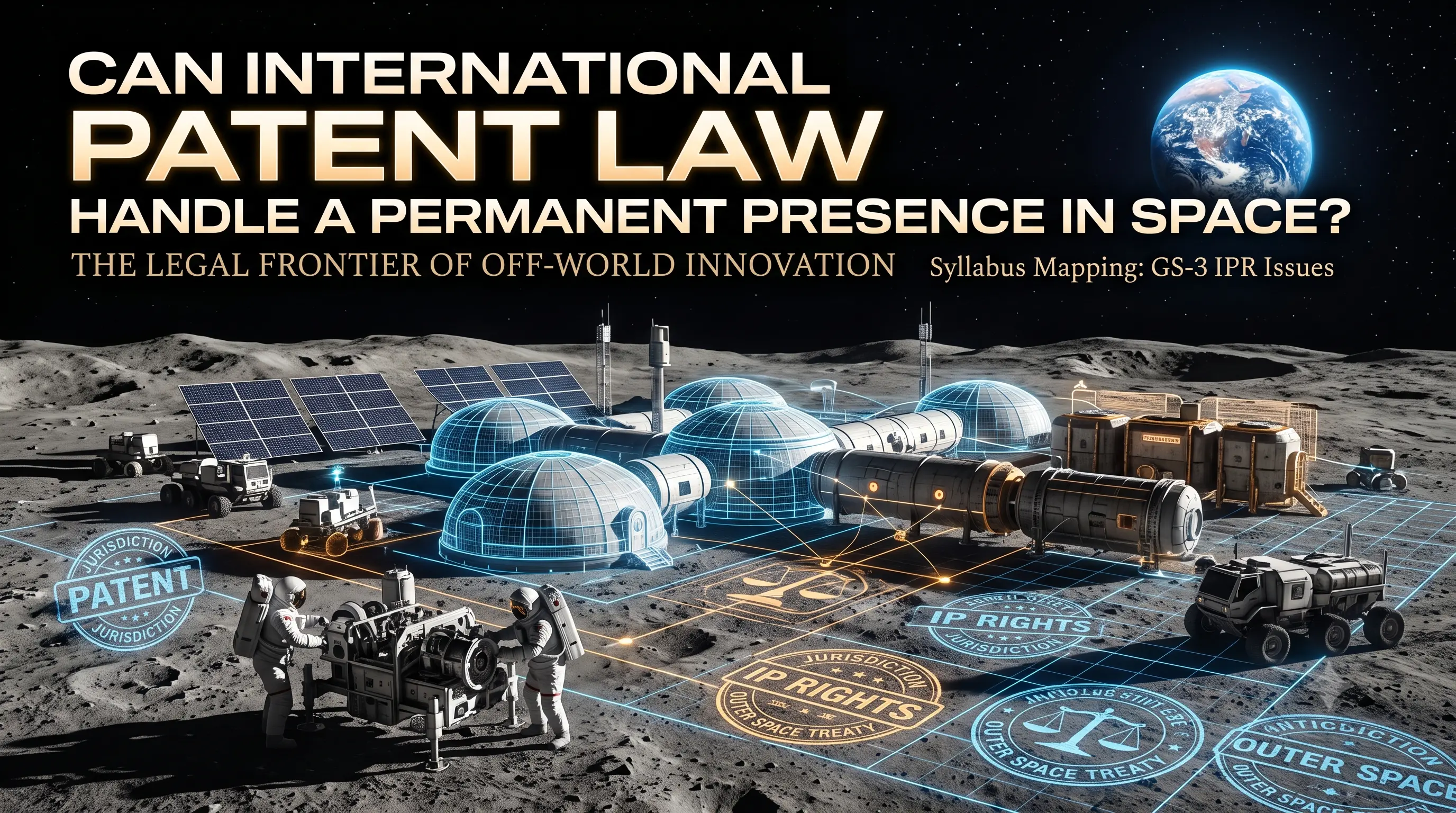
With permanent human presence in space becoming a reality, this article examines the inadequacy of Earth-bound, territorially-based patent laws in outer space. It explores the tension between private intellectual property rights and international space law principles like non-appropriation, while suggesting reforms to prevent regulatory arbitrage and ensure equitable access to survival-critical technologies.
Introduction
Context & Background
Key Points
- •Territorial Foundation vs. Space Reality: Patent law relies on terrestrial boundaries to grant exclusive rights. Outer space has no national territory or sovereign control, removing the geographical anchor for patent enforcement.
- •Registration-Based Jurisdiction: Under Article VIII of the Outer Space Treaty, jurisdiction is tied to the state of registry, treating inventions aboard registered space objects as occurring within that state's legal territory.
- •Non-Appropriation Principle: Article II of the Outer Space Treaty prohibits national appropriation of space. While patents don't claim territory, they grant exclusive control over technologies (e.g., life-support, water access) that are essential for survival in space.
- •Patents as De Facto Exclusion: Exclusive patent rights could restrict survival-critical activities in permanent settlements, creating a profound tension between private innovation incentives and the collective human interest.
- •Unequal Rule-Making Power: Although over 110 states are party to the Outer Space Treaty, only a few shape space-related IP practices, deepening global inequalities in access and innovation benefits.
- •Temporary Presence Doctrine: Article 5 of the Paris Convention limits patent enforcement for articles in transit on Earth. However, its application to space objects, docking stations, or orbital platforms remains legally unresolved.
The ISS Model vs. Permanent Lunar/Planetary Bases
| Aspect | International Space Station (ISS) Model | Future Lunar & Planetary Bases | Bookmark |
|---|---|---|---|
| Structure | Module-based jurisdiction, clear segmentation. | Shared habitats, integrated systems, not neatly divided. | |
| Innovation Source | Independent state contributions per module. | Incremental via shared data, autonomous systems, collaborative problem-solving. | |
| Jurisdiction Base | Article 21 of ISS Agreement extends domestic law to respective modules. | Registration-based jurisdiction fails to reflect actual operational control or contribution. |
Understanding 'Flags of Convenience' in Space
| Concept | Description & Impact | Bookmark |
|---|---|---|
| Meaning | Registering space objects in countries with weaker IP regulations to avoid strict laws, mirroring maritime practices. | |
| Regulatory Arbitrage | Developing technology in strict IP regimes but deploying it on weakly regulated space objects to escape legal obligations. | |
| Primary Concern | Undermines robust patent systems and encourages legal loopholes instead of genuine technological advancement. |
Related Entities
Impact & Significance
- •Threat to Open Access: In a hostile environment like space, patented technologies might control access to essential life-support, water, and energy, directly contradicting the principle of open access.
- •Implications for India: India’s rapidly growing role in space exploration places it in a strategic position to shape equitable, humanity-centric space governance and IP norms.
- •Need for National Legislation: To navigate these complex international waters, India must enact a clear national space law to bridge the gap between innovation incentives and global IP discussions.
- •Global Inequality: The current trajectory allows a few advanced nations to be rule-makers, deepening global inequalities in access, technological benefits, and legal influence.
Challenges & Criticism
- •Inadequacy of the ISS Model: The International Space Station relies on module-based jurisdiction (Article 21 of the Intergovernmental Agreement), which works for clear segmentation but fails for integrated, permanent lunar settlements.
- •Regulatory Arbitrage: The system allows for 'Flags of Convenience', where entities develop tech in strong IP countries but deploy it under weak registration regimes to escape obligations.
- •De Facto Exclusion via Patents: While patents do not claim territory, having exclusive control over survival-critical tech operates as a de facto appropriation of space resources, violating the spirit of the Outer Space Treaty.
- •Inadequate Cooperative Frameworks: Agreements like the Artemis Accords, while good for operational coordination, cannot substitute for binding legal jurisdiction in IP disputes.
- •Ambiguous Temporary Presence: It remains legally unresolved whether Article 5 of the Paris Convention (which limits patent enforcement for vehicles in transit) applies to spacecraft, orbital platforms, or docking stations.
Future Outlook
- •Dedicated Space IP Framework: Create a separate international legal regime for space-based inventions, moving beyond Earth-centric territorial patent principles.
- •Contribution-Based Ownership: Grant patent rights based on actual technological contribution and innovation, rather than the mere registration state of space objects.
- •Shared-Use Exceptions: Limit patent exclusivity for technologies essential to life support, safety, and survival in permanent space habitats through shared licensing and patent pools.
- •Prevent Flags of Convenience: Establish minimum global patent standards to stop the misuse of weak registration regimes in space operations.
- •Inclusive Rule-Making: Ensure wider participation of developing countries in shaping global space intellectual property governance frameworks to align IP rules with non-appropriation and common-benefit principles.
UPSC Relevance
- • GS-3 (Science & Technology): Awareness in Space and issues relating to Intellectual Property Rights (IPR).
- • GS-2 (International Relations): Important International institutions, agencies, and fora - their structure, mandate (Outer Space Treaty).
- • Mains Focus: Analyzing the conflict between private IP laws and global commons in space exploration; evaluating India's role in shaping future space governance.
Sample Questions
Prelims
Consider the following statements regarding the governance of intellectual property and activities in outer space: 1. Under the Outer Space Treaty, jurisdiction over a space object is determined by its physical location in space. 2. The Artemis Accords provide a binding dispute settlement mechanism for international patent infringements in space. 3. The 'Flags of Convenience' practice in space refers to registering space objects in countries with weaker IP regulations to bypass strict laws. How many of the above statements are correct?
1. Only one
2. Only two
3. All three
4. None
Answer: Option 1
Explanation: Statement 1 is incorrect: Space has no sovereign boundaries; jurisdiction is determined by the state of registration (Article VIII of the Outer Space Treaty), not physical location. Statement 2 is incorrect: Cooperative frameworks like the Artemis Accords promote interoperability but do not provide binding legal jurisdiction or resolve IP dispute settlements. Statement 3 is correct: Similar to maritime law, operators may use 'Flags of Convenience' for regulatory arbitrage to avoid strict patent obligations. Thus, only one statement is correct.
Mains
The establishment of permanent human settlements in outer space exposes the fundamental inadequacies of the terrestrial Intellectual Property Rights (IPR) regime. Analyze the challenges associated with applying existing patent laws to space and suggest a framework to balance innovation with collective human interest.
Introduction: Introduce the imminent reality of permanent space outposts and define the core conflict: Earth’s patent laws are territorial, while outer space is a global commons governed by the Outer Space Treaty.
Body:
• Challenges of Current Framework: Discuss the territorial nature of patent law vs. the absence of sovereign boundaries in space. Explain the limitations of the ISS model (module-based jurisdiction) when applied to integrated lunar bases, and the risk of 'Flags of Convenience' (regulatory arbitrage).
• Legal & Ethical Conflicts: Highlight the tension between the Non-Appropriation Principle (Outer Space Treaty Article II) and patents acting as 'De Facto Exclusion' for survival-critical technologies like life support and energy.
• Proposed Framework (Way Forward): Suggest shifting to contribution-based ownership, instituting shared-use exceptions for life-saving tech, extending the Temporary Presence Doctrine, and drafting a dedicated Space IP Framework.
Conclusion: Conclude by emphasizing the need for an inclusive rule-making process where developing nations, including India, take a leadership role in harmonizing patent rules with the 'common-benefit' principles of international space law.